Inflated Costs Boost Costs to End Users as Trucking Companies are Hit Hard by Increased Taxes in Illinois


Drivers aren’t the only ones frustrated with the increase in the Illinois gas tax, trucking companies also fear this tax increase could cost them thousands. 

Illinois lawmakers voted to increase the fuel tax, to pay for the $45 billion capital plan.That plan, known as “Rebuild Illinois,” will improve roads, bridges and other transportation projects. 

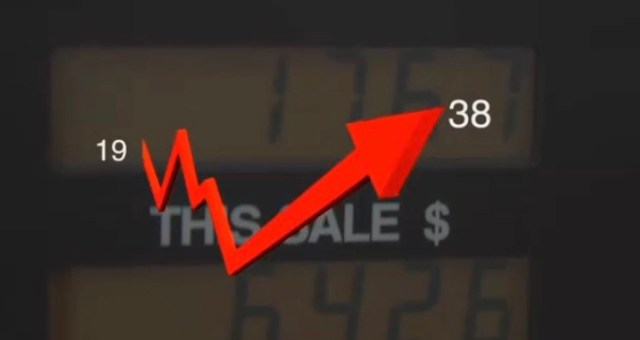
Currently the state collects 19 cents on each gallon of gas sold and 21.5 cents on diesel, but under the new legislation both of those rates would double.

Starting July 1, a gallon of gasoline will increase to 38 cents and diesel will rise to 45.5 cents a gallon. 

Dan Bost owns Bost Trucking Service in Murphysboro, a third generation trucking company, moving anything from landscaping products to household jobs. 

“They are destroying the state’s economy,” Bost said. “If they want to maybe increase it five cents or something like that, but to increase it 24 cents?”

Bost Trucking Company said their customers, that buy products like rock, can expect to see an added fuel surcharge on their bill. 

Bost said he thinks the increase in diesel will add an extra $20,000 onto their fuel bill for the year. 

“It’s good to be efficient but it makes it tough in Illinois to be efficient,” Bost said. “It’s just one more thing in the state of Illinois that  makes us uncompetitive.”

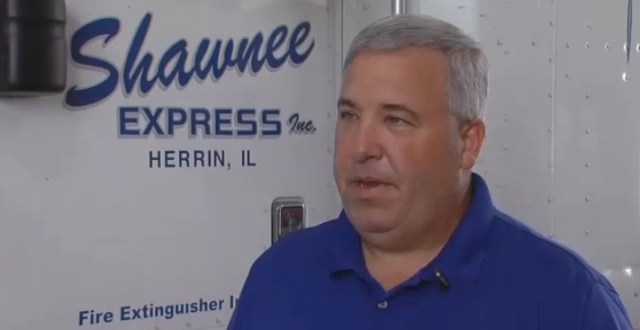
Brad Roberts is the operations manager at Shawnee Express in Herrin, another family owned trucking business in southern Illinois. 

Shawnee Express transports car parts and boats throughout multiple states. 

“In Illinois, the raising of our taxes is inevitable,” Roberts said. “The cost of the inflated prices will certainly find it’s way to the end user and to the store shelves and at the warehouses.”

Shawnee Express’ 75 semi trucks can hold anywhere from 250 to 300 gallons of fuel. 

Roberts said this 24 cent increase will cost them about $11,000 a month. 

“What’s frustrating to people is when they raise taxes and say they are going to go to one thing and then it doesn’t improve any,” Roberts said. “If the money is used for these purposes exclusively, then these up grades will be very welcome.”

The legislation also increases vehicles registration fees. 

Most drivers will see a $50 jump in fees, but for commercial vehicles like semis, companies will see a $100 dollar increase. 

Companies will get a break in a commercial distribution fee. Lawmakers voted to stop collecting the $400 fee starting July 1. 

Posted in #madigoon, #taxation, Elections, gasoline, Illinois, Illinois Pensions, illinois politics, Illinois Tollroad, infrastructure, mike madigan, News, political satire, politics, Pritzker, Rauner, referendum, Roy F. McCampbell, senator durbin, senator Mulroe, Social Media, Taxation, Transportation | Tagged , , , , , , , , , , , , , | Leave a comment

Western Illinois University President Is Forced To Resign and Gets 2 Years of Paid Salary and a Professorship—-Don’t You Just Love Illinois Government !!!


Western Illinois University President Jack Thomas said his final day on the job will be June 30, 2019, ending a presidency marred by employee layoffs, declining student enrollment, and increasing tensions between the administration and faculty. Dr. Thomas made the announcement at the beginning of the Friday, June 14 Board of Trustees meeting in Macomb.

“At this pivotal time in our history, I believe the university would best be served by new leadership,” Thomas said, reading from a prepared statement to the crowd of about 200 people in attendance.

Under terms of his negotiated departure, Thomas will spend one year on paid administrative leave and one year on sabbatical.  He will receive his full $270,528 salary in each of those years. He will then have the option of returning to the classroom as a professor of English.

BoT Chairperson Greg Aguilar said Thomas brought the proposal to the board’s closed door meeting Thursday night.  The board gave unanimous approval Friday morning after reviewing and discussing the proposal.

Aguilar praised Thomas’ leadership.

“He met the board’s charge to keep the university’s doors open. He met payroll obligations and maintained the quality of the educational experience we provide here,” Aguilar said.

“We wish to thank Dr. Thomas for the leadership he has provided.”

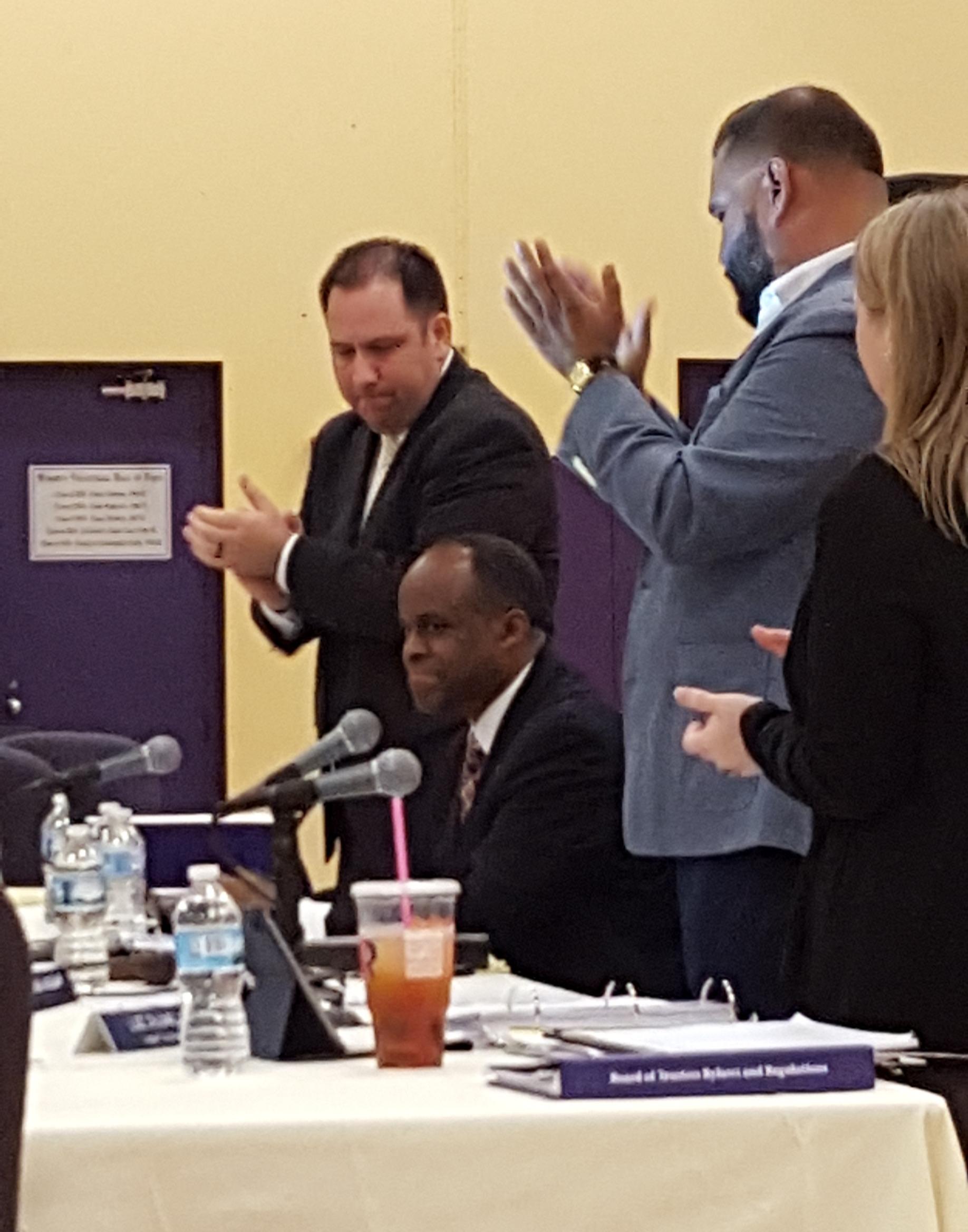
Thomas received a standing ovation from many of those in the room after Aguilar concluded his comments.

Incoming provost Martin Abraham will serve as WIU’s temporary president until the BoT can choose an interim president.  The board will conduct a national search for Western’s next president.  No timetable was set for completing that search.

The Thomas Presidency

Dr. Jack Thomas took WIU’s top job in July, 2011, succeeding Dr. Al Goldfarb, who retired.

Thomas (seated) received a standing ovation during Friday’s BoT meeting.
CREDIT RICH EGGER

Thomas came to Western in January 2008 to serve as provost.  His previous job was at Middle Tennessee State University – Murfreesboro, where he served as senior vice provost for academic affairs, interim dean of the College of Continuing Education and Distance Learning, and professor of English.

His personal page on Western’s website lists what the university considers his top accomplishments, such as the Western Commitment Scholarship and the Centennial Honors College Scholarship programs. He has also touted the President’s Executive Institute, a realignment plan announced in July, 2018, and the creation of 17 new degree programs at WIU.

Thomas served longer than the average college president, leading led Western for eight years. An article in The Chronicle of Higher Education cited a 2017 survey by the American Council on Education, which found the average tenure for college presidents was 6.5 years in 2016. 

Thomas was a finalist for leadership positions at a few other higher education institutions last year but he was not hired for any of the jobs.

Declining Enrollment, Program Cuts

The decline in student enrollment preceded the Thomas presidency, though his administration was unable to stem it or turn it around:

  • Fall 2010:  12,585
  • Fall 2011:  12,554
  • Fall 2012:  12,205
  • Fall 2013:  11,707
  • Fall 2014:  11,458
  • Fall 2015:  11,094
  • Fall 2016:  10,373
  • Fall 2017:  9,441
  • Fall 2018:  8,502 

Western was especially hurt during the unprecedented two-year state budget impasse under former Governor Bruce Rauner. Public universities received little state funding during that period, which started in July 2015 and created uncertainty for higher education across Illinois.

Western laid off 147 workers in May, 2016: 

  • 113 of its 781 civil service workers
  • 30 of its 679 faculty members
  • 4 of its 311 administrative/professional employees

Also in 2016, WIU eliminated four majors:

  • African American Studies
  • Philosophy
  • Religious Studies
  • Women’s Studies

More programs are currently under scrutiny.

“Without a doubt, I have had to make some difficult decisions, including ones that have sometimes been very unpopular but nevertheless were always made with the best interests of the overall university’s future at heart,” Thomas said during his remarks at the BoT meeting.

Campus Unrest

The past year-plus has been especially contentious at WIU. 

In March, 2018, faculty members held a “no confidence” vote on WIU’s administrative leadership team. About 65% of those who cast ballots voted “no confidence,” 33% expressed confidence, and a few ballots were invalidated. 

At the end of June, 2018, the administration laid off about two dozen faculty members and two other employees in academic affairs. Those let go include eight tenured or tenure-track teachers, one of whom is a Fulbright scholar.

In addition, the administration targeted 62 other positions for elimination. Five of the positions were already vacant, and the administration said the remaining 57 people were retiring from Western, had already left, or planned to leave for another job.

In August, 2018, the administration announced it was cutting 100% of the appropriated funding for Tri States Public Radio, effective March 1, 2019.  The announcement angered hundreds of people who attended the subsequent BoT meeting to denounce the decision. The administration has never explained why TSPR was chosen over other programs/services. 

At about the same time, Thomas announced administrators would no longer take furloughs, even though the furlough program was established to help save money for the university. The furlough program had been in place for three years.

In November, 2018, acting on orders from the Illinois Attorney General’s office, WIU released audio recordings that showed the administration and previous Board of Trustees repeatedly violating the Illinois Open Meetings Act by talking about budget matters behind closed doors. State law requires such discussions be held in public. The state ordered audio from more illegal meetings be released early this year. 

On March 1, 2019, Western laid off 132 employees, which was about 8% of the total workforce.  120 of the layoffs were on the Macomb campus:

  • 2 administrative positions
  • 10 academic support personnel
  • 27 faculty members
  • 81 civil service workers

The other 12 layoffs were on the Quad Cities campus:

  • 2 academic support personnel
  • 2 faculty members
  • 8 civil service employees

During the course of the past year, several BoT members resigned.  At the end of March, 2019, new Governor J.B. Pritzker cleared the deck, appointing seven new members to the eight member board (the eighth member is the student representative, who is elected by fellow students).

At the end of the 2018-19 school year, faculty remained unhappy with the administration. 230 faculty members completed the entire President’s Performance Survey Report (out of 478 who were eligible). On a five-point scale (with five being the high mark), Thomas received a mean value rating of 1.62, down from the year before. Among the other findings:

  • Nearly 69% strongly disagree that “Overall, President Thomas is highly effective at performing the duties of the President.”
  • Nearly 72% strongly disagree that “President Thomas manages the university’s resources well.”
  • Nearly 71% strongly disagree that “Regarding faculty, President Thomas’s management practices promote excellence.”
  • Nearly 71% strongly disagree that “President Thomas makes effective administrative appointments.”
  • More than 67% strongly disagree that “President Thomas fosters effective relationships with the UPI (University Professionals of Illinois, the union representing faculty).”

The cries to oust Thomas increased in late May after he fired Brad Bainter, Vice President, Advancement and Public Services, who graduated from Western and had worked for the university for more than 35 years.  Neither side has publicly commented on the matter.

Posted in #madigoon, #taxation, Chicago, College, Economy, Education, Illinois, Illinois Pensions, illinois politics, political satire, politics, Pritzker, robert martwick, Taxation, Western Illinois University | Tagged , , , , , , , , , , , | Leave a comment

Illinois Gasoline Tax May Be 43.5 Cents Per Gallon In 2025….Think About That…..


Illinoisans will see the state gas tax double starting July 1. But that’s not all: the tax will be tied to inflation, meaning it will automatically rise in future years so lawmakers are shielded from motorists’ ire.

Based on current inflation projections, the gas tax will rise almost a penny a year. Lawmakers bumped it from 19 to 38 cents starting in July. Their inflation mechanism is expected to drive the gas tax to 43.5 cents by 2025 — almost 25 cents per gallon more than now.

Posted in #madigoon, #taxation, Chicago, Elections, Finance, gasoline, Illinois, Illinois Pensions, illinois politics, Illinois Tollroad, Taxation | Tagged , , , , , , , , , , , , , | Leave a comment

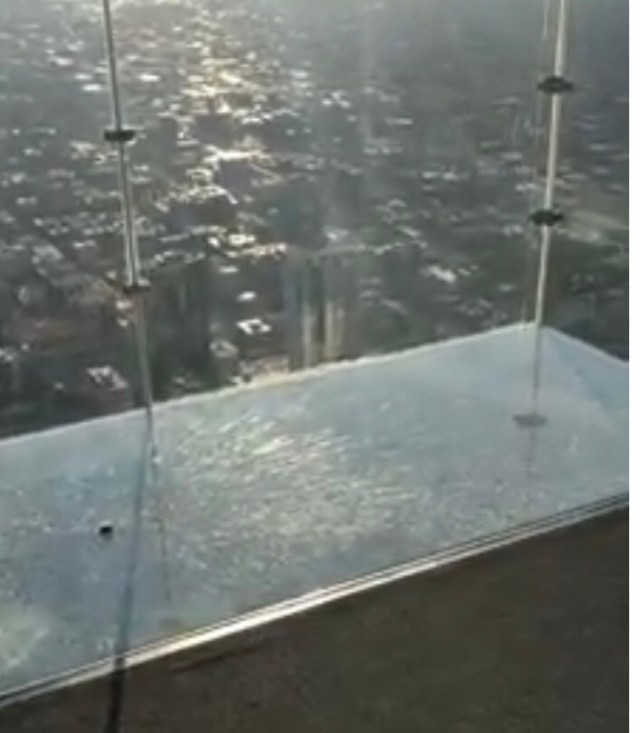
Willis Tower SkyDeck ledge cracks under visitors’ feet


Visitors to the Willis Tower’s SkyDeck got an extra scare Monday when the attraction’s protective layer covering the glass splintered into thousands of pieces.

— Read on www.cnn.com/2019/06/12/us/willis-tower-skydeck-cracks-trnd/index.html

Posted in Health, health risk, Illinois, illinois politics, News, politics, Roy F. McCampbell | Tagged , , , , , , , , , , | Leave a comment

Is this something Rosemont should consider…..with the addition of Harley Davidson renting motorcycles in the Entertainment District…….Ready or not, here come 2,500 electric scooters as Chicago chooses 10 vendors.


Mayor Lori Lightfoot’s administration on Tuesday chose 10 companies to run a four-month, 2,500 electric scooter pilot and launched a quickie education plan to persuade Chicago residents and visitors to abide by the rules of the road.

Bird, Bolt, gruv, JUMP, Lime, Lyft, Sherpa, Spin, VeoRide and Wheels will each be granted 250 scooters to operate within a 50-square mile test area bounded by Halsted Street and the Chicago River on the east; Irving Park Road on the north; Harlem and the city limits on the west and the Chicago River on the south.

During the four-month test, users will be free to “access the scooters wherever it is legal to lock a bike in the public way,” according to City Hall.

The plan calls for scooter riders to “use a smartphone to unlock and ride the devices within the pilot area, though vendors will offer services for non-smartphone users and cash-based options,” according to the city.

Two priority areas have been identified within the pilot zone, where at least 25% of scooters must be placed every morning.

To minimize sidewalk clutter, scooters will need to be parked “upright; away from street corners, bus stops, and buildings; and with a minimum six-foot clearance on the sidewalk,” the city said.

Designated vendors will be required to “retrieve and move improperly parked electric shared scooters within two hours.”

As traffic congestion continues to increase in Rosemont, this would be another adventure for Rosemont visitors.

Rosemont should consider a scooter program and a Divy bike program for those visitors to their convention trade.

Shortly Harley Davidson will be opening in the Rosemont Parkway Bank Entertainment District, where visitors will be able to rent motorcycles.

The Harley-Davidson motorcycle dealership and retail store will be the latest addition to Rosemont’s entertainment district.

Windy City Motorcycle Company, which owns and operates 14 locations in the suburbs and southern Wisconsin, is completing a two-story, 20,000-square-foot brick building at Parkway Bank Park.

Posted in Chicago, divy, Health, I 294, Illinois, infrastructure, motorcycles, politics, Rosemont, Roy F. McCampbell, scooters, Social Media | Tagged , , , , , , , , , , , | Leave a comment

New Trier, other wealthy school districts shifting their built-in pension spiking costs to taxpayers statewide……….OUCH…….!!!


To spike their pensions, New Trier high school teachers, a few years from retirement, had six percent annual bumps in salary written into their 2016-2019 contracts.

We are noting the automatic salary increases in a recent analysis of a quiet legislative maneuver to spread the costs of teacher pension spiking across lower and middle-income earners statewide.

It’s easier for teachers unions to hide what’s going on, referring to the cost shifting. Instead of the locals having to come up with the funds to pay higher pensions through higher property taxes, they are bundled into the billions the state pays out for pensions.”

Posted in Taxation | Tagged , , , , , , | Leave a comment

Illinois’ New Budget Has A Shortfall of $4 Billion Dollars


Gov. J.B. Pritzker says Illinois’ budget is balanced ”for the first time in decades.” That’s the claim he made upon signing Illinois’ $40 billion budget for 2020. Pritzker’s claim is simply not true. According to the state’s own actuarial calculations, his budget is billions in the red.JB is doing everything right if his goal is to destroy the state. Why would he want to do that?

A big reason for the unbalanced budget comes from how politicians account for the state’s retirement debts versus how financial professionals do. There’s often a gap of several billion dollars between the two. Hiding that gap has allowed Illinois pols to perpetuate the myth of balanced budgets for decades.

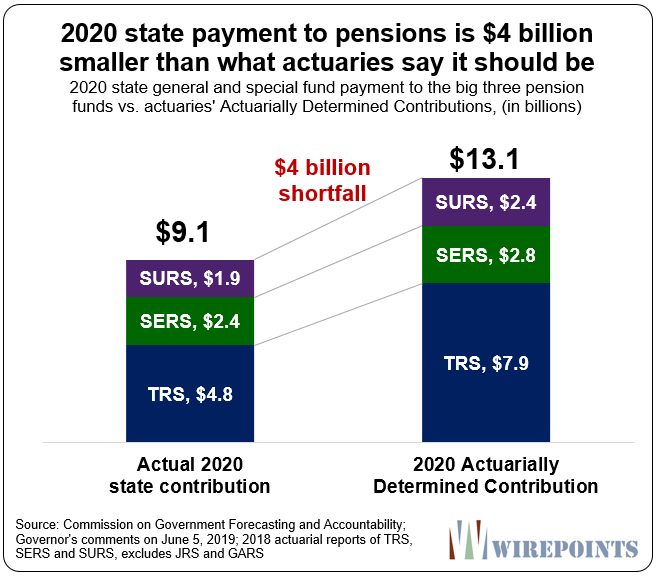
Take Pritzker’s 2020 budget. The state’s pension funding laws, set up nearly 25 years ago by the General Assembly and then-Gov. Jim Edgar, require the state to pay $9 billion* to Illinois’ five state-run pensions in 2020. “We are paying the full payment that is required under the ramp that was put in place in 1995, the statutory required payment,” Pritzker said when asked about whether the state should be paying its actuaries’ recommended contribution (click here to hear his answer).

What Pritzker ignored is the amount the state’s own actuaries say is required to properly fund Illinois’ pensions in 2020, an amount that exceeds $13 billion. That’s a total shortfall of $4 billion.

And it’s not just pension payments that are being shorted. It’s also payments for state-worker retiree health insurance that are grossly underpaid.

State actuaries calculate the required payments for those benefits at about $4 billion annually, yet the state has only paid around $1 billion yearly in recent years. That’s billions more in shortfalls that Pritzker’s budget ignores. (See Exhibit 1.)

Defenders of the “balanced-budget” claim will want to paint the above as a matter of semantics. But the billions in shortfalls are not only a matter of accounting. When the state continues to grow its pension promisesfaster than it can pay for them – and then doesn’t pay enough into its state-worker retirement plans – it doesn’t balance the budget. The state’s debts jump as a result. Illinois’ skyrocketing pension and retiree health insurance debts are the evidence of that.

Illinois not even “treading water”

Despite the fact that Pritzker’s payment to pensions consumes nearly a quarter of the current budget – no other state is in such dire straits – it still won’t stop the state’s pension debts from growing. That’s how sick Illinois’ finances are.

Illinois’ Commission on Government Forecasting and Accountability shows that despite a $9.2 billion** contribution into pensions in 2020, the state’s unfunded liabilities will still increase by $2.4 billion to $139 billion. Illinois is not unlike the financial deadbeat that never pays the minimum payment on his credit card. As a result, its debts just grow.

To just “tread water” – to keep Illinois’ debt flat from one year to the next – the state payment in 2020 should be $2.4 billion higher, or over $11 billion in total.

That tread water amount, however, does nothing to reduce Illinois’ pension debts. Even more, it’s based on the state’s actuarial assumptions actually panning out. If they don’t, then the state’s pension debts will be even bigger.

Statutory payment

If Pritzker and team want to make claims of “balanced” budgets, they’ll have to make lots of changes going forward.

For starters, they’ll need to dump the Edgar ramp, which pushes the repayment of pension debts far into the future, requires just 90 percent funding levels by 2045, and assumes overly optimistic investment rates.

In its place, they’ll have to accept the stricter standards adopted by the state actuaries (see Exhibit 2 for an example of TRS’ standard). Their required payments are larger to ensure the pension shortfalls get paid down sooner. They pursue 100 percent funding targets and accelerate the repayment of debts (TRS’ actuaries target 2035, SERS targets 2040 and SURS targets 2045). And how they account for individual pensions is more conservative (entry age normal vs. projected unit cost). All that results in required payments that are $4 billion larger than the state’s statutory requirements.

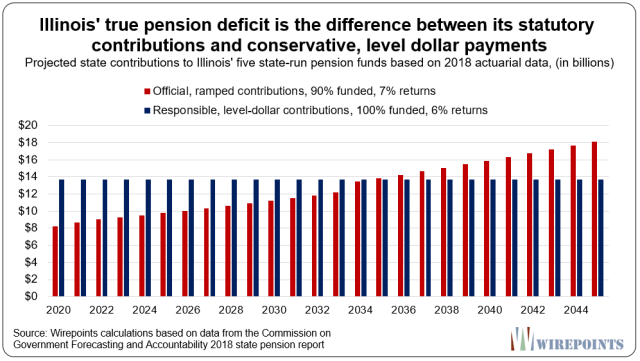
But politicians should go even further. While the actuaries still depend on ramps, other financial groups demand the use of less rosy investment rate assumptions and flat debt repayment schedules (level dollar) to determine yearly state contributions.

JP Morgan’s estimates of Illinois’ required payments and ran our own as well, shown below. Those more responsible assumptions would require the state to put even more money into the pension plans.

Politicians on both sides of the aisle can pat themselves on the back all they want for passing a budget. But the truth is they’ve just made Illinois’ debt crisis even worse.

They’re not paying what they should, nor have they passed a single structural reform that would help lower the annual cost of retirements. (In fact, they’ve done the opposite by reboosting pension spiking for teachers.)

Illinois fiscal reality won’t change until the state is more honest about its debts and it reduces those debts through structural reforms.

Posted in #madigoon, #taxation, Chicago, East Leyden, Economic Development, Economy, Education, election fraud, Elections, fafsa, Leyden, political satire, politics, Pritzker, Rauner, referendum, Roy F. McCampbell, Social Media, sports betting, Taxation | Tagged , , , , , , , , , | Leave a comment

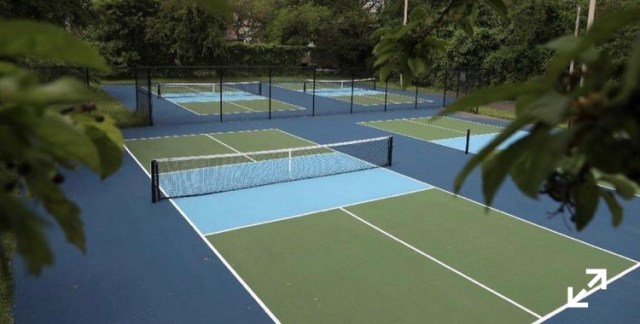
Illinois Capital Projects Plan All About Pork Barrel Projects Such as Dog Parks and Pickleball Courts, Not About Collapsing Bridges and Road Potholes


Pickleball courts, dog parks and grants for an arts program led by House Speaker Michael Madigan’s wife are on a lengthy list of lawmakers’ pet projects paid for by a massive gambling expansion and tax hikes on smoking and parking.
The pork barrel bonanza comes courtesy of Democratic Gov. J.B. Pritzker’s $45 billion construction program that lawmakers approved as the spring legislative session spilled into overtime last weekend. It’s a signature away from becoming law.

The plan was hastily put together, and it’s not yet clear where all the money will be spent. The 362-page bill contains lines with lump sums worth hundreds of millions of dollars that don’t list specific projects.

Frenzied lawmakers scrambled to put together wish lists. Some had them ready for months, some are still compiling them and some asked for more than their allotment in case there’s a little extra available. Still, many lawmakers left Springfield with a lot of questions about how to turn their concepts for projects into reality.

How much each rank-and-file lawmaker gets to claim for his or her district is a bit of a moving target, but several Senate Democrats said they were allotted about $6 million each for what’s euphemistically called “member initiatives.” Several House Democrats said they received about $3 million each from a program their party’s rookie governor had pushed for months.
For the out-of-power Republicans, the calculation was different. The GOP had spent most of the spring session opposing Pritzker’s graduated income-tax plan, warning that it was a gateway to future Democratic tax hikes. Now Republican lawmakers were faced with voting for the series of tax hikes to fund their favored projects.

The opportunity to bring home the bacon proved tempting for some GOP lawmakers frustrated by four years under former Republican Gov. Bruce Rauner that produced gridlock. In exchange for holding out for pro-business initiatives, some Republicans embraced higher taxes and fees to support the projects.

In addition, the governor’s capital bill contains big dollars for highways, bridges and public transportation supported by the state’s higher gas taxes and license plate fees.

All told, Springfield hadn’t experienced a major capital plan since 2009, when then-Democratic Gov. Pat Quinn took over for the impeached Rod Blagojevich. And the Capitol hadn’t seen such a flurry in 20 years, when deal-making Republican Gov. George Ryan pushed through a massive construction program.

“It was a rocky ride,” said Democratic Sen. John Mulroe of Chicago, who hadn’t seen this kind of money made available for rank-and-file lawmakers during his nine years in Springfield. “The plane was landing, it could have crashed, but it came to a smooth landing. We’re all happy about it. We just got out of the airport a couple of days late.”

Speaker’s clout

Speaker Madigan played a big role in carving up the pork-barrel spending. Included in the bill is $50 million for grants to be doled out by the Illinois Arts Council, which is chaired by Shirley Madigan, the speaker’s wife.

Steve Brown, a spokesman for the speaker, said many lawmakers have long shown support for the art group’s initiatives.

Madigan’s 13th Ward in Chicago also will benefit. There’s $9 million for upgrades to Hancock College Preparatory High School, where city Public Building Commission records show a replacement school with a capacity of 1,080 students is moving forward just south of Midway Airport. Brown noted there’s a “lot of overcrowding” in area schools.

Also falling within Madigan’s sphere of influence on the Southwest Side is a $31 million grant for a new building for the Academy for Global Citizenship, an independently operated charter school in the Chicago Public Schools system. It’s slated for construction at 44th Street and Laporte Avenue, which is represented in the House by freshman Democratic Rep. Aaron Ortiz of Chicago, who did not return messages seeking comment.

Ortiz won election with help from Democratic U.S. Rep. Jesús “Chuy” García, who recently has allied himself with Madigan. Brown said Madigan supported the charter school money because it is headed by a “reputable group and they have a site.”

Sarah Elizabeth Ippel, the school’s executive director, said plans call for a new Educational Learning Laboratory and Community Sustainability Hub, a solar-powered kindergarten-through-eighth-grade school that also will include a 3-acre urban farm that will grow food for the cafeteria.

The suburban portion of Madigan’s House district also scored $98 million in transportation-related funding to address the “long screeching noise” from trains at the Belt Railway Yard in Bedford Park, said Dave Brady, the village president.

Residents and hotel guests, sometimes subjected to noise exceeding 90 decibels, have complained since equipment was installed about two years ago to “basically eliminate the possibility of runaway trains,” Brady said.

‘Spork ’

The capital spending plan lists millions of dollars for baseball, football and soccer fields, basketball and tennis courts, playgrounds, bike paths and other recreational venues throughout the state. In Springfield, that’s known as “spork” — sports-related pork.

Standing to benefit is pickleball, a fledgling sport that’s part tennis, part badminton and part pingpong. Democratic Sen. Terry Link of Vernon Hills tucked in $100,000 for the Buffalo Grove Park District for pickleball courts and other renovations.

The Park District plans to seal coat eight new courts at Mike Rylko Community Park because the paddle sport has “really taken off,” said Ryan Risinger, the district’s executive director. The new courts would replace rarely used sand volleyball courts, he said.

There’s also $20,000 for pickleball courts at Gwendolyn Brooks Park in Chicago’s North Kenwood neighborhood. Freshman Democratic Sen. Robert Peters said the court provides “first touches” for people in his district, saying he made choices based on local experts and community leaders who saw the need to upgrade broken and rusted equipment.

“I hope people understand why kids feel like they can’t even be in their own neighborhoods right now — if the park isn’t even safe in its structure,” Peters said. “Growing up on the South Side, the park was where I would go when I couldn’t go home. It’s its own shelter in a time of need.”

The spending plan also includes plenty of money to make sure the family dog is well-exercised — $400,000 is set aside for dog parks.

In the city, CPS would get $50,000 for dog park construction at the Chicago High School for Agricultural Sciences in the Mount Greenwood neighborhood. The Chicago Park District would get $200,000 for dog parks at Nicholas Park in the Hyde Park neighborhood and another location that’s unclear from the legislation.

In the suburbs, the Fox Valley Park District would receive $150,000 to build a dog park on the northeast side of Aurora and upgrade existing dog parks at the Stuart Sports Complex in Montgomery and at Lincoln Park in Aurora.

Religious, ethnic projects

In Springfield, projects for ethnic and religious institutions are often popular, despite concerns over the separation of church and state.

South Side Democratic Sen. Jacqueline Collins said she secured $370,000 for the Inner City Muslim Action Network to help with renovations of a building at 63rd and Racine Avenue to provide a grocery store for healthy food.

The group also would receive $30,000 for lighting and other final touches to a memorial honoring the Rev. Martin Luther King Jr.’s August 1966 march in the Marquette Park neighborhood, where the civil rights leader was struck by a rock during an equal housing demonstration.

Collins hailed King as her role model, saying the Nobel Peace Prize winner espoused hope and promoted a social justice where “every individual can make a difference.”

The spending bill also provides $200,000 for Another Chance Church in the Roseland neighborhood.

There’s $50,000 for Lubavich Chabad for renovation of the museum of Jewish history, collaboration space and social space. And there’s $200,000 for the Jewish United Fund of Chicago for renovations to The Ark, a nonprofit social service agency. Catholic Charities of the Archdiocese of Chicago is set to receive $20 million for affordable housing for families and veterans in Waukegan.

Northwest Side Democratic Sen. Ram Villivalam said he secured millions of dollars for a Pan-Asian community center with services for seniors, people with disabilities and youths for the fast-growing population.

The goal is to help a community that ranges from Indian, Pakistani and Cambodian to Japanese, Korean and Chinese, likely at a location in Skokie, said Villivalam, the first Indian-American member of the General Assembly.

North Side dollars

North Side lawmakers are influential in the legislature, and the capital spending bill reflects that.

The plan includes nearly $1.5 million for an AIDS Garden to memorialize Chicago’s fight against HIV and AIDS.

“The AIDS Garden is a community project that creates beauty in a historic space at the Belmont Rocks, where the gay community would gather in the early days of Chicago’s LGBT movement and the AIDS epidemic,” said sponsoring Democratic Rep. Sara Feigenholtz. “To the larger community who lived through this struggle — ‘the Rocks’ are a sacred space. Enshrining it in history at a garden surrounded in beauty designed to reflect the history of this movement is important.”

Democratic Sen. Heather Steans and House Majority Leader Greg Harris secured $1.5 million in grants for construction of TimeLine Theatre in the Uptown neighborhood, a project that already has backing from the city and private philanthropy.

Harris said roads, bridges and schools aren’t the only capital projects that provide value for taxpayers’ dollars.

“A lot of different neighborhoods were fighting for them to locate there,” Harris said. “So I’m glad they’re coming up Uptown.”

Eye of beholder

The differing opinions on what’s a legitimate project and what’s not are inevitable in a state that has a multibillion-dollar backlog of bills and a $134 billion, worst-in-the-nation pension debt. But while supportive lawmakers note the latest borrowing is backed by the basketful of new and higher taxes and fees, others argue that spending is spending and taxpayers pay either way.

That was the dynamic among House Republicans.

Rep. Tom Demmer, a ranking Republican from Dixon, said during debate that he supported the overall budget and construction package along with the taxes and fees. The wide-ranging plan represented a good compromise even though there are “some things I’m not so keen on,” he said.

“The difficult vote for me is a priority for somebody else, and the difficult vote for somebody else is a priority for me,” Demmer said.

But Rep. David McSweeney, a Barrington Hills Republican, said he had no trouble deciding. He voted against the wide-ranging capital plan because it relies on enacting “massively higher taxes” and making Illinois gambling “way too expansive,” he said.

House Republican leader Jim Durkin of Western Springs said he placed his priorities on securing a series of pro-business measures in exchange for votes on the budget and construction plans rather than focusing on a list of specific projects.

“In that flurry of activity the last two days, it was intense, but it was productive,” Durkin said.

Democrats had more time to earmark projects, though many line items are bereft of details. Republicans now have started sorting through how to divide lump sums worth tens of millions of dollars, part of the process that Durkin said should be “more transparent.”

The long list of projects is fueled by new money from the casino gambling expansion, a new sports betting program, and increased taxes on parking, smoking and video poker. The transportation projects are being paid for by increases in the gas tax and vehicle sticker fee.

Rep. Mary Flowers said fellow House Democrats each were allotted $3 million to $4 million to spread around their districts to fill requests for schools, roads, bridges and other projects. Back in her South Side district, Flowers said she was still examining what requests made it into the final package.

“The governor kept things under wraps,” she said. “Then, when he came out, he came out in a big way. The governor tried — from the most northern tip to the most southern tip of the state — he tried to make accommodations for everyone. I can’t say everybody got everything, but I do know the efforts were made to accommodate as much as possible.”

After years of Springfield gridlock, Flowers said, the money helps address pent-up needs and puts Illinois “on course to move forward.”

“Everybody was kind of happy about being able to bring something home,” she said.

Posted in #madigoon, capital projects, Chicago, Illinois, Illinois Pensions, illinois politics, infrastructure, News, political satire, politics, pork, Pritzker, Rauner, referendum, robert martwick, Roy F. McCampbell, senator durbin, senator Mulroe, Social Media, Transportation, vote | Tagged , , , , , , , , , , , | Leave a comment

The Real Reason Behind Bushwood’s Demise – Skyrocketing Real Estate Taxes-A Problem Becoming Rampant Across Illinois


TThe Real Reason Behind Bushwood’s Demise – Skyrocketing Real Estate Taxes-A Problem Becoming Rampant Across Illinois . Without serious efforts to rein in the appetite of government for real estate tax dollars the future will see a new wave of foreclosures on homes and businesses in Illinois driven by skyrocketing real estate taxes. This story will be replicated in every city and village of Illinois, driven by school districts and other units of local governments insatiable appetite for local taxpayer dollars as they reach deeper and deeper into pockets of homeowners and business owners……..
— Read on thevillagefreepress.org/2019/06/06/the-real-reason-behind-bushwoods-demise/

Posted in #madigoon, #taxation, Economy, Illinois, Illinois Pensions, illinois politics, legal services, News, political satire, politics, Pritzker, Rauner, referendum, robert martwick, Roy F. McCampbell, senator durbin, senator Mulroe, Social Media, Taxation, vote | Leave a comment

The Emotional Impact of being a Sibling to a Brother/Sister with a Disability – Pieces of Me


The Emotional Impact of being a Sibling to a Brother/Sister with a Disability – Pieces of Me
— Read on piecesofme.org/2019/05/31/the-emotional-impact-of-being-a-sibling-to-a-brother-sister-with-a-disability/

Posted in Autism, Illinois, illinois politics, LASEC, News, Pennoyer School District 79, politics, Pritzker, Rauner, referendum, robert martwick, Roy F. McCampbell, senator durbin, senator Mulroe, Social Media, Special Education | Leave a comment