


Memories of 80th and Belmont, and Lessons to be Learned
With the recent closing of St. Joseph High School in Westchester, Illinois, this event has resurrected my memories of the closing of my high school, Holy Cross High School, in River Grove, Illinois, in June, 2004, and the consolidation of the remaining student body and some of its traditions and alum with the sister school on the same property, Mother Theodore Guerin, ultimately being renamed Guerin Prep, and sadly closing at the end of the school year in 2020.

For those not familiar with Holy Cross High School it was an all-boys, Roman Catholic high school in River Grove, Illinois, United States that operated from August 1961 until June 2004. In December, 2003, the school announced that they no longer had enough funding or interest in enrollment to continue. Only 79 students took the entrance exam for the 2004-2005 school year, and at least 125 were necessary to keep the school open. In June, 2004, the neighboring all-girls high school Mother Theodore Guerin High School accepted all Holy Cross students, becoming coed and changing their name to Guerin College Preparatory High School. Students from Mother Guerin and Holy Cross had already been sharing each other’s facilities for certain classes, such as drama, music, and foreign languages.

At one point, Holy Cross’s enrollment was as high as 1,556 students. The school expanded its facilities in 1969 with the construction of a humanities learning center.

The Holy Cross had a close connection to the Chicago Cubs baseball team in the late 1960s and early 1970s. Third-baseman Ron Santo ran a baseball academy on the Holy Cross grounds,[5] and the Cubs helped fund equipment for the school’s baseball team. The Cubs even held their workouts at the school in spring 1972, in the midst of a strike which had shut down all of the major league training camps
If it was not for the superior educational and athletic faculty of Holy Cross High School, these notable alum, and many others not mentioned. would not be here to make the world a better place today.


We should never forget the Holy Cross High School Glory Days:
http://www.illinoishsglorydays.com/id426.html
As Holy Cross, Mother Guerin and Guerin Prep alum, it was not about the “brick and mortar” but the classmates and instructors that we connected with during our journey at 80th and Belmont. That is what we should never forget. We can be sad that the institution is “never more”, but the memories, friendships and lessons learned live on.

It has become a recurring theme with the Catholic Archdiocese of Chicago’s school system: mounting concern over declining enrollment and rising costs; parish leaders devising a strategy to address the problems; parents mobilizing to prevent their children’s schools from shutting their doors. And in the end, another round of school closings.
This bleak reality has become familiar for many of the nation’s Catholic school systems: hit with rising expenses and shrinking enrollment, many are fighting for survival.
The Archdiocese of Chicago, has been beset with similar troubles, with total enrollment dropping to about 65,000 this year from more than 95,000 nine years ago.
What will the next decade bring for Catholic education in Chicago and the rest of our country ?
First, we all who enjoyed that education in our lives, need to step forward and support efforts to reverse this trend and preserve such a system for tomorrow’s youth.
Despite its dwindling size, Chicago’s Catholic school system remains one of the largest private school systems in the country. And its schools have received more Blue Ribbon Awards, a distinction given by the U.S. Department of Education to school for academic excellence, than any other school system in the country.
Since 2009, the number of Catholic schools in the United States declined by more than 1,200, and there are roughly 400,000 fewer students attending Catholic schools, according to the National Catholic Educational Association.
The archdiocese’s school system does outpace Chicago Public Schools in many academic standards, although critics point out private schools are able to be selective about their students.
More than 98% of the Archdiocese of Chicago Catholic schools’ students graduate from high school, compared to 77% of Chicago Public Schools students, according to the Illinois State Board of Education. And more than 96% of Catholic school students go on to attend a four-year college, according to the archdiocese.
According to the National Catholic Education Association‘s Annual Statistical Report on Schools, Enrollment and Staffing., “U. S. Catholic school enrollment reached its peak during the early 1960s when there were more than 5.2 million students in almost thirteen thousand schools across the nation. The 1970s and 1980s saw a steep decline in both the number of schools and students. By 1990, there were approximately 2.5 million students in 8,719 schools. From the mid 1990s though 2000, there was a steady enrollment increase (1.3%) despite continued closings of schools. Between the 2000 and the 2011 school years, 1,755 schools were reported closed or consolidated (21.5%). The number of students declined by 587,166 (22.1 %). The most seriously impacted have been elementary schools”
Personally, it saddens me to see any private school in decline. It is even worse to discover that schools have closed. But the sheer magnitude of these numbers is just plain scary. Let’s examine some of the reasons why Catholic education finds itself in this state across the country.
The Economy
The economy has been a major factor in the decline in the number of Catholic schools. The Great Recession of 2008 cost millions of people their jobs. As a result, when parents have to struggle just to make ends meet, then a private school education becomes unaffordable and out of the question. Historically, Roman Catholic parochial and high school educations have been some of the most affordable private school educations available. Fewer students mean more seats available. More seats available means less tuition income. It is a vicious cycle not easily broken. Once the cycle starts, it becomes very difficult to turn around.
Back in the 1950s nuns staffed Catholic schools. These wonderful teachers were also paid very little. Consequently, schools could keep their tuition low. Unfortunately, as the number of nuns declined, schools had to hire lay teachers whose compensation was more than the religious they replaced.
Changing Social Customs
Church membership nationwide in just about every denomination has been on a decline for decades. The Catholic Church has been particularly hard hit as it faced changing demographics in thousands of parishes. Whereas 50 years ago, Sunday masses were well-attended and parishes seemed to flourish, nowadays the neighborhoods have changed, leaving small, aging congregations struggling to keep the doors of their beloved old church open. Soaring energy and maintenance costs, as well as a lack of priests, have further exacerbated the problem.
The Child Abuse Settlements
The scandals which have rocked the American Catholic Church from 2000-2018 effectively drained the coffers of dozens of Catholic dioceses, requiring enormous settlements to bring a conclusion to the legal process. Church property and other tangible assets were sold to raise money to fund the settlements. Hundreds of schools which had been kept afloat with diocesan support had their financial lifeline cut off. The diocesan and archdiocesan authorities had no other choice.
The Way Forward
I know that Catholic education will survive long term. But what will in look like in the next decade. In my opinion, what we have seen is a winnowing process in which schools which already had financial and enrollment issues have been forced to face up to those issues. If those schools found answers to their problems, they survived. If they didn’t, they closed their doors. In many cases, diocesan authorities consolidated several schools which had low student populations into one larger school. The schools which are left are the ones which have weathered all the economic and cultural onslaughts which have been thrown at them over the past decade. They will probably continue to survive and find new ways to thrive. Many catholic schools are proactively reaching out to their communities.
There are lessons to be learned from the closing of Holy Cross High School and Guerin Prep High Schools in River Grove, Illinois. But will we take it to heart and preserve Catholic educational institutions over the next decade. We as alum of Holy Cross, Mother Guerin and Guerin Prep know the value of catholic education, but does the world really understand it. We do know that the world is a better place because of those that chose to attend high school at 80th and Belmont in River Grove, Illinois.


He needed a lawyer like Atticus Finch to shine light on the truth. Is that why they want to ban that book? Because it teaches that no matter what skin color you have, you have a right to a fair trial and can’t let mob rule persecute you before it? Didn’t Maxine Waters use the KKK playbook to intimidate the jury into the guilty verdict much like the mob scene in the book if Scout didn’t interject and show them they are all human trying to survive by helping one another?

Nobody deserves what happened to George Floyd. However, Derrick Chauvin had horrible representation. The prosecution allowed the case to be political and all the emotion was on their side. Here is what I would have done if Derrick Chauvin hired me. I would have humanized Derrick. Put my arm around him. Taught him to smile. I would have made sure that everyone knew George Floyd was the kind of guy that puts a gun in a pregnant women’s belly. I learned over 30 years ago that human beings are more emotional than logical. Truth. Do not let George F be painted as a Saint. He ain’t. Do not let D. Chauvin be portrayed as Gacy or Dahmer. He ain’t. This Defense lawyer should have done 1 month of ride alongs to be able to find the passion to FIGHT. Hire a real trial lawyer!
I have tried over 100 criminal cases as a prosecutor and defense attorney, as well as being an investigator at one point. My thoughts. Derrick Chauvin’s lawyer had a tough case to defend, but he was not up to it. Big cases are often won or lost on emotion. The Defense lawyer did not appear to like Derrick Chauvin or even believe there was a basis to find him not guilty. I was always told even if you don’t believe it fake it.

I disagree ,I changed my mind on points after his lawyer spoke. Officers committed manslaughter & neglect in my opinion not murder and there are many liars on that police department. It’s a bad case that should have been moved and sequestered from the start. Hope he appeals.

We know that legal action can sometimes be overwhelming.
We are dedicated to providing you help in language that you can understand.
If you don’t feel like you understand your options, just ask, and we will work to find an explanation that works for you. business consulting, legal services, general practice attorney, real estate, criminal and traffic law, divorce and child custody, special education law
https://www.attorneymccampbell.com
Don’t wait!
Contact us for a free phone consultation.
(708)878-7957
Let us help you figure out your best next steps are.
The sooner you have a plan of action, the better your chances of taking the correct steps to get the results you want.

The IL House voted to move the use of heroin, cocaine, meth, and fentanyl from a FELONY to a class A misdemeanor. After a year of releasing prisoners into our communities and passing laws to make the job of law enforcement much more difficult, the IL House continues to make our neighborhoods more dangerous.

Illinois HB3447 hasn’t made the news much. It passed the house and is now going to the senate. It deals with a lot of changes to the drug possession and delivery statutes with simple possession amounts being changed from a class 4 felony to a class A misdemeanor. It also changes the drug delivery statutes and allows for “retroactive sentencing.”
Link to bill:
Currently, possession of 15 grams or less of heroin or cocaine can result in a felony conviction that typically can’t be expunged from criminal records.
Foxx was asked whether she would advocate expunging convictions for possession of those harder drugs, Foxx answered “yes” — as long as it’s part of a larger, progressive approach to handling addiction.
On Thursday, the Foxx doubled down on that commitment.
“Substance use disorder is an addiction. It’s a public health crisis. There’s not been a leader in the public health space who has said otherwise. And yet, we used the criminal justice system to criminalize people who have addition issues,” Foxx said.
“These are conversations that are ongoing that we’re having with state legislature members, the governor’s office and otherwise to see what does it mean to meaningfully and adequately resource treatment as opposed to incarceration. It is a bold vision and one that we hope to have in place in the near-term.”

On April 25, 2019, the Cook County Board of Commissioners passed an amendment (Ord. No. 19-2394) to § 42-38 of the Cook County Human Rights Ordinance (“Ordinance”) to
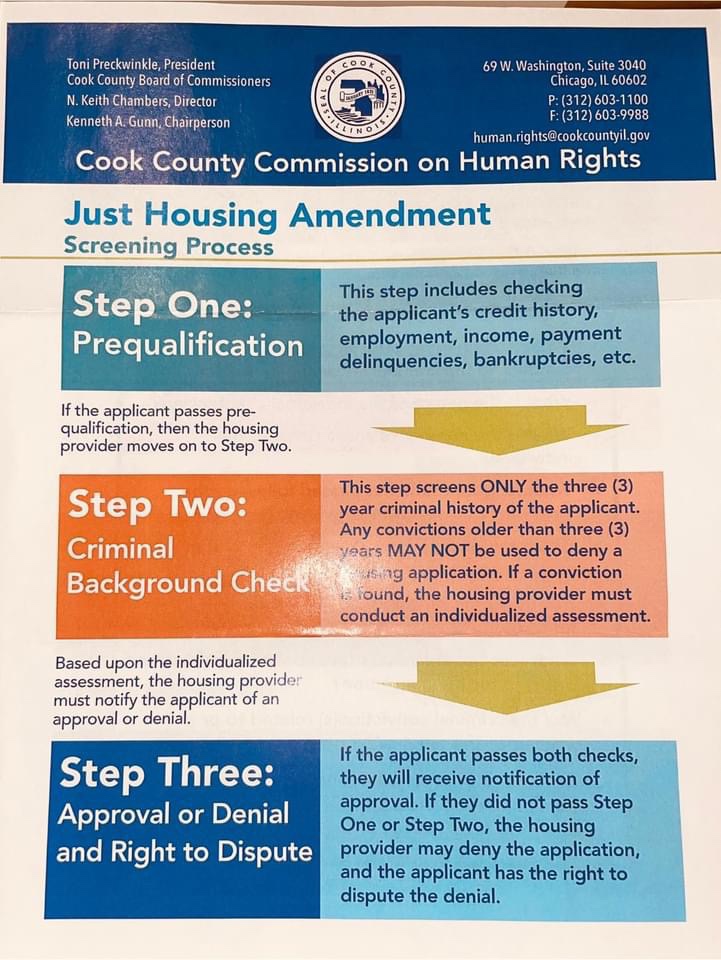
Below are frequently asked questions for applicants and the general public to help navigate the Just Housing Amendment to the Human Rights Ordinance. PDFs of this FAQ and a FAQ for landlords, sample language for notices to applicants, definitions, and an outline of the processes and individualized assessment tool are available to download here:
In most cities, people with any kind of criminal record, even just an arrest, can be unfairly denied housing. The JHA was passed to help these individuals access safe, stable and affordable housing.
The JHA:
An individualized assessment is a questionnaire that considers all relevant factors from an individual’s conviction in the previous three (3) years. The following list of factors can be considered. This list does not include all factors that a landlord can consider:
The JHA went into effect on January 1, 2020. However, the Cook County Board of Commissioners has delayed enforcement of the Amendment until February 1, 2020.
The JHA applies to real estate transactions. Real estate transactions include the sale, rental, lease, and sublease renewal of residential properties.
No. A landlord cannot consider criminal history that is more than three (3) years old, and a landlord mustconduct an individualized assessment of any criminal history that is less than three (3) years old.
Yes. A landlord may deny an applicant for a new lease or lease renewal of residential properties based on any of the following:
No, the JHA does not require landlords to conduct criminal background checks.
No. Arrests and convictions are very different. An arrest without a conviction cannot be considered when evaluating rental applications.
Once an application fee is accepted, the Just Housing Amendment requires landlords to engage in a two-step tenant screening process.
Step One: Prequalification
Step Two: Criminal Background Check
The JHA requires the landlord to complete an individualized assessment before denying housing. Landlords cannot consider convictions more than three (3) years old.
Yes. The following are examples of evidence of rehabilitation:
Yes, however, a landlord must still complete the evaluation and then approve or deny a housing application within three (3) business days as required by the JHA.
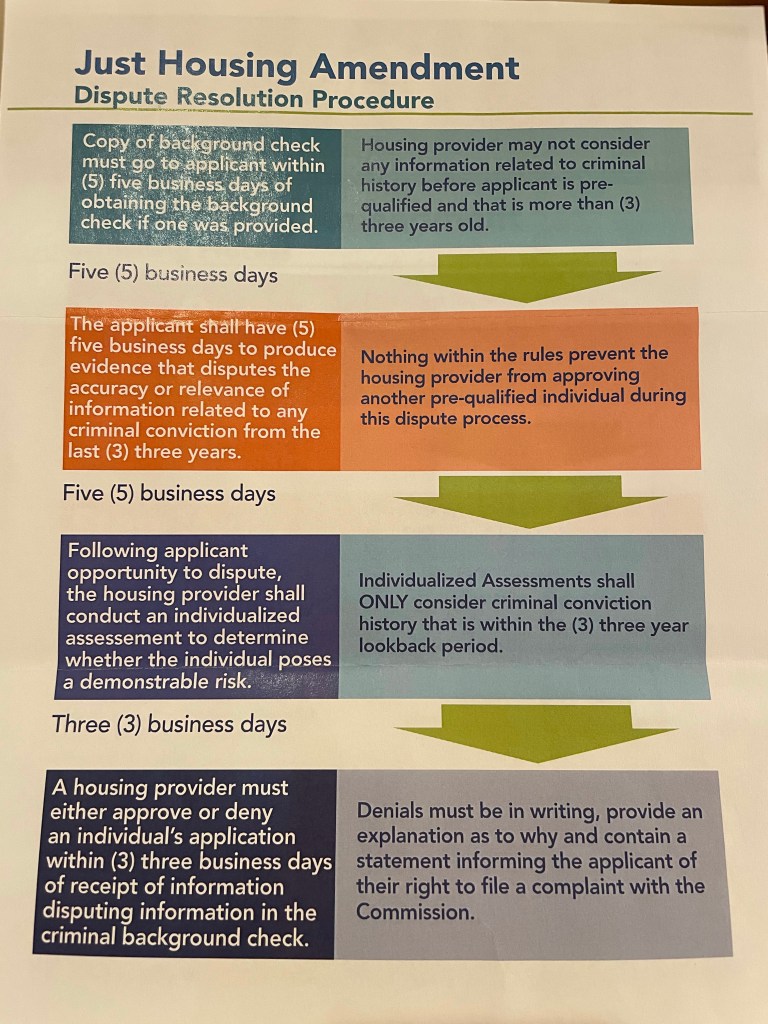
Yes. The JHA includes Conviction Dispute Procedures as described below:
No, a landlord does not have to hold a unit off the market.
The landlord has three (3) business days from receipt of the dispute information to accept or deny the application.
Any denial of a housing application or continued lease based on a conviction must be in writing and provide the applicant with an explanation of why the application denial was necessary to protect against a demonstrable risk of harm to personal safety and/or property.
For complaints investigated by the Cook County Commission on Human Rights, the penalties for violating the Just Housing Amendment may include complainant’s compensatory damages and attorney fees and Commission fines.

Mayor Caiafa and Mayoral Candidate Diaz were both out in full force with their fellow candidates canvassing Schiller Park all weekend presenting themselves to the voters.
No one has agreed to a debate for the Voters to hear the candidates discuss their positions on the issues and their view of the solutions, therefore, for the good of the spirit of democracy in Schiller Park it is time for a community conversation on the issues The intention is that this will be a civil and probing discussion of the needs and concerns of the community to both enlighten the voters and the candidates as to where the community’s priorities should be focused and how the community should come together to collaboratively pursue a future vision.

On Sunday, March 14, 2021, at 8 PM, join a Schiller Park Community Wide Conversation to discuss the issues in the upcoming municipal election. This will be hosted by this Blog and is open to the community as well as all of the candidates to dialog in a Town Hall meeting type of format to hear what the community feels about the issues which are now being circulated by the candidates for political office in Schiller Park.


Here is the link
Roy F McCampbell Blog is inviting you to a scheduled Zoom meeting.
Topic: Schiller Park Community Conversation On Issues in the Upcoming Municipal Election
Time: Mar 14, 2021 08:00 PM Central Time (US and Canada)
Join Zoom Meeting
https://us02web.zoom.us/j/85002362568?pwd=Z3VqK2xiemlSUEJDM2FnS3RtS2pOZz09
Meeting ID: 850 0236 2568
Passcode: 779259
One tap mobile
+13126266799,,85002362568#,,,,779259# US (Chicago) +13017158592,,85002362568#,,,,779259# US (Washington DC)
Dial by your location
+1 312 626 6799 US (Chicago)
+1 301 715 8592 US (Washington DC)
+1 929 436 2866 US (New York)
+1 253 215 8782 US (Tacoma)
+1 346 248 7799 US (Houston)
+1 669 900 6833 US (San Jose)
Meeting ID: 850 0236 2568
Passcode: 779259
Find your local number: https://us02web.zoom.us/u/koGpu3Wbk
Numerous issues have been been raised by residents including:
What is the future plans for Sexton Land Fill ?
What are the facts about the Village finances ?
Do the Schiller Park Taxpayers really owe the Police and Fire Pension Funds over $50,000,000 as the tax bills portray ?
What are the facts about the legal work costs for the Village of Schiller Park ?
Who benefited from the construction of the Senior Housing on Irving Park Road ? Did this help or hurt the Schiller Park Seniors ?
What are the facts behind the labor negotiations for the Schiller Park Fire Department ?
What is going to be done to resolve the flooding issues south of the Senior Housing in the residential areas ?
What are the future plans for the redevelopment of Irving Park and Mannheim Road ?
These are just some of the topics that will be explored in the upcoming community issues discussion …………
Please add additional topics to be discussed in the comments section of this post.

Governor Pritzker has signed HB3653, the “Criminal Justice Reform Bill” .

Nobody is surprised that he would sign this legislation, but there are multiple problems with this Bill. Here are some, but not all, of the lowlights to remember:
These are just a handful of things from the almost 800 page bill. With many more laws of similar confusion in it.
If some of these things sound odd to you, it’s because they are. It’s because no professionals in the field were included in the drafting of this bill, and it’s because it was written by people who have no idea of the realities of police work. This is what happens when laws are drafted by sensationalism, and not real research and experience. And also when that law is snuck through the legislature at 4:30 in the morning, while Illinois is asleep, after it’s name is changed twice in order to shake citizens off from following it’s progress.
Remember this Bill the next time your senator or representative are up for election. Remember this bill when crime sky rockets. Remember this bill when we have less qualified and competent people wanting to get into law enforcement, and officers are retiring, resigning, or leaving the state.
Remember this Bill when you’re the victim of a crime, and don’t ask yourself “why didn’t the police do more?”
Thank you Gov. Pritzker.🤬
I’m hoping all Illinois residents will wake up soon and when election time comes up it don’t matter Republican or Democratic.
I prefer to call it the “anti-police bill,” a term that the bill’s sponsors object to. But the bill unfairly targets officers and attempts to punish them, not just make them accountable. Just one example: One provision that says officers cannot review their own body-camera video before writing a report. That is “gotcha” language. That would be like saying television reporters cannot review any video they shot before writing a story for the airwaves. Sounds crazy, doesn’t it?
Need more evidence? A letter from a former Illinois chief that was posted on Facebook on Friday, predicting a significant departure of officers from Illinois if the bill is signed, already has been shared more than 3,100 times and has had more than 58,000 “engagements” by social media users. That is well beyond what a reasonable person would see as a hot topic, and it demonstrates grave concern about the negative effects of this bill on their careers.
A Law Enforcement Coalition statement sums it up well: “This new law is a blatant move to punish an entire, honorable profession that will end up hurting law-abiding citizens the most.”

Just got this from the Illinois Chiefs of police association. Worth reading!
Special Alert: Statements you can use to explain concerns about HB 3653: Fact vs. Fiction
ILACP Executive Director put this statement together to help you understand and identify the problems with HB 3653. It describes specific concerns and includes the page numbers in the bill for your reference. This statement is long and so it is attached here as a PDF that you can download.
This is Major Update #2 from the Illinois Chiefs. You can access our comprehensive Police Reform Bill Resource Center here. Today’s statement follows:
Summary of major concerns about HB 3653:
The Illinois Chiefs support law enforcement modernization that enhances the safety of citizens and communities. We support reform, but too much of the language in this bill is flawed.
This bill would endanger communities and individual citizens and embolden criminals.

IMPORTANT NOTE: Bill proponents say we are “blatantly wrong” in saying that, so please read on. Refer to page numbers in the bill for more details.
Citizens would no longer be protected by some routine police activity to stabilize tense situations such as removing an unwanted person from a residence or business. Page 326.
We all promote and train de-escalation, but this bill unreasonably restricts the use of less-lethal options such as Tasers, rubber bullets, and OC spray (commonly called pepper spray). Page 288.
Some sections of the bill target individual police officers in punitive ways:
It creates a new felony offense against officers for failure to follow body-worn camera laws and policies. Page 307.
It allows the attorney general to impose a penalty of up to $25,000 against individual officers for “pattern and practice” violation of rights. Page 46.
It prohibits officers from reviewing their own body-camera video before writing a report. This is “gotcha” language. (NFL referees are allowed to review video from multiple angles to get a call right. So why not police officers, who make split-second decisions in violent situations while protecting and rescuing citizens in danger?) Page 82.
The Illinois Chiefs have been leaders for decades in advocating for ongoing training and professionalism in law enforcement. Suggestions that law enforcement is resistant to change and improvement are utterly false.
In support of police reforms
Our association has been a leader in promoting advancements in law enforcement to increase officer accountability and professionalism. It is false to say that law enforcement always opposes change and reform and always pushes back. Just a few examples:
In the 1950s, we recognized the need for more law enforcement training and worked with the University of Illinois to establish the Police Training Institute on the U of I campus. PTI is still thriving.
In the 1990s, we established the Voluntary Police Chief Certification Program, designed to provide benchmarks of professionalism for chiefs.
In the early 2000s, we pushed the Illinois General Assembly to establish “licensing” for police officers, but we could never get a hearing.
In 2008, we established the voluntary Illinois Law Enforcement Accreditation Program (ILEAP), which requires police agencies to meet up to 180 standards.
In 2015, we participated fully in the new Commission on Police Professionalism, chaired by then-Senator Kwame Raoul and then-Representative Elgie Sims.
In 2017, we provided our own national expert to suggest a very progressive use of force policy for Illinois agencies.
In 2018, we adopted Ten Shared Principles in collaboration with the NAACP Illinois State Conference. These include treating everyone with dignity and respect, community policing, procedural justice (voice, fairness, transparency, and impartiality), de-escalation by all, and more.
From 2018 to 2021, more than 260 local police agencies have “adopted” these principles as their own, often in high-profile local ceremonies. So has the National Organization of Black Law Enforcement Executives at the national level.
In 2020, our Law Enforcement Coalition developed a 15-point Plan for Safe Communities and Police Modernization.
Why Illinois citizens should be concerned about HB 3653
There is language in the bill that will endanger our communities and make citizens in towns and cities of every size feel less safe. For example, if this bill is signed:
If you call the police because an unwanted person is peeking in your windows or standing in your yard or place of business and you don’t want them there for a legitimate reason, you can call the police, but the police will not be able to physically remove that person. All they can do is issue a citation (like a traffic ticket). Then, if the unwanted person still doesn’t leave and is not being threatening, the police will have no authority to arrest them or get them to “move along.” This applies to all Class B and Class C misdemeanors. Page 326.
The amount of “force” an officer can use will be limited in ways that will cause danger to innocent people and victims of crimes. This will cause citizens to wonder why the police have stopped pursuing obviously violent people. Pages 286-87 and 326.
Consider this scenario: The police respond to an armed offender that just committed a crime with a gun running towards a schoolyard with children. Under current law, they would be authorized to use deadly force to stop him. Under the new definition of “imminent” however, they cannot stop the subject and would have to wait for him to actually get to the schoolyard and threaten the children and potentially shoot one before they could use deadly force to stop the subject. See page 286.
Major concerns of the Illinois Chiefs (in addition to citizen concerns above)
Use of force language also restricts force while making an arrest if an officer reasonably believes the person cannot be apprehended at a later date. Almost anyone can be arrested at a later date. See pages 283-284.
We are pleased that chokeholds were banned by Illinois law in 2015, but this bill further restricts the definition of chokehold, too narrowly, by prohibiting “direct pressure to the throat.” Page 287.
Body camera language that (a) makes it a Class 3 felony for an officer not to comply with laws and policies requiring the use of body-worn cameras, page 307, and (b) that does not allow an officer to review their own body cam video before writing a report. Page 82.
The idea of removing qualified immunity, one of our biggest concerns, is still on the table with the creation of a task force to study this topic and present a report to the governor by May 1. Page 12.
Language about use of force seems to prohibit aiming a Taser at a person’s back, which is the recommended target. This prohibition reduces the apparent desire for officers to use “less-lethal” methods and tools. Page 287.
The bill prohibits of the acquisition of certain military surplus equipment, which some people mistakenly believe to be primarily armored tanks. Such surplus equipment can also include weapons that local agencies cannot otherwise afford. It is ironic that the week this bill was passed, the state of Illinois collaborated with local law enforcement with a major military presence to protect the State Capitol in Springfield. Page 53.
The “three phone-call requirement” is still in the bill. It requires three phone calls for detainees within three hours of being in custody. There are occasions where this is not possible, and this could make it more difficult for law enforcement to solve crimes. Page 411.
New authority given to the Illinois attorney general allows a penalty to be imposed against an individual officer of up to $25,000 and up to $50,000 for a second offense. This would be for an alleged “pattern and practice” of violating a person’s constitutional rights. Instead of this, the Westchester-based Intergovernmental Risk Management Agency (IRMA) says that “pattern and practice” cases focus on systemic police misconduct, and therefore, “true reform” would have such cases directed at agencies, not individuals. Page 46.
Language allows for anonymous complaints against officers, without a sworn affidavit. The “sworn affidavit” requirement was put into law because before that, departments and officers were victims of numerous frivolous and unfounded complaints. We prefer the “confidential complaint” language in the final section of the bill. That way, a person could file a complaint confidentially, but at some point, if the review process continued because it was a legitimate complaint, the person filing the complaint would be revealed. Pages 95 and 702.
Unintended consequences and misleading statements
One of my biggest concerns about the bill is unintended consequences. I am especially concerned that too many will say this is the Black Caucus vs. law enforcement, or even worse, black Illinoisans vs. law enforcement.
It is clear to me that black legislators and the black community want criminal justice reform, and it is just as clear to me that the police support changes to modernize policing, make communities safer, and get rid of bad cops.
The Black Caucus and the Illinois Chiefs want the same thing: justice for all and safe communities. In fact, they all want safer communities and all individuals to feel safe.
The trouble is, legislators put law enforcement on the defensive by introducing this bill at this time in this way, and some of the legislators who voted for it are now on the same script and very much on the defensive themselves. Rather than everyone being on the defensive, it would be far better for us to continue to engage in productive, honest conversations. It is noteworthy that today [February 2], a “Fact vs. Fiction” webinar promoted in northern Illinois includes no invitations to people with my perspective on this bill.
Behind the scenes and in public, I will be the first to listen more and speak less. The bill’s sponsors know this.
Now I want to address some of what I’m hearing from those who are critical of law enforcement’s response to this bill:
“The bill was not rushed through and it does not have ideas that have not been vetted. It was the result of 30 hours of testimony in nine hearings last fall, plus some language that has been around for years as the result of decades of concern about police practices.”
Ed’s response: At the nine hearings last fall, each one ended with no agreement about what should be done with the concepts that were discussed. They were subject matter hearings, not debates about bill language. That means there was no movement toward agreement, just a presentation of ideas followed by questions from legislators. Such hearings are valuable, but they are not enough. For example, in the hearing on qualified immunity, different people testified about the pros and cons of diminishing qualified immunity, but it was never clear what might or might not be in the bill.
The final language of the 764-page bill first emerged about 4 a.m. on Wednesday, January 13. The Senate passed it by 5 a.m., and the House passed it by 11:30 a.m. the same day, with a half-hour to spare before the lame duck session ended. Law enforcement had not seen the final language until it appeared in the middle of the night. The only part of the bill on which we had “agreed language” was the final section on police certification, and that language had been successfully negotiated by Attorney General Kwame Raoul, not the bill’s sponsors. That language was unexpectedly added to this omnibus bill in the middle of the night.
“The bill is a compromise, like a lot of legislation is, and so it must be an acceptable outcome though not agreeable to all.”
Ed’s response: Some legislators who were on the fence say they voted for the bill because some of the most egregious language, like eliminating qualified immunity and eliminating financial penalties to municipalities, were taken out of the final bill. But these same legislators are silent about the serious problems we have found in the bill.
The fact is, there was no compromise on numerous sections of the bill. Compromise is a part of the legislative process, indeed. But it is also part of the process to make sure that enough time is given for real debate on controversial language.
For example, we gave the sponsors language to fix the state’s body-camera law. We had presented these same ideas at the hearing last year. Not only did the final bill ignore our language, but it added different language, described above, that makes the body-camera law much worse, not better. We also asked them not to make body cameras mandatory, and if they do, make sure to provide the adequate funding for the cameras, storage, and manpower to implement the equipment properly. The mandate is in the bill, but not the funding, which will be problematic for most Illinois municipalities, counties, and other units of government such as universities, park districts and conservation districts.
“The time is now for reform. Vote for this bill.”
The bill’s major proponents used this language on the final day of the lame-duck session. The truth is, the time is always right for reform. That is why the Illinois Chiefs have been leaders in reform since at least 1956. It is why we endorsed the six pillars of the 2015 President Obama Commission on 21st Century Policing, and, in 2018, our own Ten Shared Principles.
The suggestion in Springfield earlier this month was that if you want criminal justice reforms, you vote FOR this bill. YEA means you want reforms; NAY means you are stonewalling and opposing any change. So said the proponents.
A third way was and is possible: Continue discussions that began in the fall. That will lead to a much better Illinois. We don’t have to start over. There is a lot to build on. We know the Black Caucus wants reforms, and we know they understand many of our concerns. Let’s keep talking. We believe in reform, but not in the language contained this bill.
“This bill should be signed because it’s a ‘good start.’”
People who say this is a “good start” forget too much history. They forget that Illinois is already a leader in police reforms and has required since 2015 some very progressive training – on cultural competency, procedural justice, and much more. We totally embraced community policing in the 1990s, and we have ever since.
The truth is, we are on a long journey together, and we each have our own place and time in history to make a difference. The discussion about the bill is not a “start,” but a part of a journey that we all share.
To say “just sign this bill because it’s a good start” totally dismisses our specific, legitimate concerns about language that could be improved.
“Law enforcement always opposes change and still opposes police reforms.”
I have already addressed this and proved it is wrong – historically wrong – but it isn’t stopping people from saying it.
“We included every suggestion of the Law Enforcement Coalition’s 15-point plan for police modernization,” translated in a Sun-Times article as “We included every suggestion made by law enforcement, so they should not be complaining.”
That is not accurate. In collaboration with our Law Enforcement Coalition, we did indeed promote a 15-point plan for Safe Communities and Police Modernization, but we never got to the legislative table for a deliberative discussion of these ideas. For example, we all agreed that the time is right for a standardized statewide use of force policy. But there wasn’t enough time in December and January to arrive at that language, and it’s not in the bill.
Also, we made a lot of suggestions at the subject matter hearings last fall on the concepts under discussion, but those concepts and the ones in the bill go way beyond the topics in our 15-point plan. So it’s inaccurate to say that every law enforcement suggestion can be found in the bill.
“Why do the police sound like they are against body cameras?”
We support the use of body cameras, but there is a good reason that fewer than 10% of agencies have adopted their use since the law passed in 2015. There are required processes in the law that make body cameras too expensive to launch, and difficult, from an operational and manpower standpoint, to implement. The legislators know our concerns and seem willing to fix them, but that did not happen in this bill.
Closing observation: This is not us versus them
When I went on the popular black talk radio station WVON in Chicago two days after HB 3653 passed in the Illinois General Assembly, host Matt McGill began the conversation by saying the black community believes these police reforms are necessary and law enforcement does not, and so he wants my perspective. As soon as I could, I said I want to reframe that. I explained why we were totally supportive of the bill’s language that will help departments get rid of bad cops. I also explained that the Illinois Chiefs have adopted Ten Shared Principles with the NAACP Illinois State Conference. These principles include much of the black community wants from law enforcement. I lamented that the conversations so far this year have degenerated into “us versus them,” and I offered some perspectives to modify that narrative. Samantha Joseph joined Matt McGill in hosting this interview. You can listen to it here.
“You are way more reasonable than I thought you were going to be,” McGill said toward the end of the interview.
I consider that progress.

Strategic Arts and Wellness
Find What's Trending
Personal Musings and Thought Experiments
The Content Scientists
gehadsjourney.wordpress.com
Health and Diet Tips
Climbing, Outdoors, Life!
www.amazon.com
Bipartisan dialogue for the politically engaged
Sarcasm and Silliness by a Resident of Leyden Township
German comfort food for the soul
 Roy F. McCampbell's Blog
Schiller Park Crystal Creek Is Not So “Crystal Clear”
At 25th and Rose Street by Schiller Park Fire Station 2 an unknown material was pouring into Crystal Creek this afternoon at about 3 pm further contributing to the Crystal Creek pollution issues.
No one seemed concerned that this unknown pollutant was being discharged into the creek from an unknown pollution source.
Who at the Village of Schiller Park is responsible to follow up on the polluting of Crystal “not so crystal clean” Creek ?
Share this: