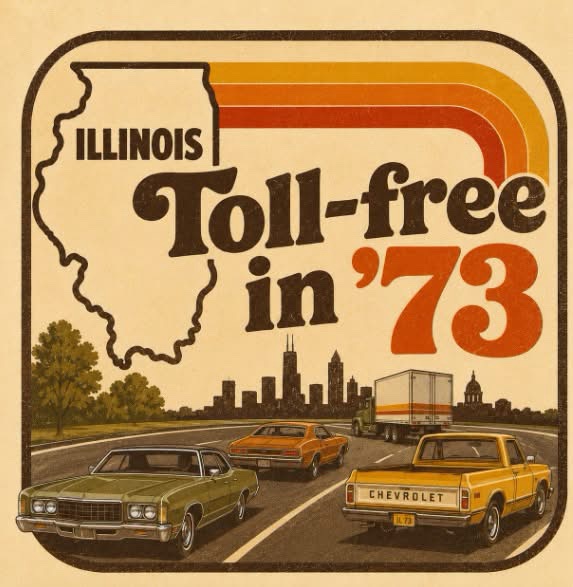
Toll free in’73″…a promise by Illinois politicians. Anybody remember that slogan? JB Pritzker and Illinois Democrats are now guaranteeing that Illinois tollway roads will ‘not’ toll-free by 2073, either.
JB Pritzker actually said there’s “no guarantees” your taxes won’t change at any moment.
In fact, Illinois tolls will increase by 45 cents to $1.20 a toll starting on Jan 1, 2027…and then ‘automatically increase very year afterwards starting in 2029. By increasing tolls automatically, Democrats will avoid having to vote to approve the a new toll increase which is politically awkward and embarrassing (as it should be)
Commercial vehicles will see a 30% toll hike.
In July, the tollway Authority will hold public hearings each of the 12 counties the tollway serves, and in August the tollway board, appointed by Gov Pritzker, will rubber stamp the increase anyway. The decision has already been made, the public hearing is just a formality.
Fifty years ago, Illinois politicians made a promise to taxpayers:
The tollway system would eventually become free.
Instead, it’s become a permanent, multi-billion-dollar cash cow. And now, they want even more.
Here is what the @GovPritzker-appointed
@ILTollway is pushing for 2026:
A massive 45-cent hike on passenger tolls, driving the average to $1.24 per toll.
A 30% rate hike on commercial vehicles, which already sit at an all-time high.
An extra $1 billion extracted from drivers every single year to fund a $26.5 billion capital plan.
A permanent inflation escalator starting in 2029 to keep costs rising automatically.
The worst part? The Illinois Tollway is taking in more toll revenue than ever before. They are collecting far more than they need to operate and maintain the roads, with net revenues peaking in 2024.
Since 1973, Illinois taxpayers have poured at least $27 billion into these plazas.
Why are we paying for infrastructure that was supposed to be paid off decades ago?
June 9: JB Pritzker: “Do people in Illinois want tolls raised to pay for the Bears? I don’t think they do.”
Two weeks later: He’s defending the biggest toll hike in state history.
JB Pritzker is a slimy politician who talks out of both sides of his mouth.
JB Pritzker says a 30% toll hike will only hurt out-of-state truckers.
Really?
Illinois businesses use those same tollways every day. Higher tolls mean higher shipping costs—and those costs don’t disappear. They get passed on to Illinois families every time they buy groceries, supplies, or everyday goods.
Once again, working people end up paying the bill.
The 30% toll increase takes effect on January 1, 2027.
Toll increase [watch]JB Pritzker says that you don’t need to worry because “tolls haven’t been raised in quite some time“.. this ridiculous statement ahead of the largest toll increase in the history of the state of Illinois!
Affordability my A#S JB!
The tolls are being raised because toll revenue that were in reserves is being shifted to the city of Chicago as a result of the transit bill passed by Illinois Democrats … Now the toll Authority wants their money back, and to do that they have to raise tolls.
Bad News: Starting July 1st, 85% of Illinois Road fund dollars will be shifted away from local roads in order to fund Chicago mass transit.
Your local roads will not get repaired, because the money previously allocated, will instead be redirected to Chicago under legislation approved by Illinois Democrats and signed by JB Pritzker.
Many local road projects in areas outside of the City of Chicago are expected to be cancelled or significantly delayed.
Illinois Senate Bill 2111, approved by Illinois Democrats and signed into law in December 2025 by JB Pritzker, redirects approximately $1.5 billion in annual funding from the state’s Road Fund to public transportation, primarily aiding Chicago transit. The new formula takes effect on Wednesday.
The shift of funding stems from a major legislative overhaul passed to bail out and reorganize Chicago-area public transportation. This legislation altered how the state’s motor fuel tax and Road Fund interest are distributed, fundamentally changing the state infrastructure allocation formula.


