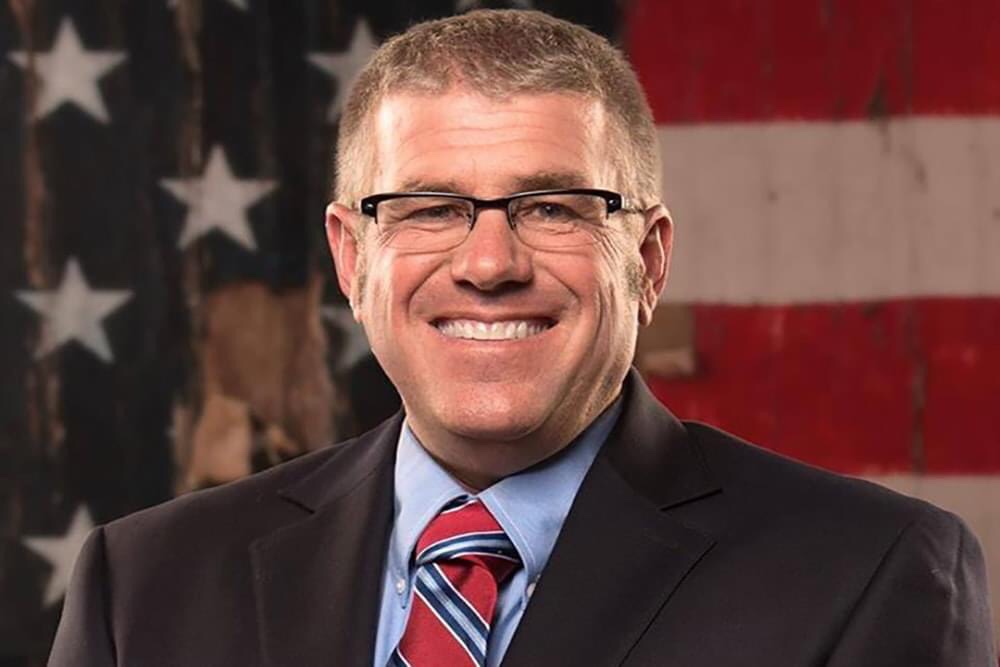
Governor Pritzker Is Hiring 4,000 New State Employees Amid Economic Meltdown—-A Successful Politician Knows How To Exploit Every Crisis


Think about the fact that only Illinois state government would add thousands of state employees amid an economic meltdown … which was largely caused by state government.


Illinois Gov. JB Pritzker proposed a massive $80 million program Friday to hire “an army” of nearly 4,000 state workers to track anyone who came into contact with people who test positive for COVID-19.

Modeled after a similar and likely smaller program employed in Massachusetts, the so-called contact tracing program is regarded as necessary to reopen parts of Illinois once the governor pulls back on his stay-at-home order, which began a 30-day extension on Friday.

“In order to safely move back toward normalcy, Illinois, the United States, and frankly the whole world must contact trace on a never-before-seen scale,” Pritzker said during his daily COVID-19 briefing, which has taken place for 57 straight days.

The development capped a busy day in the state’s evolving response to the coronavirus pandemic that claimed the lives of another 105 people during the past 24 hours, bringing the overall statewide death toll to 2,457.

Hundreds of protesters, many not observing social-distancing guidelines and not wearing protective face coverings, converged on the James R. Thompson Center in Chicago and the state Capitol in Springfield to rally against the governor’s newest stay-at-home order, which runs through May 30.

And late Friday afternoon, with the exponential rise of COVID cases leveling off, both Pritzker and Chicago Mayor Lori Lightfoot announced a further scaling back of the temporary COVID-19 field hospital at McCormick Place. Originally, the facility was designed to accommodate 3,000 beds for less seriously ill COVID-19 patients.

On Friday, a top aide to Pritzker said the facility will be downsized to only 500 beds, a more aggressive scaling back than had been announced just last Sunday. Officials had said that the McCormick Place facility would be pared back to 1,000 beds because of the state’s flattening COVID-19 curve.

“All patients currently receiving care at McCormick will continue to receive outstanding medical care for the duration of their illness, and plans for deconstruction are currently underway,” according to a joint statement from the governor’s and mayor’s offices.

But the big news of the day was the governor shedding light for the first time on his plans for a massive contact-tracing program that would aim to begin functioning by the end of May.

Contact tracing is a practice that aims to slow the spread of highly contagious illnesses like the coronavirus by quickly notifying friends, families, co-workers and others who made contact with someone who tested positive for COVID-19. Those people then would move into a self-isolation phase, ensuring anyone who caught the virus wasn’t spreading it to others, thus hindering transmission of the illness.

On Friday, for example, there were 3,137 new COVID-19 cases. The Pritzker administration wants the state ultimately to be in the position of being able to notify multiple contacts for each new case that they, too, may be at risk of getting the virus. The state’s expected hiring binge assumes 30 new workers are needed for every 100,000 residents in the state.

“Here in Illinois, we’ve had more than 50,000 known cases to date, largely in just a 60-day time frame. Their contacts are 50,000 sets of family, friends, coworkers, commuters, classmates and other contacts. It’s an unprecedented public health challenge so we need an unprecedented solution to meet this moment,” Pritzker said.

“To do that, Illinois will be building on our existing infrastructure and expertise to shape a massive statewide contact-tracing operation, gradually building over the coming weeks and then scaling up an army of contact tracers by the hundreds and then by the thousands,” Pritzker said.

The announcement came as protesters were rallying outside the Thompson Center against the governor’s plans to extend the stay-at-home order for a second time.

Protesters waved American and Trump-support flags and carried signs decrying the state’s stay-at-home order, as Chicago police officers in face coverings looked on.

“Give me liberty or give me COVID-19,” read one sign, and “Let my people go … back to work,” read another.

One demonstrator — former Republican Cook County Commissioner Tony Peraica — said extending the stay-at-home order through May 29 will cause “irreparable harm” to individuals and the economy. Peraica said public bodies — including the state legislature — should convene to begin a regionalized approach to opening more sectors of the economy.

“This unilateral action by our governor and other governors across the country is causing irreparable harm,” Peraica said. “It’s time to have some accountability, and it’s time to allow people to go to work.”

The anti-Pritzker protesters were met by healthcare workers represented by the Illinois Nurses Association, who were rallying in support of the governor’s actions.

Paul Pater, a University of Chicago Hospital emergency room nurse and board member of the nurses union, said protesters on the other side behaved belligerently, noting one who held a sign that read “Nurses are Nazis.”

“People were telling me that I wasn’t a real nurse, that I was a paid actor,” said Pater, who organized the nurses protest. “They were saying, ‘You’re not a hero, you don’t have valor. You’re stealing valor from the troops. I served and if you didn’t serve, you don’t mean anything.'”

Despite the made-for-newscasts protest, Pritzker’s actual handling of the COVID-19 crisis appears to have drawn favorable marks from Illinoisans.

New national polling by a consortium involving Harvard University, Northeastern University and Rutgers University found that in Illinois, 69% of residents support the governor’s response to the virus. That is 30 percentage points better than how those surveyed here view President Trump’s handling of the public-health crisis.

In other developments on the state’s COVID-19 front:

  • Opening pockets of the state before May 30: Pritzker said he is willing to take a regional approach to reopening the state’s economy before his new executive order expires — but it depends on healthcare availability in those regions. Pritzker said if there’s another surge in COVID-19 cases, he wants to see that there are enough hospital beds, ICU beds and ventilators available to handle the caseload. “I want as much as everybody else does for everybody to get back to work and for us to move toward normalcy, but I also want to say that I’m not going to do it until we know people are safe, and it isn’t gonna be because some protester has a sign that says ‘Liberate Illinois,’ ” Pritzker said.
  • Cicero nursing home lawsuit: Yet another lawsuit was filed against the state over its COVID-19 response, this time involving its oversight of nursing homes hard hit by the virus. The Town of Cicero filed suit against the state, the Illinois Dept. of Public Health and City View Multicare Center. The town alleges City View did not properly quarantine patients, staff did not wear protective equipment and that the state has not seen any demonstrable assistance from the state to hold City View accountable. Ten residents and staff members have died there. Dr. Ngozi Ezike acknowledged the outbreak at City View, but said that the goal is to mitigate outbreaks inside nursing facilities once cases already exist there.
  • No state layoffs or skipped pension payments: As Pritzker faces a projected $10 billion budget hole over the next two years, on Friday he publicly rejected two possible ways to cut spending: He won’t skip what the state owes in pension payments, and he won’t lay off state employees. “In a pandemic … you need state services more than ever,” Pritzker said. “Think about the damage that is done if we lay off state workers in areas like DCFS or in challenging domestic violence and overcoming that, in dealing with our healthcare system. This is not a time for us to further de-fund and further hollow out government.”
  • Spike in Latino infections: Pritzker acknowledged that communities of color, particularly in Latino neighborhoods, have seen a spike in COVID-19 cases. He said that’s part of the reason why they’ve expanded testing locations in those communities. The Illinois Dept. of Public Health reports that Hispanics make up 14% of COVID-19 deaths in the state and 23% of confirmed cases. 
  • Religious services provision in new order: The new executive order taking effect today specifically mentions that religious services can commence — so long as they don’t violate the definition of a mass gathering, which is more than 10 people in one place. It comes after The Beloved Church in Lena, Ill., filed a federal lawsuit against the state, stating the governor’s executive orders infringed on their constitutional right to assemble. Pritzker said the new language in the executive order effective May 1 doesn’t change the situation for religious services — it just makes explicit what they can and cannot do.
  • Ravinia closure and summer festival cancellations: Ravinia, the famed outdoor music venue, announced the cancellation of its entire 2020 season on Friday. Pritzker said without knowing what the situation will be in July or August, he encouraged other music venues, festivals and local governments to decide whether to cancel their events.
Posted in #taxation, Corona Virus, Covid-19, E Learning, Economic Development, Education, Finance, Health, health risk, Illinois, Illinois Pensions, illinois politics, News, On Line Education, politics, Pritzker, referendum, robert martwick, Rosemont, Roy F. McCampbell, state representative, Taxation, vaccines | Tagged , , , , , , , , , , , , , , | Leave a comment

May 1—Get Back To Work Day !!!


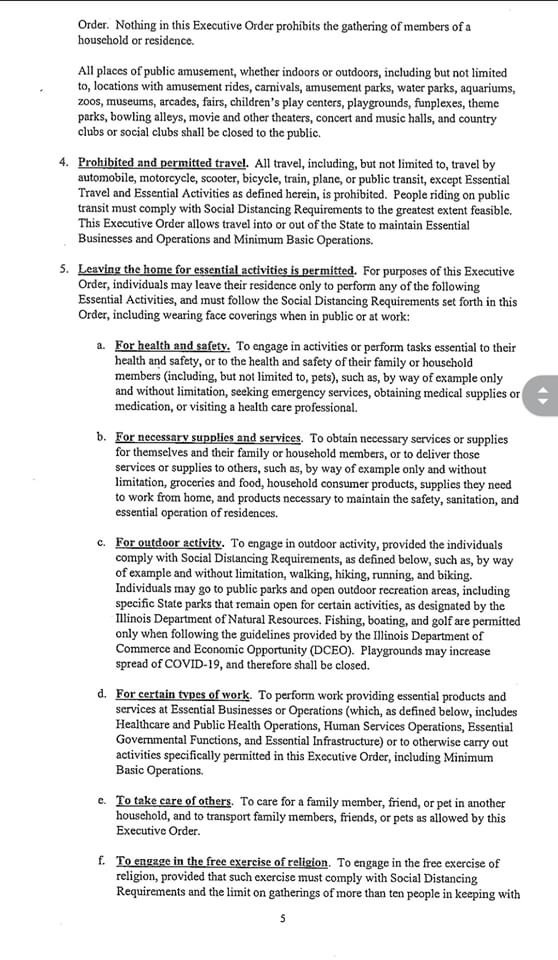
Governor JB Pritzker issued Executive Order 2020-32 yesterday, purporting to continue his emergency powers and the suspension of Illinoisans’ rights for what has now been 53 days since he proclaimed the State of Illinois to be a distaster.

Some noteworthy parts of his order:

“the State’s modeling shows that without a ‘stay at home’ order, the number of deaths from COVID-19 would be between 10 to 20 times higher”

“face coverings are required in public indoor spaces”

“retail stores . . . must cap occupancy at 50 percent of store capacity”

“Social Distancing Requirements includes washing hands with soap and water for at least twenty seconds as frequently as possible or using hand sanitizer”

“Essential Businesses and Operations and businesses engaged in Minimum Basic Operations must take proactive measures . . . including . . . Having hand sanitizer and sanitizing products readily available for employees and customers; and . . . Providing employees with appropriate face coverings”

The Governor says you are still not allowed to leave your house, unless for activity he has deemed essential. If he decided your business is not essential, he now says you can engage only in what he calls “Minimum Basic Operations.”

This order purports to be effective May 1 and has no expiration date.

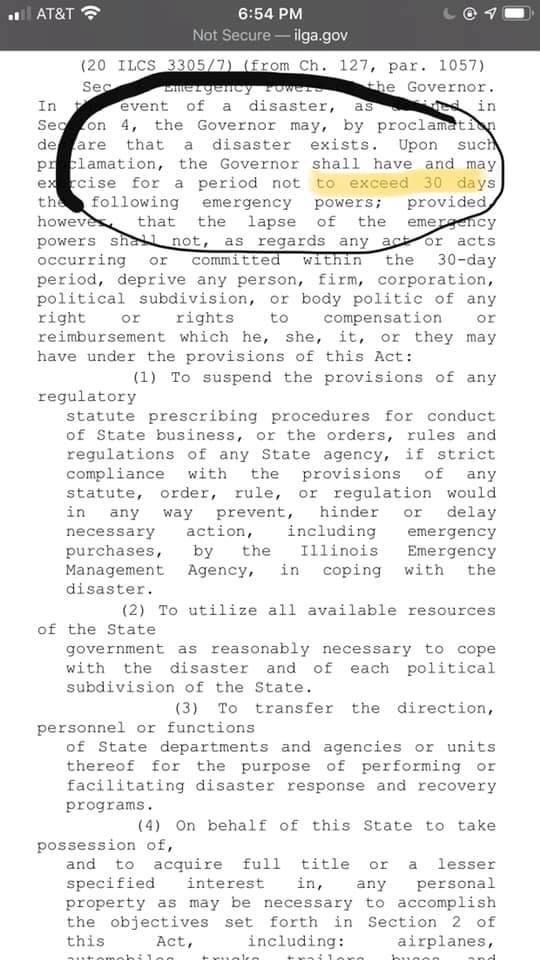
So according to the ILCS the governor has only 30 days after disaster proclamation to exercise specific powers like limiting the movement of people and shutting down businesses. Can someone please explain how our governor is able to even continue a lockdown when his 30 days are already up?

Posted in #madigoon, #taxation, Allstate Arena, Chicago, Chicago Cubs, Corona Virus, Covid-19, Crime, E Learning, East Leyden, Education, election fraud, Elections, foia, Foxx, Franklin Park, Illinois, Illinois Pensions, illinois politics, Kim Foxx, Leyden, lightfoot, lobbying, Medical, medical marijuana, mike madigan, minimum wage, nanny state, News, Norridge, Northlake, political satire, politics, Pritzker, referendum, Rosemont, Roy F. McCampbell, Schiller Park, senator durbin, Social Media, Taxation, teamsters, vote | Tagged , , , , , , , , , , , , , , , | Leave a comment

Northwestern Illinois church sues Pritzker in federal court over his stay-at-home order


A church in northwestern Illinois added to Gov. J.B. Pritzker’s legal woes Thursday, filing a federal lawsuit seeking an immediate injunction that would allow it to conduct worship services.

A Christian church in northwestern Illinois has joined a growing list of those challenging the authority of Illinois Gov. JB Pritzker to rule by executive order amid the COVID-19 pandemic, asserting Pritzker’s orders have discriminated against people of faith by ordering churches and other houses of worship closed, while allowing other “essential” institutions and businesses to remain open.

On April 30, The Beloved Church, an evangelical Christian church in Lena, in Stephenson County, and the church’s pastor Stephen Cassell, filed suit in federal court in Rockford.

Church filed a federal challenge vs Pritzker’s stay home order; ‘Rank bigotry’ vs people of faith, complaint says

Named defendants include Pritzker, Stephenson County Sheriff David Snyders, Lena Police Chief Steve Schaible and Stephenson County Public Health Administrator Craig Beintema.

The lawsuit takes aim at Pritzker’s executive orders barring large gatherings and his stay at home order, all of which were issued in mid-March.

The church asserts the governor’s actions “demonstrate an illegal and discriminatory hostility to religious practice, churches, and people of faith.”

The lawsuit asserts the governor’s orders violate “the fundamental religious liberties of Illinoisans, in violation of the First Amendment’s Free Exercise clause and parallel provisions of the Illinois Constitution and statute.”

The lawsuit specifically notes Pritzker has closed churches and houses of worship, while at the same time allowing a host of other businesses deemed “essential” to remain open and serve as public gathering spots amid the duration of the statewide stay at home order. These, they noted, include big box retail stores like Menards and Walmart, as well as liquor stores.

“Plaintiffs believe that, in these dark times, Illinoisans need the Spirit of Almighty God, but Pritzker’s orders have left them to settle for the lesser spirits dispensed out of the state’s liquor stores,” the church writes in its complaint.

“The churches and pastors of Illinois are no less ‘essential’ than its liquor stores to the health and well-being of its residents. Defendants have thus intentionally denigrated Illinois’ churches and pastors and people of faith by relegating them to second-class citizenship.”

Posted in #madigoon, Bradley Stephens, Chicago, Corona Virus, Covid-19, Economy, Illinois, Illinois Pensions, illinois politics, politics, Pritzker, robert martwick, Roy F. McCampbell, senator durbin, Social Media, vaccines, vote | Tagged , , , , , , , , , , , , , , | Leave a comment

Illinois closed until July 4th? Don’t be surprised !!!


Illinois closed until July 4th? Don’t be surprised. Unless the courts decide otherwise and local and county health departments are brought into play, the State will probably remain shut down until at least the 4th of July

Polling shows nearly 40% of your neighbors (in Cook and the Collars) believe we should not open until the end of May.

Another 22% believe we should not open until July 4th.

And, of course,more Democrats than Republicans prefer closure. But a surprisingly big number, including Republicans, want to keep things shutdown.

Oh, and over 60% think Pritzker is doing a good job on his COVID 19 response.

Today is Wednesday, April 29, 2020.

  • We are (at average) at 42 days of social isolation. In the US alone, there are just under 1 million confirmed covid19 cases with 55,000+ deaths as of this morning.
  • Schools have been closed since March 13th and are teaching remotely on-line. Schools will not reopen for the 2019-2020 school year, and be on-line for the summer possibly carrying into 2021 in that format.
  • Only “essential” retail stores are open such as grocery stores, hardware stores, and pharmacies. Amazon delivery windows average 3 – 4 weeks when they used to be max. 2 days. No gyms are open, and it’s almost impossible to find weights, exercise equipment, bikes, etc.
  • All extra curricular/ volunteer/business meeting and other gatherings are now on virtual meeting platforms i.e.(Zoom, House Party, Go to Meeting, Whatsap, Webex, Google Duo) the list goes on. Hang in there, life will continue and eventually, all together, we will get to a new normal!
  • There are lines / tape inside the stores on the floors to keep people 6 feet apart.
  • Bars and restaurants are open only for takeout, home delivery & drive through.
  • Playgrounds and sports fields are closed. Most beaches, parks and cemeteries are closed to the public. No visitors are allowed in hospitals.
  • All major and minor league sports competitions have been canceled as well as kids’ sports. The NFL draft was done virtually this week.

-American Idol was done virtually this week.

  • All festivals and entertainment events have been banned.
  • Weddings, family celebrations, and graduations have been canceled. Funerals limited to 10 people graveside.
  • People are doing drive-by parades and sidewalk chalk decorating to celebrate birthdays.
  • Young kids can’t understand why they can only see grandparents & other extended family and friends on a screen or thru a window if someone visits in person or on Facetime online.

-Visitors are prohibited at nursing homes and assisted living residences.

  • Hugs and kisses are not exchanged.
  • Places of worship are closed or online.
  • We have to stay away from each other more than six feet and no one even makes eye contact in public.
  • Shortage of disposable masks and gloves in hospitals.
  • People are wearing masks, some places REQUIRE that you wear them to enter! People are even sewing their own cloth masks for sale or donation to medical facilities. Illinois announced that as of May 1st, face coverings are required in public over the age of 2 where social distancing cannot be maintained.
  • Toilet paper, hand sanitizer, bleach, antibacterial wipes and anything Lysol or Clorox is in short supply and limited per person…. IF you can even find them! (This goes the same for flour and yeast).
  • Stores are closing early to disinfect everything. (24 hour stores are even closing by 6,8 or 9pm)
  • Store check outs, pharmacies and even fast food drive thru windows have added plexiglass between the employee and the customer. Have to reach around or under to pay!
  • You can’t find isopropyl alcohol easily. .. the supply per person is limited.
  • Australia, USA, Canada and Europe have closed their borders.
  • Western Australia has been divided into 9 territories & an instant $1,500 fine issued for crossing the border without a valid reason. (Transport workers, Essential services etc)
  • No one is traveling for leisure. Airports empty. Tourism has the worst crisis in history.
  • Wi-Fi and cell phone providers have extended their limits to provide connection to the Internet for people to continue to work from home and for students to learn from their teachers.
  • Many public pool access, concerts and summer activities will not be allowed/take place.
  • We don’t know if baseball seasons will start, hockey season will continue/end or any summer camps, etc. will run. Lots of teen/college summer jobs are up in the air.

-Colleges have not made definite decisions about whether to take their classes online, in person, or open at all for the fall.

-K-12 has ended their school year and plans to open for the fall have so many unknowns, social distancing, new guidelines for keeping everyone safe. How will it be scheduled? Can sports and activities continue as they have?

  • Society appears to be divided about whether or not we should continue to isolate or open back up and get the economy going. It’s an election year and politics are messy and complicating this issue.

Why do I post this?

Next year & then every year after, this status will appear in my Facebook memories feed. And it will be an annual reminder that life is precious & that nothing should be taken for granted. We are where we are with what we have. Let’s be grateful.

Posted in #madigoon, #taxation, Chicago, Corona Virus, Covid-19, Economic Development, Economy, Illinois, Illinois Pensions, illinois politics, legal services, Leyden, News, politics, Pritzker, robert martwick, Roy F. McCampbell, Schiller Park, Social Media, state representative, Union, vaccines | Tagged , , , , , , , , , , | 1 Comment

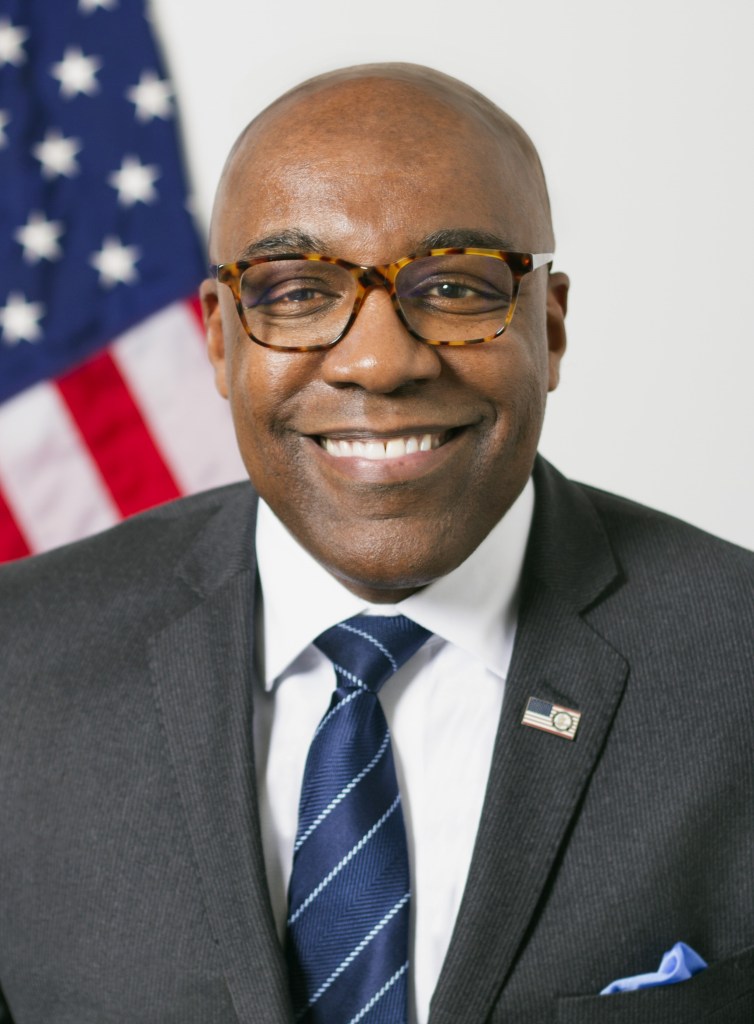
Illinois Attorney General Affirmatively States: “Pritzker has power to declare 30-day emergencies as long as he believes emergency” in his Illinois Supreme Court filing


Illinois Gov. JB Pritzker has asked the Illinois Supreme Court to step in to undo Monday’s ruling from a Clay County judge, blocking the governor’s stay at home order from applying to at least one Southern Illinois state lawmaker, and declaring the governor likely exceeded his authority under state law.

“… The public interest requires an expeditious and definitive determination of this appeal by this Court,” Raoul wrote in the emergency motion for direct appeal.

In the motion for direct appeal, Pritzker and Raoul ask the state Supreme Court to use its supervisory power to “summarily reverse” the temporary restraining order issued by Clay County Judge Michael McHaney.

The reasoning in the emergency motion to the state Supreme Court echoes both the language of the brief filed April 29 by the Attorney General in the Mt. Vernon-based Illinois Fifth District Appellate Court. It also echoed Pritzker’s public statements, repeated nearly every day at daily press briefings, that, without the exercise of his emergency powers, “the death toll will skyrocket, and Illinois hospitals will be overrun.”

In their arguments, Pritzker and Raoul claim the governor is empowered by the law to continue to assume broad emergency powers for as long as he believes the emergency exists, so long as he makes a “periodic determination” every 30 days that the situation that caused the emergency still “exists.”

In this instance, Raoul argued, if the governor’s emergency powers were to be limited by the courts, the result would be “exponential spread” of COVID-19 and an “inevitable loss of many lives.”

“That cannot be the result the General Assembly intended,” Raoul wrote.

That petition, filed by Illinois Attorney General Kwame Raoul on behalf of Pritzker, followed the governor’s appeal to a downstate appellate court.


The filing came two days after Clay County Circuit Judge Michael McHaney granted a temporary restraining order requested by Illinois State Rep. Darren Bailey (R-Xenia).

In that lawsuit, Bailey argued a plain reading of the language of the Illinois Emergency Management Act – a law repeatedly cited by Pritzker to justify his continued statewide executive orders in response to COVID-19 – reveals Pritzker has exceeded his authority.

The relevant portion of the IEMA statute says: “In the event of a disaster… the Governor may, by proclamation declare that a disaster exists. Upon such proclamation, the Governor shall have and may exercise for a period not to exceed 30 days” a number of sweeping emergency powers. 

Bailey argued the text of the law limits the governor to one 30-day emergency declaration. Beyond that, Bailey said, the governor must secure permission from the Illinois state legislature, known as the General Assembly, to continue ruling by emergency executive orders.

The Democrat-dominated General Assembly, however, has cancelled all of its previously scheduled legislative sessions since Pritzker declared a statewide disaster in response to the COVID-19 pandemic in early March.

However, after Pritzker announced his intention last week to extend a stay at home order again, this time to late May, calls have increased from Republican members of the General Assembly to convene the legislature to address the governor’s actions, and, at a minimum, ratify them by a vote.


Democratic leaders, including Illinois House Speaker Michael Madigan, have indicated no public willingness to convene at all, particularly since the governor issued a stay at home order in mid-March.

Almost immediately following Pritzker’s announcement related to the May stay at home extension, Bailey filed suit in Clay County Circuit Court, reflecting concerns among many that the governor had overreached. It also arrived a few days after an Illinois appellate prosecutor had indicated Pritzker’s legal authority may not be as rock solid as the governor has asserted.

It set up Monday’s hearing and Pritzker’s immediate appeal

“The comments by Judge McHaney make it clear in my opinion that the governor or the legislative leaders could have called us back into session to debate and clarify the emergency powers, but they have not done so,” Bailey said in a statement released on April 28. “The U.S. Congress has met using common sense distancing and even local city councils and county boards have been meeting with the use of technology like Zoom.

“The only other option at this point to ensure the checks and balances of power in Illinois are through the courts,” Bailey said

In the meantime, however, others have petitioned for similar restraining orders. And on Wednesday, State Rep. John Cabello (R-Machesney Park) filed a similar lawsuit to Bailey’s, but this time to include not just one state representative, but everyone in Illinois.

In the appeal, Raoul argues the court must act quickly to snuff out such legal challenges, and affirm Pritzker’s open-ended emergency powers, or risk allowing the coronavirus that causes COVID-19 to spread more quickly throughout the state and claim many more lives.

In the appeal, Raoul asserts other governors, including former governors Pat Quinn and Bruce Rauner, have extended disaster declarations to claim emergency executive powers in smaller or more limited disasters, including in response to the H1N1 influenza outbreak in 2009 and river flooding in more recent years.

While these emergency powers were never challenged in court, Raoul said it demonstrates the intent of the law to allow governors to continuously redeclare emergencies in 30-day increments for as long as they deem necessary, without any input from the General Assembly or the courts.

Raoul noted the law does not specifically limit the number of times a governor can declare a 30-day emergency, nor specify each emergency declaration must apply to a new, distinct emergency.

Raoul also argued Pritzker has authority separate from the IEMA law, under the state constitution, to take actions as the “supreme executive power” in the state, to “protect the public in a health crisis.”

Raoul noted the General Assembly’s disinterest in even attempting to convene also demonstrates their agreement with the governor’s sustained exercise of emergency powers.


“Illinoisans have been working together to prevent the sickness and death of our families, friends, and neighbors, our health care workers and emergency responders, and the vulnerable among us,” Raoul wrote. “The (Clay County) circuit court’s TRO (temporary restraining order) threatens our collective efforts and puts the lives of our fellow Illinoisans at great risk.”

Posted in #madigoon, Corona Virus, Covid-19, E Learning, Education, Elections, Illinois, illinois politics, legal services, politics, Pritzker, robert martwick, Roy F. McCampbell, Social Media, vaccines | Tagged , , , , , , , , , , , , | 1 Comment

Pritzker to face yet another lawsuit over stay home order, this time to apply to entire state


Even as he appeals a southern Illinois’ judge ruling that put a dent in his stay at home order, Illinois Gov. JB Pritzker will soon face a new legal action, from another state legislator, challenging his authority to keep Illinois largely closed for business amid the COVID-19 pandemic.

“At first, I believed he (Pritzker) was trying to do the right thing, and was doing well,” said Cabello. “But now, it seems to me he is progressively acting more and more like a dictator.”

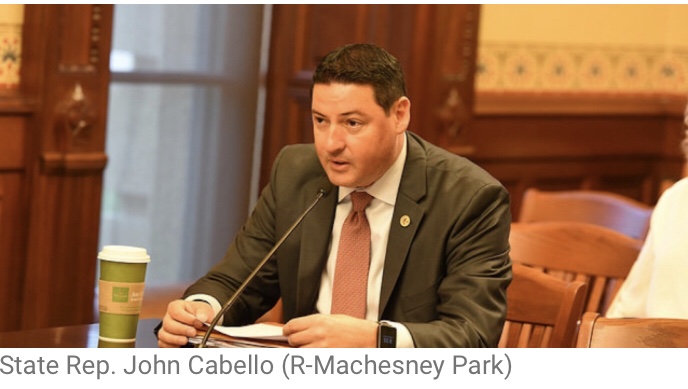
On April 28, State Rep. John Cabello (R-Machesney Park) announced his intent to sue Pritzker, arguing the governor has overstepped his legal power in extending his statewide stay at home order in response to the infectious disease outbreak.

“At first, I believed he (Pritzker) was trying to do the right thing, and was doing well,” said Cabello. “But now, it seems to me he is progressively acting more and more like a dictator.”

Cabello said his lawsuit would largely echo the claims laid out in the lawsuit filed last week by State Rep. Darren Bailey (R-Xenia). In that action, Bailey asserted Pritzker did not have the authority under the Illinois Emergency Management Act to declare an emergency and assert sweeping emergency powers over the state and its economy for more than 30 days. Beyond 30 days, Bailey argued, the governor needs to secure the approval of the Illinois General Assembly. The General Assembly has not convened at all, nor shown any intention of doing so, since Pritzker declared a statewide emergency in March.

The governor, however, has asserted the law gives him the authority to declare emergencies for “30 days at a time,” until he decides the emergency has ended.

Pritzker announced late last week his intention to extend the stay at home order, which had been scheduled to expire on April 30, to the end of May. Bailey’s lawsuit swiftly followed, asserting Pritzker’s declaration was illegal.

On Monday, Clay County Circuit Judge Michael McHaney, in far southeastern Illinois, granted Bailey’s request for a temporary restraining order, blocking the governor from imposing a new stay at home order. However, since Bailey’s lawsuit listed only himself as a plaintiff, the order applies only to him at this time.

Pritzker vowed a swift appeal. On Monday evening, Illinois Attorney General Kwame Raoul filed a notice to appeal McHaney’s decision to the Illinois Fifth District Appellate Court in Mt. Vernon.

Cabello acknowledged Bailey’s victory, but said his lawsuit, by contrast, would ask a judge to issue a similar restraining order, and this time apply it to everyone in the state.

Posted in #madigoon, Bradley Stephens, Corona Virus, Covid-19, Crime, Economic Development, Elections, Health, health risk, Illinois, Leyden, Medical, mike madigan, politics, Pritzker, robert martwick, Roy F. McCampbell, senator durbin, Social Media, Union, vaccines | Tagged , , , , , , , , , , , , , , , | 1 Comment

Judge slaps TRO on Pritzker’s stay home extension; Gov. vows swift appeal to get ruling ‘overturned


A southern Illinois judge has cast more legal doubt on Gov. JB Pritzker’s plan to extend the statewide stay-at-home order through the end of May.

On April 27, Clay County Judge Michael McHaney ruled against Pritzker, imposing a temporary restraining order on the governor’s further COVID-19 restrictions, at least as it applies to one downstate legislator, state Rep. Darren Bailey (R-Xenia.)

The ruling drew a sharp reaction from Pritzker, who pledged to immediately appeal the decision and “have this ruling overturned.” He blasted Bailey and the ruling, calling it “dangerous” and asserting it places millions of Illinoisans at risk from COVID-19.

Bailey responded by, in turn, calling the governor’s actions “reckless” and “tyrannical.”

In a video posted to Facebook, he said the governor’s comments place “millions of deaths” on Bailey’s shoulders. Such “reckless” language, he said, “exposes the very motives” of the governor in continuing to keep the stay at home order in place.

Bailey further asserted it is Pritzker who is not following the pandemic response plan created and maintained by the Illinois Department of Public Health. He pointed to the document, known as the Illinois Pandemic Influenza Preparedness and Response Plan, which was published in 2014. In that document, he specifically referenced language in the plan which cautions against the use of regional or geographic quarantine.

The document says: “Quarantine (a period of isolation to prevent disease spread) is not effective in controlling multiple influenza outbreaks in large, immunologically naïve populations, because the disease spreads too rapidly to identify and to control chains of transmission. Even if quarantine were somewhat effective in controlling influenza in large populations, it would not be feasible to implement and enforce with available resources, and would damage the economy by reducing the workforce. Most people will voluntarily quarantine themselves in their home.”

Ordinarily, rulings would be appealed first to a state district appeals court. Clay County is located in the state’s Fifth Appellate District, which is based in Mt. Vernon.

WEEKLY NEWSLETTER
Sign-up and get latest news about the courts, judges and latest complaints – right to your inbox.

Email
By signing up you agree to receive email newsletters or alerts from Cook County Record. You can unsubscribe at any time.
However, appeals can also be taken up immediately by the Illinois state Supreme Court, which is dominated by Democrats.

The lawsuit was filed by State Rep. Darren Bailey, R-Xenia. He is represented by attorneys Thomas DeVore and Erik Hyam, of Greenville.

In the lawsuit, Bailey argued Gov. Pritzker exceeded his authority by extending his executive orders, and particularly his statewide stay-at-home order, through the end of May, to sustain the state’s response to the COVID-19 pandemic.

In those orders, Pritzker asserted his emergency powers derived from the Illinois Emergency Management Act.

However, in his lawsuit, Bailey argued the IEMA law only permits the governor to exercise such broad emergency powers for a maximum of 30 days. Beyond that, Bailey asserted, the governor needs the approval of the Illinois General Assembly.

In his comments following the ruling, Bailey blasted his colleagues in the General Assembly, saying they should have convened and acted within the 30 days following the governor’s emergency declaration, to clarify what powers the governor was actually being given.

Instead, Bailey said, they “sat on their hands, and let this governor wreck and wreak havoc with our constitution.”

The General Assembly has not convened, nor indicated any intention to convene, since Pritzker declared a statewide emergency and began governing through a series of emergency executive orders.

Illinois House Speaker Michael Madigan issued a rare public statement amid the pandemic, also condemning Bailey and the ruling, and asking appeals courts to overturn the ruling and allow Pritzker to continue to govern using emergency executive orders.

“Like Governor Pritzker, I find Representative Bailey’s lawsuit to be extremely reckless, at a time we can least afford it. The governor’s actions have consistently reflected an understanding that, as we face this crisis, we must be guided by what is right – not what is easy, comfortable or expedient. Clearly, we cannot say the same for all the leaders of our state,” Madigan said in a statement posted to the website of the Illinois House Democratic Caucus.

“It is my sincere hope that upon further review, this decision is reversed, and that our health care workers, first responders and loved ones are not unnecessarily subjected to added risk by such a short-sighted lawsuit.”

Pritzker has credited the stay-at-home order, imposed since mid-March, with helping Illinois combat the spread of COVID-19.

Under the judge’s order, the extension of the stay-at-home order and other emergency executive orders would be restrained beginning May 1, but only as it applies to Bailey. The current stay-at-home order, which is scheduled to expire April 30, would remain in place.

During proceedings, Judge McHaney questioned whether the governor has the authority to “shred the Constitution for 30 days,” according to quotes tweeted by reporter Mark Maxwell, of WCIA TV in Champaign.

In imposing the restraining order, the judge said he believed Bailey had a high likelihood of success on his claims the governor had exceeded his authority.

While the ruling only applies to Bailey directly, it creates a path for others to bring similar legal actions and to petition for similar relief. In his post-ruling statements, Bailey said he expects the ruling will soon apply to “everyone.”

According to a story published by The Center Square, DeVore, Bailey’s attorney, said he had received inquiries from others interested in potentially also filing suit against the governor.

Posted in Chicago, Corona Virus, Covid-19, Illinois, illinois politics, lightfoot, lobbying, Medical, politics, Pritzker, robert martwick, Roy F. McCampbell, Social Media, state representative | Tagged , , , , , , , , , , , , , | Leave a comment

Judge rules against Pritzker’s extension of stay-at-home order | WGN-TV


The judge ruled that the Governor does not have the authority to extend the stay at home for an additional 30 days??? Now what??

CLAY COUNTY, Ill. — A judge in Clay County Illinois ruled against Gov. JB Pritzker’s extension of the stay-at-home order. Pritzker will appeal the ruling. A status hearing is set for next week. This ruling is a temporary restraining order and applies to the governor’s second stay-at-home order that goes into affect on Friday May […]
— Read on wgntv.com/news/coronavirus/judge-rules-against-pritzkers-extension-of-stay-at-home-order/

Posted in Pritzker, Rosemont, Roy F. McCampbell | Leave a comment

Why Weren’t Leyden, Norwood Park and Maine Township Schools as well as the Rest of the State of Illinois Prepared for On-Line Education When This Pandemic Came Upon Us ? Historic School Teacher Union Opposition to On-Line Education Is the Answer !!!


Leyden High Schools pioneered on line education calling it E-Learning for that one or two snow days a year, but because the teachers’ unions such as the  Illinois Education Association and the National Education Association oppose such a direction for education, even Leyden High Schools never truly perfected the E-Learning.   

Then when the Coronavirus-19 hit in early March, 2020, Leyden got caught with their “proverbial pants down”.     Since 2010, numerous companies have developed tremendous on line education products which would by pass much of the problems confounding parents today with the students studying at home, but because Leyden High Schools like all of the other schools in the State of Illinois are tethered to the union dictatorship the parents and the students are obstructed from getting a truly successful on line education.   So while teachers and administrators sit at home collecting 6 figure salaries protected by union contracts, parents struggle using a cobbled together E-Learning system that is neanderthal at best to see that their children are properly educated.    The Illinois State Board of Education knows that they cannot strictly grade the students and in fact are actually powerless to force the students to study on line because of the lack of continuity and synergy in the educational design of the current E-Learning.    Major corporations have spent millions of dollars in creating on line education programs, that the administrators and teachers are trying to replicate to protect their jobs and six figure salaries not caring what is best for the students in their charge.

The Leyden High School Administrators and Board of Education has done a good job of lying to themselves that they had achieved a premiere E-Learning system.    They started the pilot program in 2015, but failed to constructively include special education students in the E-Learning model that they constructed.   They needed to construct a curriculum that was seamless and would have functioned effectively during this current crisis;  but -they could not adopt an effective national on line e-learning program and avoid “crossing swords” with the educational unions.
For years the teacher unions have fought home schooling state by state as they pursued legislation to make it hard and complicated for parents and on-line companies to provide home schooling.    Now they are still refusing to relinquish their strangle hold on the education as they graspingly try and protect their personal interests and forget to employ what is best for the students.

E-Learning will likely be the norm well into 2021 and very likely beyond——–Leyden 212 and all state wide school boards need to brake the shackles of the teacher unions and start doing what is best for the students.    The teacher unions need to join hands with the stewards of education state wide and stop opposing an effective usage of on-line learning opportunities.

In 2020, toddlers start consuming digital information not long after they’ve started consuming solid food.

Now take that kid, tack on a handful of years, and drop him into a classroom. A child who was perfectly content with a video stream, an MP3, and a chat flowing past him is suddenly ordered to sit still, shut up, and listen while a grown-up scrawls on a blackboard and delivers a monologue. And school is even worse for the older girls down the hall. The center of their universe is on social networking and chat sites, so spending six hours a day marooned in a building with no WiFi is akin to water torture. The same pre-teen who will happily while away hours playing Scrabble with her friends on Facebook dreads each Thursday afternoon, when she will be forced to laboriously write out a list of spelling words in silence alongside two dozen peers.

During the last 30 years, the per-student cost of K-12 education has more than doubled in real dollars, with no academic improvement to show for it. Meanwhile, everything the Internet touches gets better: listening to music on iTunes, shopping for shoes at Zappos, exchanging photos on Flickr.

Even with school hours offline, kids are logging plenty of computer time. A January study by the Kaiser Family Foundation found that kids spend an average of 7.5 hours a day in front of a screen. The knee-jerk response is to lament those lost hours and hatch schemes to pry the kids’ hands from their keyboards. But that’s the wrong approach. If you can’t beat ’em, join ’em: Let kids stare at a computer screen until their eyeballs fall out, but add more educational material to the mix.

A growing number of kids and their parents are figuring out ways to sneak schoolwork online. More than 1 million public school students are enrolled in online classes, up from about 50,000 a decade ago. In Florida, nearly 80,000 kids take classes in the state-sponsored Florida Virtual School. Virtual charter school companies such as K12 Inc. provide full-time online education to 70,000 students in 25 states. Hundreds of small, innovative companies are springing up, vying to combine learning with the power of the Internet. Nationwide, 17 percent of high school students report having taken an online course for school in the last year; another 12 percent say they took a class on their own time. Harvard Business School professor Clayton Christensen, co-author of Disrupting Class, a seminal 2008 book about online education, estimates that half of all high school courses in the United States will be consumed over the Internet by 2019.

But the commercial Internet has already been around for a decade and a half. As the 3-year-old with the iPhone might whine from the back seat of the minivan: Why aren’t we there yet?

School in the Sunshine State

Online education’s biggest success to date is the Florida Virtual School (FLVS). Founded in 1997, FLVS was the first public statewide online education program in the country. Founder Julie Young had snagged a $200,000 “Break the Mold” grant from the state of Florida to experiment with online learning. In the early days, as she traveled the state selling the idea to local districts, the reception was muted. “People were sitting there with arms folded and saying, ‘You’ve got to be kidding me,’?” recalls the friendly, carefully manicured Young, who had previously worked as a teacher and technology adviser in the state’s public schools.

With the election of Jeb Bush in 1998, Young found herself working under a governor with a serious interest in education reform. With Bush’s support, legislation expanding the virtual school gave the program a unique advantage: Rather than allowing school officials to be the arbiters of who gets to go online and how, the law said any Florida student who wants to take an FLVS course online must be allowed to do so. The students themselves—not preoccupied guidance counselors, budget-conscious principals, or any other gatekeepers—decided whether to give the virtual school a try.

As the Harvard education scholar Paul Peterson put it in his 2010 book Saving Schools, “Much like an Everglades alligator, Young took a quiet, underwater approach.” At a time when Gov. Bush and his cadre of education reformers were regularly butting heads with the educational establishment, Young went out of her way not to antagonize teachers unions or disparage traditional schools. “From day one, what we tried to do was design FLVS so that it was not competitive with the schools, but complementary,” she says. Her pedagogical philosophy is noncontroversial—with a few exceptions, the curriculum is typical of the stuff Florida students would get in a traditional classroom—and she is studiedly nonpolitical. The courses offered by FLVS are supplemental; the virtual school cannot grant degrees on its own. Nearly every student remains enrolled in a full-time program at a physical school. The funding formula adopted by the state takes only a fraction of the annual per-student cost from their local school, and FLVS gets paid only when students successfully complete the course.

Young doesn’t use the language of reform or revolution. Instead she talks about “doing what’s right for kids.” Yet Florida Virtual School’s model is, in its own way, revolutionary. The school employs 1,200 accredited, nonunion teachers, who are available by phone or email from 8 a.m. to 8 p.m., seven days a week. Kids take what they want, when they want. The academic results are more than respectable. FLVS boasts that kids in advanced placement courses—39 percent of whom are minority students—score an average of 3.05 out of 5, compared with a state average of 2.49 for students in offline public school classes. FLVS students also beat state averages in reading and math at all grade levels, with 87 percent of eighth-graders receiving at least a passing score on the state standardized test in math, compared with 60 percent statewide. Even critical studies of educational achievement in Florida’s online courses find that the results are as good as or better than state averages on virtually every measure.

Picking Fights

Not all of the major players in online education have opted for the stealthy alligator approach. K12 Inc., one of the largest private providers nationwide, doesn’t mind picking political fights. One of its founders is Reagan administration Secretary of Education Bill Bennett, an outspoken conservative. (He resigned from the school’s leadership in 2005 after some intemperate remarks about the alleged links between abortion, race, and crime.) While FLVS was sneaking up on the Sunshine State’s educational establishment, K12 Inc. started showing up all over the country in 2000 with a bullhorn.

Unlike FLVS, K12 provides full-time instruction. That means students from kindergarten through 12th grade can do their entire school year online. While the curriculum isn’t particularly innovative, the model is potentially far more disruptive than a program like FLVS. K12 takes children and teenagers out of school and away from traditional teacher-student relationships. The company has some partnerships with traditional public schools, but K12 primarily works by helping charter schools in states with lenient laws go virtual, accepting kids (and the money they bring with them) from all over the state.

In the zero-sum world of education dollars, that approach means that state education bureaucrats generally don’t show up at K12’s virtual door with welcoming tater tot casseroles. In 2003 Wisconsin’s Northern Ozaukee School District was experiencing declining enrollment and hoped that bringing in a virtual charter might attract students (and their per-pupil spending allocations) from around the state. This worked brilliantly, with 500 students signing up for the virtual charter school from all over the state in the program’s first year. The district and K12 split the $5,000 that came with each kid, and everyone was happy. Well, everyone except the administrators and teachers in the districts losing enrollment dollars to the experiment in online learning. The conflict exploded in January 2004 with a lawsuit brought by the teachers union and the elected state superintendent. State Sen. John Lehman (D-Racine), who heads his chamber’s education committee, accused private education companies of “profiteering off of kids.”

The result was a compromise that neutered virtual education in Wisconsin. K12 could continue to operate, but it could enroll students only from the physical district where the charter school was located—essentially stopping the Internet at the county line. And enrollment was capped at 5,250 students. For good measure, Wisconsin announced plans to create an FLVS-like state-sponsored virtual academy, which will compete with K12 on lopsided terms and, unlike in Florida, be firmly under the control of the education bureaucracy.

Unions Fight Back

The National Education Association, the country’s main teachers union, takes a hard line on virtual charters such as K12. “There also should be an absolute prohibition against the granting of charters for the purpose of home-schooling, including online charter schools that seek to provide home-schooling over the Internet,” says the organization’s official policy statement on charter schools. “Charter schools whose students are in fact home schoolers, and who may rarely if ever convene in an actual school building, disregard the important socialization aspect of public education, do not serve the public purpose of promoting a sense of community, and lend themselves too easily to the misuse of public funds and the abuse of public trust.” But analog unions can’t stave off online education for digital natives forever, and state-run virtual academies like FLVS—rather than virtual charters like K12—make it easier to control the pace of change.

Similar battles have been fought in Oregon, where the state teachers union declared last year that resisting another full-time virtual charter company, the Baltimore-based Connections Academy, would be its top priority. “You’d think among all the kids in Oregon there are some other pressing issues,” says Barbara Dreyer, CEO of Connections, which runs one Oregon school and dozens of others across the country. When 2009 began, the state legislature had already obliged the union by capping enrollment for virtual schools and mandating that kids do work under the eyes of physically present teachers. Yet union support for funding and expanding the state’s Oregon Virtual School District (which has been slow to attract enrollment) remained strong, with union members citing the existence of the government-run academy as sufficient to meet online education needs in the state.

Says Dreyer: “Many states say, ‘We hate the whole thing with these for-profit providers. We should just do it ourselves.’ But with the exception of FLVS, nobody has been able to do it. It’s complicated; it takes capital. It’s tough to do it from scratch. They don’t have expertise. It’s particularly tough in these times when there is no money.”

Something analogous happened four years ago in Indiana, where the charter school law seemed to authorize the creation of full-time online schools. K12 launched a program and started recruiting students. Even though the legislative session was over for the year, when opponents of online education got wind of the new venture they executed some special maneuvers to insert language into the budget bill to kill the virtual charters. While a hybrid model did get up and running, it was on a far smaller scale than originally intended, leaving most of the interested parents and kids out in the cold. This year, with the demand for online education still growing, the union supported the creation of a 200-person pilot program for the state education department to run its own virtual academy.

In its 2010 legislative program, the Indiana State Teachers Association claims to support virtual schools. That is, as long as the programs adhere to nearly all of the criteria that define traditional schools, including class size, seat time, teacher licensing, grading mechanisms, and the physical location and conditions for testing. They can’t open their programs to homeschooled kids, and they can’t spend more than 5 percent of their budgets on administrative costs.

Teachers unions, consistently among the biggest donors to U.S. election campaigns, are incredibly powerful. The National Education Association can buy and sell elections, but a continuous flow of membership dues will be tougher to come by if online education blooms.

Make New Friends

Politics aren’t the only reason online education is coming to the masses at the speed of a 14k modem. Cultural resistance is strong as well. Parents and politicians fret about the consequences of creating a nation of lonely nerds with Google tans.

Socialization looms large in discussions of online education, but the worriers may be missing the point. For one thing, kids are already doing much of their socializing on their screens. That hasn’t brought sports, clubs, summer camp, or neighborhood activities to an end, and neither will online education.

More important, it’s not clear that the kind of socialization we’re currently offering kids in schools is doing them any favors. Even in schools where the quality of education is decent, enthusiastically partaking in it can make you a mockable nerd, even a target for daily brutalization. The problem is worse among minority populations at large urban schools. Smart black kids across America are choosing not to speak up in class every day, even when they know the right answer, because it’s not worth the social suicide. A large body of social scientific literature investigates this problem, beginning with Signithia Forham’s seminal 1986 paper “Black Students’ School Success: Coping With the ‘Burden of “Acting White.”?’?” The reasons for the problem remain a topic of heated debate, but the problem itself is well-established: Surveys consistently show that black students worry more than white students that their peers will criticize their academic success.

While the smartest kids face one set of troubles, the slower kids in the same classes have problems of their own, mutely letting lessons roll by because they’re afraid of asking a question and being called stupid. Learning online in the morning and then heading out to play in the park in the afternoons could be a much better alternative for both kinds of kids.

The real issue here isn’t socialization but something else. If there is one thing that nearly all American parents have in common, it is the paralyzing fear that they might have to figure out what to do with their children all day, every day, for 12 long years. Michael Horn, one of the co-authors of Disrupting Class, estimates that the number of kids who might learn full time at home tops out at 5 million, a figure based on how many live in family structures that allow for all-day adult supervision. That leaves more than 90 percent of the nation’s 55 million school-age children in need of someplace to go during the day.

The Future of Online Education

One promising idea is a hybrid approach, where kids get the socialization and adult supervision of a shared physical space but consume much of their actual instruction online. Of the million kids already taking classes online, some are just logging in from their bedrooms, but others are taking courses on computers in community centers or gyms or heading out to the strip-mall outposts of private tutoring companies.

Such hybrids are springing up around the country. Rocketship Education in San Jose, California, brings at-risk elementary students together in a safe, colorful, trailer-like modular space, with a small staff to keep an eye on the kids while they do lessons online. Dropout recovery programs such as AdvancePath Academics catch kids who have fallen out of the system. Some of these programs, in which the content is administered primarily online, give kids physical spaces to learn in shopping malls. Kids in mentoring programs such as Group Excellence are offered a choice: they can opt for after-school tutoring in a physical space with free pizza, or take advantage of 24-hour support to do the same work on an iPhone, netbook, desktop, or even a Nintendo, whenever they want.

State governments spend between $10,000 and $15,000 annually on each of the nation’s 55 million school kids, making primary and secondary education a $1 trillion market. Under ordinary circumstances, that kind of money attracts entrepreneurs. But the uncertainties of politics, the powerful opposition of the teachers unions, and the astonishing technological backwardness of the education establishment discourage would-be entrepreneurs and, perhaps more importantly, potential investors.

In the 2010 annual letter from his charitable foundation—the biggest in the United States, with a $33 billion endowment—Bill Gates listed online education as one of his top priorities. “Online learning can be more than lectures,” he wrote. “Another element involves presenting information in an interactive form, which can be used to find out what a student knows and doesn’t know.” Hundreds of smaller contenders are proliferating, trying to figure out ways to exploit the new medium and answer concerns about what a nation of online learners might look like. Carnegie Learning uses artificial intelligence techniques to customize math learning to the individual. The Online School for Girls creates and administers advanced courses geared to female learning styles. The list is as large and diverse as the iPhone app store and growing every day.

Internet access isn’t a barrier anymore. The digital divide has essentially closed. A 2009 Pew Research Center report found that 93 percent of Americans between the ages of 12 and 17 are online. Computers are cheap, and they’re getting cheaper every day. Textbooks are expensive, and they always have been. There’s a point not too far off where the price of a decent laptop and the price of a single hardback biology textbook will converge. Books full of nonhyperlinked text already must seem like a cruel joke to the congenitally connected. The virtual charter school company Connections Academy supplies its 20,000 full-time students with computers as part of the package.

Adults who weren’t weaned on broadband find the beeps and boops of their computers distracting, but distractions from the computers aren’t a problem for kids. Slow brain death from data deficit while they sit still, eyes forward, listening to a one-dimensional lecture that’s going too slowly, too quickly, or in the wrong direction altogether is a much more serious threat.

Failing for Success

From the perspective of education reformers and policy wonks, beaten down by a decades-long war of attrition, online education has swept onto the scene with astonishing speed. Paul Peterson, the Harvard education scholar, calls the rate at which the online education sector has grown “breathtaking.” But his private-sector counterpart Tom Vander Ark—who helped found the country’s first K–12 online school in 1995, served as the executive director of education for the Bill & Melinda Gates Foundation, and now runs a private equity fund focused on education—has a different view. “Coming from the business world, I thought this would all happen fast,” he says. “It’s frustrating that 15 years later online learning is just beginning to mature.”

Until recently, virtual schools have been funded by state education budgets. Now states are increasingly fishing for federal dollars. Sixteen states included an online education component this year when requesting funds from Race to the Top, a federal grant program launched under George W. Bush and expanded under Barack Obama that was designed to bribe states to push toward greater teacher accountability and competition. The first round of funding was awarded in April, and while the inclusion of online education in several of the winning proposals is encouraging, the grants heavily favor top-down, state-run online academies over virtual charters and other bottom-up options.

Vander Ark calls the online component of the Race to the Top finalists’ plans “lame.” On his blog, he explains: “Given less than optimal policy environments, state v-schools can and do play an important role in supporting blended environments and online options.” But “we’re a generation behind where we should be in terms of online tools, platforms and options—a state government caused market failure. Where competition is welcomed, we’ll see innovation.”

The existing offerings are making life better for hundreds of thousands of kids. But we’re a long way from widespread access to genuinely innovative educational practices. Only 28 states allow full-time online programs right now. If you’re a kid who lives in New York, you don’t have access to any public online programs. In Virginia you have online A.P. courses, but nothing full time. If you’re in California, you have access to full-time programs but not supplemental ones, unless you happen to live in a district that made an independent investment in online learning.

We can’t let state legislatures and federal grant programs pick winners. We can’t let teachers unions allow only one version of online education to squeak by. But if online learning keeps growing, when that 3-year-old with the iPhone graduates from high school in 2035, education will be virtually unrecognizable, and thank goodness for that.

In 2012, education technology firms attracted $1.1 billion from venture capitalists, angel investors, corporations, and private equity—an order of magnitude more than the industry was pulling in 2002. Startups Coursera and Udacity, which offer high-quality online college courses to the masses, have each received more than $20 million from investors. Big corporations are buying their way into the industry, with Rupert Murdoch’s News Corp. leading the way in 2010 by dropping $360 million to acquire ed-tech firm Wireless Generation and luring education superstar Joel Klein away from his gig as the head of New York City schools.

But will the rush of cash translate into a radically transformed education landscape? When this kind of money flowed into tech companies in other sectors of the economy, we saw radical improvements in everyday transactions, as well as some dramatic booms and busts. Think Amazon instead of the mall, iTunes instead of the record shop, Expedia instead of a travel agent. But also think Pets.com and Full Tilt Poker, where intense competition and bad politics squelched what looked like good bets. There has been a flowering of good ideas in online education, like hybrid learning, in which kids still head off to school every morning but receive the bulk of their instruction from an infinitely patient piece of software instead of a harried, overworked teacher. Yet education, particularly K–12, has remained mostly immune to the improving and empowering forces of the Internet, leaving millions of kids stuck in offline backwaters for six hours a day. Per-pupil spending on public education has more than doubled over the past three decades, while student performance has flatlined.

As the parent of a students, I’d love to start banking on virtual elementary school matriculation. I want more choices than just the neighborhood public school or an exorbitantly priced private school offering pretty much the same curriculum in nicer facilities. Personalized learning and highly specific feedback appeal to me as a parent. But while Wall Street’s interest in online education may bode well for entrepreneurs and students, bullish investors and parents would do well to listen to war stories from weary education policy wonks.

At the university level, MOOCs and other forms of virtual schooling are cheaper alternatives to a wildly overpriced product. But at the K–12 level, companies looking to break into that market have to make a choice: compete with the traditional educational system, which parents think of as free, or jump through the hoops required to get your product integrated into public schools—which will mean satisfying at least 50 different sets of standards, plus watering down, rejiggering, and generally accommodating your product to a system that wasn’t designed for tech-driven plugins in the first place.

Every few years, Washington goes through a spasm of education reform. Some of the highlights include 1983’s “A Nation at Risk,” which encapsulated the Reagan-era push to eliminate federal involvement in public education. The Goals 2000 Act, signed by Clinton in 1994, looked to boost graduation rates with extra tutoring. The bipartisan No Child Left Behind Act of 2001 focused on testing and rankings and is long overdue for a makeover. Washington can’t make up its mind about education, which means the industry faces a significant amount of political risk. If pols turn against online education, pushing into an area so thoroughly dominated by public institutions may become even trickier. And laws designed to shoulder online ed companies out of the public sector could easily spill into the private side of the equation, creating a hostile regulatory environment or overly specific standards for state-certified graduation.

At the state level, a mishmash of laws and regulations means that battles to make room for online schooling will have to be fought over and over. Long-standing rules requiring that students sit in desks looking at a teacher for a certain number of hours a day—so-called seat time and line of sight requirements—could kill online learning in the cradle. Requirements for specific teacher-student ratios are tough to translate in a world where a single school day might have a student chatting with a friendly avatar online, getting tech support from an in-person teacher’s aide, and emailing with a subject-specific tutor, all while having her tests graded by a team of data-center workers in India.

In states where online education has made headway, often via laws that make room for charter schools, local and state teachers unions have filed lawsuits and pushed legislation to place strict caps on charter school enrollment, close virtual schools altogether, and—in a rather spectacular display of purposeful obtuseness about how the Internet works—to limit enrollment to students who live in the district in which the online school is based.

Former Florida Gov. Jeb Bush, a Republican, has been the most prominent political backer of online education. Bush founded the advocacy group Digital Learning Now with another former governor, Democrat Bob Wise of West Virginia. Despite this bipartisan partnership, in 2011 the liberal Mother Jones gazed across the landscape and spotted Machiavellian GOP politics at work:

“[T]he online-education push is also part of a larger agenda that closely aligns with the GOP’s national strategy: It siphons money from public institutions into for-profit companies. … And it undercuts public employees, their unions, and the Democratic base. In the guise of a technocratic policy initiative, it delivers a political trifecta—and a big windfall for Bush’s corporate backers.

That narrative isn’t wrong. The GOP isn’t fond of teachers unions, and undermining their power is certainly a nice bonus. And small-government types, which many Republicans profess to be, would prefer to see public institutions step back when private players can do as well or better. But both sides have ideology and cash at stake. The National Education Association spent $24 million in the 2012 political campaign cycle and another $6 million on lobbying that year. Virtually all of that money went to Democrats, who are well aware the NEA is not welcoming online education companies with open arms. (Exact wording from the NEA’s website: “There also should be an absolute prohibition against the granting of charters for the purpose of home-schooling, including online charter schools that seek to provide home-schooling over the Internet.”)

Online learning faces many of the same obstacles that charter schools do. It also has to overcome the same legitimate concerns about how to assess quality of a product offered by largely untested companies. Skeptics are right to note that many, perhaps most, of the online education providers out there won’t survive the decade—competition is intense, the technologies are new and changing rapidly, and not everyone can be a winner. Someone will be the Pets.com of the ed-tech boom. That prospect is alarming to the traditional school bureaucracy, which tends to make contracts with vendors that span years or decades. They’re not set up to contract with firms offering services for a monthly fee that can be canceled at any time. And parents are rightly concerned about the long-term value of a degree from Pets.edu.

That’s why online education is already making the most headway scooping up kids who are already lost to the system—dropouts who are looking to get those last few credits, home-schoolers, kids with disabilities that make normal school attendance difficult, and students whose extraordinary abilities make normal school attendance impossibly boring. People with little to lose are the ripest market right now. Parents demonstrate their willingness to pay for a higher-quality alternative to what’s being offered for free, even parents who are in the most dire circumstances. (See: Kenya, where vast numbers of poor parents pay for private school, despite a universal public schooling entitlement.)

Truly amazing new products have transformative power. And competing with free isn’t impossible. But online education entrepreneurs looking to break into the K–12 market will have to do much more to come up with a product that’s a little better than what’s already out there. They have to come up with something truly new and mind-blowing, because to survive they’re going to have to short-circuit, bypass, or rewire the entire education bureaucracy. Good luck with that. 

Posted in #leydenpride, #taxation, E Learning, Harwood Heights, Health, IEP, Illinois, Illinois Pensions, illinois politics, LASEC, Leyden, Leyden Area Special Education CoOp, Leyden High School Dostrict 212, lightfoot, Mannheim School District 83, News, Norridge, Norridge School D80, On Line Education, Pennoyer School District 79, political satire, Pritzker, referendum, Rosemont, Rosemont School District 78, Roy F. McCampbell, Saint Maria Goretti, Schiller Park, Schiller Park School District 81, Social Media, Special Education, Totem Lumber Fire, Triton, Triton College, Union Ridge SD86, West Leyden | Tagged , , , , , , , , , , , , , , , , , , | Leave a comment

Leyden High School’s Superintendent, Dr Polyak Addresses the Governor’s Shutdown for the Balance of the School Year


Leyden High School’s Superintendent, Dr Polyak Addresses the Governor’s Shutdown for the Balance of the School Year………..How will this impact the students ? Will there be summer school ? ……

Posted in #leydenpride, Corona Virus, Covid-19, Elmwood Park School District 401, Franklin Park, Illinois, illinois politics, Mannheim School District 83, Norridge, Norridge School D80, Pennoyer School District 79, politics, Pritzker, Rosemont, Rosemont School District 78, Roy F. McCampbell, Schiller Park, West Leyden | Tagged , , , , , , , , , , , , , , | Leave a comment