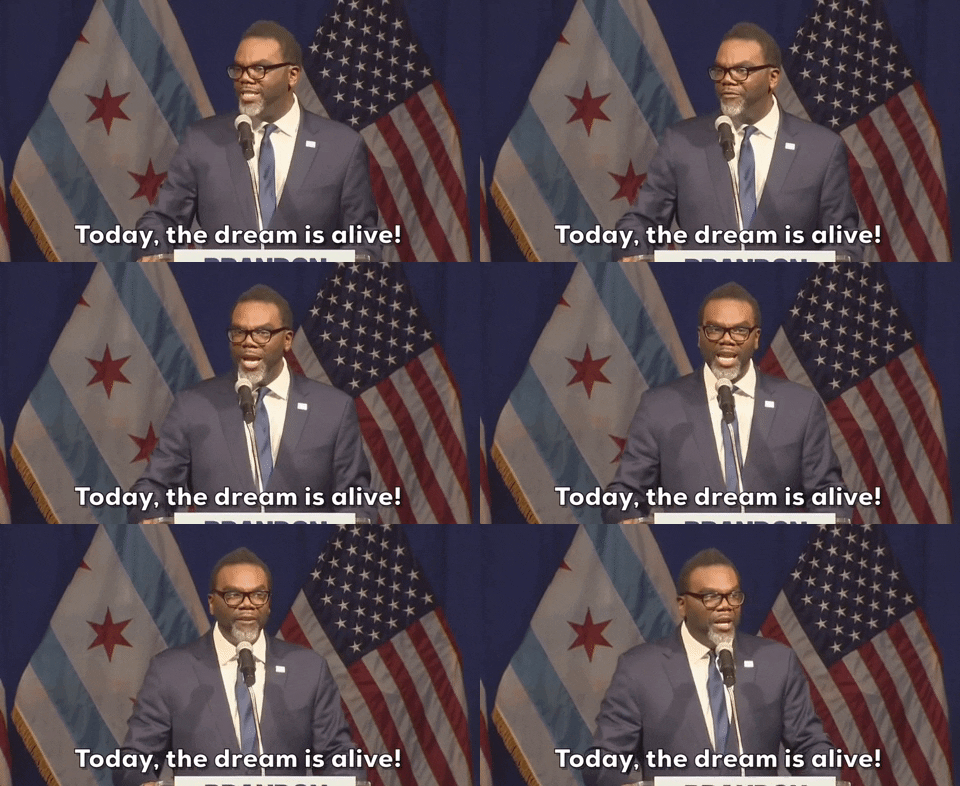
While celebrating the midpoint of his term, @ChicagosMayor sat with Dr. Byron Brazier of Apostolic Church of God and predictably doubled down on his divisive race rhetoric while challenging the audience to name a condition in Chicago he had caused to become worse.
Mr. Mayor, here are 10 ways you have worsened life for Chicago residents:
• You ignored poor residents by giving special treatment to illegals, spending $600M on housing, and healthcare to sustain them and allowed CPS schools to spend $210-400M more.
• You denied poor students a better chance at an education at the CTU’s bidding by deliberately working to destroy public charter and magnet school alternatives to failing neighborhood schools.
• You denied Supt Snelling enough officers to respond all High Priority 911 calls (only half are responded to), to clear cases (major crime arrest rate is 6%) and protect witnesses and victims.
• You left residents in a lurch by cancelling ShotSpotter. To date, more than 42 Chicagoans have been shot — a majority Black — for which there was no emergency CPD response.
• You neglect riders who use the CTA, denying adequate police protection on an increasingly dangerous transit system. Mayor’s police detail has almost as many officers as the CTA.
• You have taken no action to improve drinking water for poor families with simple water filters to remove poisonous lead and “Forever Chemicals” from unfiltered water.
• You have hurt Chicago businesses, by imposing costly and needless business mandates.
• You have disregarded the housing needs of city residents, so far preferring to award connected developers with $324 million in subsidies and producing a meager 505 housing units.
• You have ignored the needs of Chicagoans who suffer from mental illness by reopening only 3 of the 12 mental health facilities closed by Rahm Emanuel.
• You have provided no relief from the Speed & Red Light Camera & Parking Ticket system, that disproportionately punishes the Black community and has bankrupted thousands of families, while adding more speed cameras.
Chicago’s population is its smallest in 100 years, the biggest exodus the last 20 years being Blacks, overwhelmingly middle-income families with children. They left because of high taxes, lack of quality schools and crime, for which CTU leaders are in part responsible.
Patrick J. Buchanan was systematically excluded from American political life because he represented a serious, coherent alternative to the ruling, uniparty consensus.
Since 1945, American politics steadily narrowed into a managed opposition, in which both parties accepted the moral and ideological framework of the emerging liberal postwar order. The real debate was no longer over ultimate ends, but over the most effective means: how to “spread democracy” and maintain global hegemony, not for the good of the nation but for the benefit of an increasingly cosmopolitan “American” elite detached from the people it claimed to represent.
Market liberalization became a tool of imperial projection rather than national prosperity. Deindustrialization, mass immigration, the offshoring of production, and the outsourcing of labor were recast as moral imperatives or economic inevitabilities, even as they hollowed out the American heartland and displaced the very people who once defined it.
More to the point, it was his vision of America and the clarity with which he foresaw the consequences of this postwar consensus that made him intolerable to the emerging post-American elite. He spoke of the nation not as an abstraction or a marketplace, but as a flesh-and-blood people, rooted in ancestry, faith, and memory. He rejected the illusion that the United States was merely a collection of consumers, bound by commerce or shortsighted political slogans, or a crusading empire tasked with exporting “democracy” at gunpoint.
For him, the nation was not a theory but a living continuity, a people bound by lineage and duty, grounded in soil, sacrifice, and shared destiny. The very word natio, from the Latin, means a people brought forth. It implied inheritance, obligation, and the sacred bonds that tie the living to both the dead and the unborn. America, in Pat’s vision, was a homeland to be preserved, not an ideological franchise to be sacrificed for the short-term financial gain of a few.
He rejected the managed decline offered by the bipartisan elite and called instead for a national renewal grounded in ethnocultural continuity and a restrained, interest-based foreign policy.
And for this most “grievous sin” of putting America and its people first, he was labeled an extremist, smeared as a “racist,” removed from the institutions he had served, and denounced by those who feared not his irrelevance, but his appeal.
His ideas were never radical—and they remain anything but today. They resonated with a public whose working and middle classes had been gutted by “free trade,” whose culture had been hollowed out by liberal modernity, and whose sense of peoplehood had been replaced with emptyheaded consumerism.
In his book, “The Death of the West,” Buchanan laid out a vision rooted in demographic stability, national sovereignty, and a foreign policy aligned with American interests rather than ideological crusades. He warned that demographic transformation was not a benign shift but a civilizational rupture. He understood that mass immigration was not pragmatic but utopian, that multiculturalism would fracture into tribalism, and that global capitalism would dissolve the nation it claimed to uplift.
Buchanan’s campaigns in 1992 and 1996 were not failures. In New Hampshire, he secured nearly 40 percent of the vote against a sitting president. His message rallied a forgotten America—factory workers, veterans, and disaffected youth—who no longer saw themselves represented by either party. His politics fused economic nationalism with social traditionalism. He sought to protect American labor, restore national cohesion, and disentangle the country from entanglements that served foreign interests. He spoke of America as a home, not a transactional outpost for global capital. For this, he was branded a “fascist,” a reactionary, and a threat to “our democracy.”
But Buchanan was not a populist agitator. He was a statesman in the truest sense: historically literate, morally serious, and loyal to his people. From his time in the Nixon and Reagan administrations, he emerged with a clear-eyed view of the realignment underway. He saw that the end of the Cold War would not bring peace, but would instead redirect imperial energy inward, toward the management of dissent and the redefinition of American identity.
He saw that the postwar conservative movement, under the influence of William F. Buckley’s National Review, had cut itself off from its roots. It had abandoned its ethnic, cultural, and religious foundations in exchange for market worship, foreign interventionism, and an unthinking alliance with the global democratic project.
Buchanan understood that the heart and soul of America were at stake, and for that reason he did not merely offer tacit dissent. He exposed the entire realignment for the fraud it was. He saw neoconservatives not as allies, but as usurpers—men without loyalty to the historic American nation, who hijacked conservatism and turned it into a vehicle for perpetual war abroad and ideological capitulation at home. He rejected the illusion that American greatness could be sustained through endless interventions or a borderless economic order.
That was the heart of Buchanan’s message: America is not an idea. It is a people, a civilization, a legacy. And it can be lost. In “A Republic, Not an Empire,” he made one of the most prescient arguments of the post-Cold War era. He called for an end to imperial overreach. He warned that terrorism would follow from entanglements in the Middle East. He predicted the Second Gulf War (The Iraq War) and described its likely consequences years before it began.
And for this, he was purged.
The media labeled him dangerous. His every speech was parsed for “code words.” His networks dropped him. MSNBC fired him for discussing demographic replacement. The Republican elite abandoned him. Religious leaders who agreed with him in private refused to support him in public. His 2000 Reform Party bid, which briefly showed promise, was crippled by internal sabotage and institutional silence.
And yet, everything he warned of came to pass.
The endless wars. The border collapse. The demographic upheaval. The erasure of national sovereignty. The hollowing out of the Right, which still cannot speak honestly about identity, culture, or who America is for. Today’s populist uprisings, the revolt against globalism, the rediscovery of nationalism, these are not new movements. They are echoes of Buchanan’s voice, of a movement silenced but not forgotten by those whose loyalty remains with the nation, not the regime.
Patrick J. Buchanan did not fail the American people. The system did. It chose capital over kin, empire over home, and ideology over identity. It cast out its prophets so that it could rule unchallenged and without reflection. But truth endures. Memory survives. And the questions Buchanan raised are more urgent now than ever before.
The question is no longer whether he was right.
The question is whether anyone will finish what he began.
You know, it’s funny when people hear that Pope Leo XIV has a math degree, taught physics, and wrote a thesis on monastic leadership, they act like it’s some wild plot twist.
The Catholic Church has always been low-key obsessed with education. I mean, did you know nearly every pope since the Renaissance has had a PhD? Benedict XVI had five. Cardinals today basically need doctorate-level expertise to even get a seat at the table. Leo XIV isn’t an outlier; he’s following a 2,000-year-old playbook where faith and reason are BFFs. This is the same institution that gave us the Big Bang theory (thanks to a Jesuit priest, Georges Lemaître) and the guy who invented genetics (shoutout to Gregor Mendel, the pea-plant-obsessed Augustinian friar). Yet somehow, we still think of the Church as just incense and hymns.
The Church’s duality; defending doctrinal tradition while pioneering intellectual frontiers, is its defining paradox. Consider the Vatican’s astronomical observatory, which has operated since 1582, or the Pontifical Academy of Sciences, which has included members like Hawking and Einstein.
Let’s break it down. Those monks and nuns you picture copying manuscripts in candlelit monasteries? They weren’t just praying, they were preserving ancient Greek philosophy, advancing math, and basically saving Western civilisation during the Dark Ages. Fast-forward to today, and the Vatican still runs its own space telescope (yes, really, Jesuit brothers track asteroids). The Chúrch condemned Galileo, sure, but now it funds ethical stem-cell research and partners with IBM on AI ethics. It’s like the ultimate comeback story: “Oops, we messed up on heliocentrism; here’s a think tank on quantum physics.”
And let’s talk about those religious orders. Jesuits? They basically invented the modern university system. The Jesuits founded in 1540, by a chap called Ignatius Loyala, (half monk, half soldier) ran over 800 universities globally. Franciscans gave us Occam’s Razor; you know, that “simplest explanation is best” rule you learned in science class? That came from a 14th-century friar who loved logic more than the Pope loved his fancy hat. The Dominicans had Thomas Aquinas, who merged Aristotle’s philosophy with theology. Augustinians, Leo XIV’s crew, were all about community and critical thinking, traits he took to Peru, where he spent 20 years teaching in slums while quietly holding dual citizenship. The guy’s got more layers than a medieval manuscript.
But here’s the upper-cut: the Church thrives on this weird paradox. It’s conservative enough to make your grandma nod approvingly (“No women priests? Classic.”) but progressive enough to have a Pope who trash-talks eco deniers and slams border politics. Leo XIV fits right in; he’s a Republican primary voter who also called Trump’s family separations “illicit,” a social media critic who warns bishops not to be divisive online. It’s like the Church says, “We’ll debate evolution with Darwinians by day and chant Latin psalms by night and we’ll look good doing both.”
So next time someone acts shocked that a pope knows quantum physics or tweets about refugees, just smile. The Catholic Church has been playing 4D chess with knowledge for centuries. It’s not a relic; it’s a living library, where friars argue about black holes over breakfast and nuns run coding bootcamps. Leo XIV? He’s just the latest chapter in a story where faith doesn’t fear science…It fuels it.
YEP… It took 50 years, but the truth is finally out.
The Warren Commission lied. The government covered it up. JFK’s assassination was not the act of a lone gunman — it was a full-blown military intelligence coup.
SCREW YOU, LBJ. I always smelled a Rat, and you were the Big one. JFK had signed The Tonkin Act, effecting pulling all troops out of Southeast Asia-(Vietnam).
Lady Byrd Johnson owned control and interest in Kellog/ Brown & Root, later merge KBR, INC, Halliburton, Inc. who made most of the munitions the United States Military used to fight the Vietnam War. Just one small piece of the puzzle. Part – The Military Industrial Complex.
The day after JFK was assassinated, President Lyndon Baines Johnson rescinded the Tonkin Act, giving President Lyndon Baines Johnson authority to increase involvement in the war between North and South Vietnam.
Declassified documents released January 30, 2025, expose what many of us have long suspected: JFK was murdered by the very system he tried to dismantle. He challenged the Federal Reserve, the CIA, and the shadow elite. He signed Executive Order 11110 to return to sound money. Within months, he was dead. And what followed was decades of lies, cover-ups, and silencing of truth.
The files reveal CIA death squads (Operation Execute), a “JFK hit memo” from the Federal Reserve, and names like E. Howard Hunt, David Atlee Phillips, and even George H.W. Bush linked to that dark day in Dallas. Even more chilling — JFK knew they were coming for him. A newly surfaced audio tape confirms it. “They’ll come for me soon… But if I fall, let history know I tried to warn them.”
Remind you of anyone???
The parallels to President Donald J. Trump are right in front of us. Two men, decades apart, both targeted by the same Deep State machine. Both tried to return power to the people. Both exposed the lies of the industrial and financial slavery system. And both paid — or are paying — the price for defying the system.
JFK’s death was the day America lost its innocence. But January 30, 2025, was the day the veil was finally lifted.
History isn’t just repeating — it’s screaming at us. The question is: are we listening now???
Pope Leo XIV 1975: This man made a shocking decision: He rejected Harvard Law to serve Peru’s poorest villages Now, he’s the 267th Pope
Speaks ancient Incan
Walked 8hrs to help the poor
First American born ever
The untold story of new elected Pope Robert Prevost: In 1975 Robert Prevost was at the top of his game. Chicago math teacher.Devout Catholic.Accepted into Harvard Law. He had everything a young man could dream of, But then—he made a decision that no one saw coming. He said no to Harvard No to a six-figure future. No to fame. No to comfort And yes—to something few dare to choose: A life of complete surrender. He joined a missionary group and moved to Peru. Not to the cities. Not to the tourist spots . But to the most remote villages—where children die from treatable diseases. And families walk miles just for clean water. There were no roads. No running water. No WiFi Just mountains. Silence And poverty. But he embraced it like home Robert didn’t just live among the people. He became one of them
Learned Quechua—the sacred language of the Incas
Carried food on foot for days
Slept on dirt floors with the villagers
Prayed under the stars His acts weren’t broadcasted.But they echoed through the Andes Bishops noticed Priests noticed And eventually—the Vatican noticed They called him back to lead his entire Augustinian order. From serving a village. To overseeing 2,800 brothers in over 40 countries. Still—he kept his same sandals Still—he walked with the poor Still—he rejected luxury Then came the call that changed everything: Rome wanted him closer. In 2020 He was appointed Archbishop and assigned to govern other bishops globally. It was rare. But Robert had never chased tradition. He wasn’t just fluent in Latin or Canon Law. He was fluent in compassion In humility In listening In presence The Vatican didn’t just see a priest. They saw a leader with soul. On September 30, 2023. Pope Francis made it official: Robert Prevost was named a Cardinal. Just one step below the Pope And then… in 2025 History was made. For the first time ever An American A former math teacher A missionary to the forgotten Was elevated as the 267th Pope of the Catholic Church
And he didn’t forget the people who shaped him. To this day. Pope Robert still returns to the same villages. Still prays in Quechua Still sits on dirt floors Still holds the hands of the elderly in silence Because leadership he believes: Is about presence not position The world is obsessed with power. But Robert Prevost proves:
Titles mean nothing without service
Knowledge is useless without love
And faith—without sacrifice—is noise He turned down the world. And changed it instead.
For context, Pope Leo the 14th was born in Chicago, his father is of French and Italian descent, while his mother is of Spanish descent.
He has also been largely based in Peru with the Spanish speaking and other indigenous people for over 40 years so I am not panicking, I think it is normal for people to have conspiracies, especially now but I’m not worried yet.
He’s had years and years of experiencing life with those indigenous people, he’s a missionary so I wouldn’t connect him with the likes of Trump or what the other average American people are like because he’s been disconnected from them for the longest time – I will remain positive until I see otherwise.
Amazingly our Pope Leo the 14th chose the name Leo the 14th because of Pope Leo the 13th who died 7-20-1903 and he believed in what he stood for. 52 years and 56 days later Pope Leo the 14th was born. His family and friends said he knew since very early age that he was going to be a Priest. That while his 2 brothers played cops and robbers, he played Priest using his mom’s ironing board as a alter covered in a table cloth and used the candy Necco Wafers as the host. This at 5 years old? I believe in reincarnation and this is mind blowing. Pope Leo the 13th was the longest reign of any Pope and he did alot of God’s work in the world. He passed from pneumonia and I think he came back to finish God’s work. We need togetherness in this World now. We need a real World leader, and I think the world just got one. God Bless you Pope Leo the 14th.
It’s also important to know that his studies were with the Augustan order, meaning he’s learnt to be like them from a young age, in my previous post I touched on what they believe in, sharing, community, working together towards the same God…
Also nice to note that he’s a mathematician and worked as a teacher in Peru outside of his official religious work. The director of the Holy See says that the name is a “direct reference to Leo XIII,” the last pope to take the name Leo.
Pope Leo XIII, who headed the Catholic Church from 1878 until his death in 1903, was a founding figure of the Catholic social justice tradition. He is known for his encyclical “Rerum Novarum,” meaning “Of New Things,” which is “considered to be the foundation for the modern social doctrine of the Church. – This is for the people wondering why he chose the name Leo.
He also said in his opening speech that he is determined to continue the work that pope Francis and there’s a large similarity between the two as they both come from orders liked to simplicity, that are people centered.
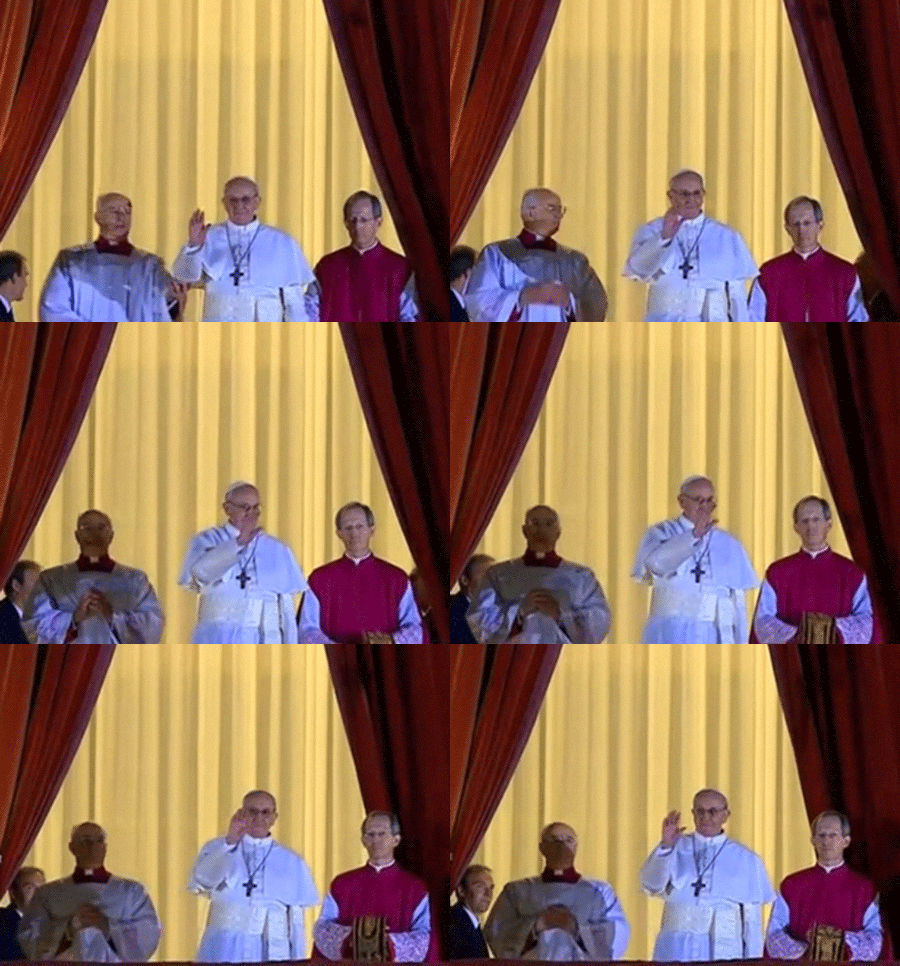
The US media is outraged as the first ever new American Pope, Leo XIV (14th) gave his first Papal Address in Italian and Spanish, not “English”. The speech was centered about the need for “Unity and peace on Earth”.
I have great hope in our new Pope.. The world and the church must change. It will not change from the outside or from hate… it will change from within. Be the Love.
Quote from Pope Leo X1V.
” Brothers, sisters… I speak to you, especially to those who no longer believe, no longer hope, no longer pray, because they think God has left.
To those who are fed up with scandals, with misused power, with the silence of a Church that sometimes seems more like a palace than a home.
I, too, was angry with God. I, too, saw good people die, children suffer, grandparents cry without medicine. And yes… there were days when I prayed and only felt an echo.
But then I discovered something: God doesn’t shout. God whispers. And sometimes He whispers from the mud, from pain, from a grandmother who feeds you without having anything.
I don’t come to offer you perfect faith. I come to tell you that faith is a walk with stones, puddles, and unexpected hugs.
I’m not asking you to believe in everything. I’m asking you not to close the door. Give a chance to the God who waits for you without judgment.
I’m just a priest who saw God in the smile of a woman who lost her son… and yet she cooked for others.
That changed me.
So if you’re broken, if you don’t believe, if you’re tired of the lies… come anyway. With your anger, your doubt, your dirty backpack. No one here will ask you for a VIP card.
Because this Church, as long as I breathe, will be a home for the homeless, and a rest for the weary.
God doesn’t need soldiers. He needs brothers.
And you, yes, you… are one of them.”
Robert Prevost (Leo XIV)
POPE LEO’S SILENCE SPEAKS VOLUMES.
Pope Leo the 14th might just be making history as the first black Pope! 🌍 But he’s keeping us all guessing with his silence.
His family background has some surprising details, and everyone is talking about it.
🕊️ What his family history reveals 🗣️ Why his silence is causing a buzz 🌎 How this impacts black Catholics
Talk about a momentous shift! Did you know his brother says they never identified as people of colour? 🤔
Pope Leo 14th is definitely not a Liberal. He is known as centrist who leans right.
👉He is passionate about helping the Poor and the migrants and willing to listen to each and every opinion of the community. 👉But he is strict when it comes to Church laws, doctrine and Moral Teachings. He opposes the ordination to a woman and he criticized western LGBTQ lifestyle and ideology.
👉He opposed a government plan to add teachings on gender in schools. 🗣️“The promotion of gender ideology is confusing, because it seeks to create genders that don’t exist,” he told local news media..
Pope LEO 14th elected on the feast of Our Lady of Pompei, who emphasized the weaponry we need against hate. 8th of May also commemorates the presence of St Michael on Mount Gargano. It was a sign to continue the work of Pope Leo 13th to coordinate the Militant Church behind the great general St Michael the archangel which is so HUMBLE that brings with him the presence of God which instills PEACE.
What are your thoughts on how this could change the Church’s future?
These are from a book called Disorder in the American Courts and are things people actually said in court, word for word, taken down and published by court reporters that had the torment of staying calm while the exchanges were taking place.
ATTORNEY: What was the first thing your husband said to you that morning? WITNESS: He said, ‘Where am I, Cathy?’ ATTORNEY: And why did that upset you? WITNESS: My name is Susan!
ATTORNEY: What gear were you in at the moment of the impact? WITNESS: Gucci sweats and Reeboks.
ATTORNEY: Are you sexually active? WITNESS: No, I just lie there.
ATTORNEY: What is your date of birth? WITNESS: July 18th. ATTORNEY: What year? WITNESS: Every year.
ATTORNEY: How old is your son, the one living with you? WITNESS: Thirty-eight or thirty-five, I can’t remember which. ATTORNEY: How long has he lived with you? WITNESS: Forty-five years.
ATTORNEY: This myasthenia gravis, does it affect your memory at all? WITNESS: Yes. ATTORNEY: And in what ways does it affect your memory? WITNESS: I forget.. ATTORNEY: You forget? Can you give us an example of something you forgot?
ATTORNEY: Now doctor, isn’t it true that when a person dies in his sleep, he doesn’t know about it until the next morning? WITNESS: Did you actually pass the bar exam?
ATTORNEY: The youngest son, the 20-year-old, how old is he? WITNESS: He’s 20, much like your IQ.
ATTORNEY: Were you present when your picture was taken? WITNESS: Are you shitting me?
ATTORNEY: So the date of conception (of the baby) was August 8th? WITNESS: Yes. ATTORNEY: And what were you doing at that time? WITNESS: Getting laid
ATTORNEY: She had three children , right? WITNESS: Yes. ATTORNEY: How many were boys? WITNESS: None. ATTORNEY: Were there any girls? WITNESS: Your Honor, I think I need a different attorney. Can I get a new attorney?
ATTORNEY: How was your first marriage terminated? WITNESS: By death.. ATTORNEY: And by whose death was it terminated? WITNESS: Take a guess.
ATTORNEY: Can you describe the individual? WITNESS: He was about medium height and had a beard ATTORNEY: Was this a male or a female? WITNESS: Unless the Circus was in town I’m going with male.
ATTORNEY: Is your appearance here this morning pursuant to a deposition notice which I sent to your attorney? WITNESS: No, this is how I dress when I go to work.
ATTORNEY: Doctor , how many of your autopsies have you performed on dead people? WITNESS: All of them. The live ones put up too much of a fight.
ATTORNEY: ALL your responses MUST be oral, OK? What school did you go to? WITNESS: Oral…
ATTORNEY: Do you recall the time that you examined the body? WITNESS: The autopsy started around 8:30 PM ATTORNEY: And Mr. Denton was dead at the time? WITNESS: If not, he was by the time I finished.
ATTORNEY: Are you qualified to give a urine sample? WITNESS: Are you qualified to ask that question?
And last:
ATTORNEY: Doctor, before you performed the autopsy, did you check for a pulse? WITNESS: No. ATTORNEY: Did you check for blood pressure? WITNESS: No. ATTORNEY: Did you check for breathing? WITNESS: No.. ATTORNEY: So, then it is possible that the patient was alive when you began the autopsy? WITNESS: No. ATTORNEY: How can you be so sure, Doctor? WITNESS: Because his brain was sitting on my desk in a jar. ATTORNEY: I see, but could the patient have still been alive, nevertheless? WITNESS: Yes, it is possible that he could have been alive and practicing law.
🚨Chevron’s Exit From Venezuela By May 27th, 2025 Threatens US Energy Independence And Hands China A Strategic Victory 🚨
We should as a nation be concerned about the growth of China in our hemisphere. South America in particular Venezuela is politically important.
How China is about to grow even more powerful in the Western Hemisphere, control Latin America, kill thousands of American jobs and have dominance over Venezuela’s oil unless President Trump extends the licenses for American oil companies in Venezuela by May 27th
@realDonaldTrump @JDVance @SecRubio @marcorubio
On May 27, 2025, @Chevron, the last major American oil company operating in Venezuela, will be forced to wind down its operations in the South American nation, marking a significant blow to U.S. energy interests and a dangerous step backward for American energy independence. This deadline, set by the U.S. Treasury Department under President Donald Trump’s administration @SecScottBessent, stems from the revocation of Chevron’s OFAC-issued license to operate, move tied to escalating sanctions against Venezuela’s Maduro regime.
While the intent behind these sanctions was to punish what many view as a corrupt and anti-democratic government, it is clear the ultimate consequences of this license revocation could undermine America’s strategic position in the global energy market, cede critical influence and power to China, and weaken our nation’s ability to secure affordable, reliable energy for the American people and initiate another migrant crisis at our borders. Rather than America First, this policy shift signals a China First approach that should be avoided at all costs.
For over a century, Chevron has been a cornerstone of American energy presence in Venezuela, a country sitting atop the world’s largest proven oil reserves—some 300 billion barrels. Chevron’s joint ventures with Venezuela’s state-owned PDVSA produceapproximately 242,000 barrels per day, accounting for roughly a quarter of Venezuela’s total oil output. In 2024 alone, Venezuelan crude made up 13% of imports to U.S. Gulf Coast refineries, providing a vital supply of heavy crude to American refiners like Valero Energy, PBF Energy, Phillips 66, and ExxonMobil which is simply unavailable in large, commercially viable quantities from US domestic oil producers.
This steady flow of oil has helped stabilize domestic fuel prices and ensured that American consumers aren’t left at the mercy of volatile global markets. But, with Chevron’s forced exit, this critical supply chain is at risk, threatening higher energy costs for American families and businesses at a time when economic stability is paramount and at a time where a global economic showdown between the US and China is festering.
The decision to push Chevron out of Venezuela is rooted in the Trump administration’s aggressive stance against Nicolas Maduro’s regime, which has been accused of electoral fraud, human rights abuses, and U.S. demands on the repatriation of illegal aliens.
On March 4, 2025, the Trump administration replaced Chevron’s General License 41 with a wind-down order, extended to May 27th via General License 41B, signaling a return to the “maximum pressure” sanctions of Trump’s first term – arguably one of the few foreign policy failures of the first Trump administration. Additionally, a 25% tariff on countries purchasing Venezuelan oil, effective April 2nd, aims to choke off Maduro’s revenue streams. While these measures may hurt Maduro’s coffers, they are much more likely to simply drive Venezuela’s oil trade underground, reducing transparency and empowering adversaries like China to fill the void left by American companies.
Why would we want to give China the upper hand and allow them to control Venezuela’s oil reserves when we can use these reserves to our benefit and negotiate a deal with Venezuela that allows for illegal alien repatriation and US control over Venezuelan oil with strict stipulations that President Trump and his special envoy Ric Grenell @RichardGrenell can implement and control?
Grenell’s recent visit to Venezuela proved that @NicolasMaduro Maduro, despite his flaws, has a deep respect for President Trump and is willing to comply with illegal alien repatriation and hostage releases. Moreover, he has demonstrated a preference for doing business with American controlled companies over Chinese, CCP controlled companies. Why would we want to further stoke conflict with Venezuela when we can take control of their oil reserves to benefit our long term goal of energy independence?
China, already the largest buyer of Venezuelan oil, stands to gain the most from Chevron’s departure. In February 2025, China imported 503,000 barrels per day—55% of Venezuela’s total exports—often at steep discounts due to sanctions. With Chevron out, Venezuela’s Vice President Delcy Rodríguez has actively courted Chinese investment, and even met with Chinese officials in April to secure increased oil purchases and supplies of diluent needed to process Venezuela’s tar-like crude.
This move not only strengthens China’s grip on Venezuela’s vast oil reserves, but also enhances Beijing’s influence in America’s backyard, just across the newly proclaimed Gulf of America. As Chevron CEO Mike Wirth recently warned, if American companies are forced out, “the oil production continues, and American companies are replaced” by Chinese and Russian drillers who offer less favorable terms to Maduro but secure strategic footholds in the Western Hemisphere.
Allowing China and Russia to have an increased presence and economic control in the Western Hemisphere poses a national security threat, and it contradicts President Trump and the State Department’s recent move to take back the Panama Canal for the explicit purpose of countering Chinese influence in Central and South America and the Panama Canal Zone.
The implications for American energy independence are dire. The United States, the world’s largest oil producer, has championed energy dominance under Trump’s “America First” agenda. Yet, losing access to Venezuelan crude—a reliable, geographically proximate source that compliments, rather than competes with domestic production—could increase U.S. reliance on more distant suppliers like Saudi Arabia or Iraq, raising procurement costs and exposing American refiners to geopolitical risks due to the perpetual state of chaos and violence in the Middle East.
U.S. Energy Secretary Chris Wright @SecretaryWright has downplayed the impact of China gaining more control over oil exports in Venezuela, claiming “small interruptions from other nations” won’t affect global supply. However, analysts at TD Cowen have recently warned that Chevron’s exit from Venezuela could spike crude prices, hitting U.S. Gulf Coast refineries hard and potentially driving up gasoline and diesel costs for American consumers. At a time where inflation remains a current concern, as the US continues its efforts to recover from Biden’s economy, this is a self-inflicted wound we cannot afford.
Additionally, why should America forgo the tens of thousands of well-paying jobs that will be created by allowing American companies to do business with Venezuela? These are American jobs in oil-field services, refining, and trading that will instead be sacrificed, once again, to China if the licenses to Americans in the oil industry are not extended in Venezuela.
These are American jobs in oil-field services, refining, and trading that will instead be sacrificed, once again, to China if the licenses to Americans in the oil industry are not extended in Venezuela.
Moreover, Chevron’s departure risks undermining the transparency and efficiency it brought to Venezuela’s oil sector. The “Chevron model,” which paired joint ventures with PDVSA with strict oversight to curb corruption, boosted Venezuelan production by 70,000 barrels per day in 2023 alone. Without Chevron’s expertise and capital, Venezuela’s crumbling energy infrastructure could deteriorate further, reducing output and forcing Maduro to rely on opaque deals with Chinese firms controlled by the CCP, or shadow fleets, as seen during earlier sanction periods.
These shadow oil fleets operate with a high degree of non-transparency and evade sanctions and regulations. These ships, often older and flagged in countries outside of Western sanctions, are used to circumvent price caps and other restrictions imposed on Russian oil exports.
This will not only enrich corrupt intermediaries, but it also diminishes U.S. leverage over Venezuela’s oil market, handing China a free pass to dictate the terms.
From an America First perspective, maintaining a strong U.S. presence in Venezuela’s oil sector is not about coddling Maduro, but about securing our national interests. Chevron’s operations have kept American companies at the forefront, ensuring that the United States—not China or Russia—benefits from Venezuela’s vast resources. By forcing Chevron out, we risk ceding this strategic asset to adversaries who will use it to fuel their own economic and geopolitical ambitions.
As the looming May 27th deadline approaches, the United States must reconsider this path. An extension of Chevron’s, and other American’s licenses will allow for the Trump administration to have a pragmatic approach with strategic engagement, ensuring that American companies, not Chinese companies, shape the future of Venezuela’s oil industry.
The stakes are high. Losing ground in Venezuela not only threatens our energy security but also emboldens China to challenge U.S. leadership in the Western Hemisphere. For the sake of American workers, consumers, national security, and our global standing, we must prioritize energy independence and keep Chevron and other American oil companies in the game to block China from turning Venezuela into their personal oil depot.
President Trump’s energy strategy is about dominance—drill, baby, drill, and keep our adversaries at bay. Letting Chevron leave Venezuela is a step backward, and we can’t afford to lose ground to Communist China.
The Wheels On The Bus Fell Off: JB Pritzker’s “EV flop”
CHICAGO — Back in June 2023, JB Pritzker, Dick Durbin, Tammy Duckworth, and a crowd of lawmakers flocked to Joliet, patting themselves on the back as they cut the ribbon on Lion Electric’s electric vehicle plant. Fast forward two years and Lion Electric’s disastrous tenure in Illinois is coming to an end. The results of Pritzker’s “EV Flop” speak for themselves: December 2024: The wheels on the bus fell off as Lion Electric shuttered their Joliet plant and laid off hundreds across the United States and Canada
Last week: Quebec announced it would NOT invest $24 million to help Lion relaunch
May 15th: The company’s equipment goes on the auction block, and liquidation seems all but certain
Don’t forget: Last December, Pritzker announced that $19.9 million of our taxpayer dollars would be used to build 70 electric school buses in nine school districts — over $284,000 per bus.










 Roy F. McCampbell's Blog
Roy F McCampbell Blog makes number 4 on 15 Best Political Satire Blogs and Websites in 2025
Roy F McCampbell Blog makes number 4 on 15 Best Political Satire Blogs and Websites in 2025
https://bloggers.feedspot.com/political_satire_blogs/
Share this: