

The federal Individuals with Disabilities Education Act guarantees special ed students extra help no matter how much it costs.
Can IEP Teams Say “No” To Special Education Services Based on Money Woes? No, No and No!
By Michelle Ball, California Education Attorney for Students since 1995
Oftentimes parents attend an Individualized Education Program (IEP) meeting, and although their child needs additional services to meet his or her goals, can be denied needed services based on reasons such as: “no funding,” or “we just don’t have the resources,” or “that is not available here as there are no staff.” Are these legitimate reasons to deny a student services that will meet their unique needs? No!
The whole special education system can be very overwhelming for parents and they often “trust” the IEP team to guide them on what their child should or should not receive as far as services, placement, and education. Parents may also simply accept an IEP team denial of services based on money woes of the school district. However, regardless of the funding problems school districts seem to be having right now, they cannot deny special education services based on those issues. If a student requires a service (e.g. resource class, speech therapy, or a one-on-one aide) to receive an appropriate education to meet their unique needs, the district should provide the service.
If a district wants to deny services, they have to do so legitimately. In other words, do a thorough assessment to evaluate, and prove the service is not needed. If they do this, they may be able to “legitimately” defend themselves on a decision to reduce or deny services. However, the bottom line is that many districts still will flat out say that “we can’t afford speech and language therapy,” and tell the parent to take a hike. Sorry to say, but that is not legitimate.
If the district does not have staff to provide a service such as speech and language therapy, and the special needs student requires that service, the district has to provide the service another way. For example, the district can pay a private therapist to deliver the speech and language therapy off site and can also pay for transportation to and from the therapy. The district can’t just say the child won’t receive the service as they don’t have the staff. If the child needs the service to meet their unique needs, it needs to be provided one way or another.
This is one reason why recording IEP meetings is so crucial. Often parents can document denials based on lack of money simply by recording the meeting. When a school/district representative says “we don’t offer speech and language due to the budget crisis,” or words to that effect, the parents have a valid argument which they can later raise in a due process hearing to overcome the denial.
If a school or district is denying services based on money, parents need to stand up and say that is an unacceptable reason for the denial and demand the service be provided.
The federal Individuals with Disabilities Education Act guarantees special ed students extra help no matter how much it costs.

Posted in Autism, Education, Schiller Park School District 81, Special Education
Tagged IDEA, Special Education
Leave a comment
Girl Scout Cookies and Wine Pairings

It’s our favorite time of year once again—Girl Scout Cookies are here! We’ve added new editors’ picks of great beers to celebrate the season with and a collection of cookie-and-beer pairings we compiled from around the web. Let’s hear your favorite pairings!
https://beerandbrewing.com/VKm9gisAAF-R_rap/article/beer-pairings-for-girl-scout-cookies-2016-update
Share this:

New Bill Just Introduced in Springfield to Expand Gambling

The Illinois General Assembly gambling bill includes six new casinos in Chicago, Lake County, Rockford, South Suburbs, Danville, Williamson County, slots at tracks
Share this:

Ald. Ameya Pawar Throws First Official Hat in Democratic Ring for Illinois Governor

For a sitting, massively rich Republican governor who just added $50 million in personal cash to his re-election campaign, a sitting Chicago alderman with a measly $50,000 probably doesn’t seem much of a threat.And perhaps pro-business, union-critic Governor Bruce Rauner has nothing to worry about from 47th Ward Alderman Ameya Pawar, a liberal (progressive, if you prefer) who has decided to take him on.
Pawar, 36, made it official as of Tuesday.
“I am running because we’ve gotten to a point in this country where wealth worship is the only qualifier for public office, trumping public policy. Chopping benefits or declaring strategic bankruptcy or selling companies off in pieces for profit is somehow seen as the secret ingredient for an Illinois utopia,” said Pawar.
The case he plans to make? In his words, “Government should be aspirational. People like to tell us how terrible government is but it was the federal government after the Great Depression that created the middle class. And sent a man to the moon.”
Pawar, an Indian-American, who holds three graduate degrees in urban planning, disaster management and social policy, is accustomed to being discounted.
It was in the Spring of 2011 in the Machine fortress 47th ward that Pawar was written off by a pile of prominent progressives like Mike Quigley, Forrest Claypool, Heather Steans, Bridget Gainer, and last but not least, Rahm Emanuel whose Ravenswood house is in the ward. The whole pack of them went with retiring alderman Eugene Schulter’s anointed pick, Tom O’Donnell.
But Pawar, earnest and intelligent, outworked and outguessed them all, knocked on every door, and resonated with fed-up homeowners who complained they hadn’t seen or heard a new idea from their politicos in a long, long time.
And so Pawar beat the machine and the Progressives with 50.8 percent of the vote, enough to win free and clear without a runoff.
The best piece written about his victory was done by The Reader’s Ben Joravsky:
It’s a great read and, following the general election of 2016 where we once again saw conventional political wisdom upended, it’s a reminder that we sometimes fail to see the rebellion that’s right in front of us.
Pawar, for his part, has tried to be a consensus builder in City Council. Sometimes to his credit, sometimes not. But he has worked hard, been thoughtful, and so far, is still idealistic enough not to be under the yoke of the Mayor nor a member of the Old Guard. Nor is he a full partner of the Progressive Caucus.
One of his greatest fights has been in behalf of quality public high schools in his ward.
Does Pawar have the wherewithal to go up against the potential primary election cash of Democratic billionaires (Chris Kennedy & JB Pritzker)? Or to take on, maybe, a couple of state senators (Kwame Raoul & Andy Manar), a pair of congresswomen (Robin Kelly & Cheri Bustos) or an Attorney General named Madigan?
He’s decided to try.
And so, as of early Tuesday morning, Ameya Pawar tells Roy F. McCampbell he’s in.
Share this:

Posted in Economy, Education, Elections, Finance, Franklin Park, Horse Racing, Illinois Pensions, News, O'Hare Noise, Schiller Park, Schiller Park Commentaries, Taxation, Union
Tagged governor, Illinois, Pawar
Leave a comment
Is Illinois Going to Have A Budget Soon ?

A plan to end a two-year Illinois budget standoff negotiated in the Senate — which likely includes an income tax increase as well as items on Gov. Bruce Rauner’s agenda — could get a vote in Springfield as early as Monday, a leading Republican senator said Sunday.
The deal was still shaping up over the weekend after weeks of talks between Democratic Senate President John Cullerton and GOP Leader Christine Radogno, said Sen. Pamela Althoff, a Republican from McHenry.
While it would mark a significant step toward smashing the logjam on a state spending plan between Republican Rauner and Democratic legislative leaders, there are just two work days remaining for the current General Assembly — no time to seek a House vote.
But it could position the Senate as distinct in what has largely been a test of wills between the billionaire governor and Chicago Democrat Michael Madigan, house speaker for three decades. Rauner often invokes Madigan’s name to represent the entire legislature.
Althoff, the Republican caucus chairwoman and a budget point-person, called the action “recognition” by Senate leadership that “we need to take care of the people of Illinois.”
“They’ve been working feverishly to come up with a plan that can be presented and crafted into a solution — a true budget deal,” Althoff said.
Cullerton spokesman John Patterson declined comment Sunday. Steve Brown, spokesman for Madigan, said he could not comment on the Senate’s potential substance or strategy because the House hadn’t been included in the talks.
Althoff said the plan would include increased revenue — Democrats have argued that Rauner’s opposition to continuing a temporary income tax increase as he prepared to enter office in 2015 knocked the budget off-kilter and hastened the flow of red ink.
But it would also put checkmarks in several boxes on Rauner’s agenda, including term limits on legislators to rotate out “career politicians” the governor believes hurt the system and a freeze on local property taxes he says is choking homeowners. To this point, Democrats have argued those are “non-budget items” that should be negotiated separately.
And it might include a plan to borrow billions of dollars to pay down overdue bills — which topped $11 billion on Friday — to vendors and service providers.
Rauner spokeswoman Catherine Kelly did not comment Sunday. On Friday, the governor told reporters in Carbondale he knew few of the details but said, “I’m optimistic that Democrats and Republicans will continue to negotiate in good faith to come up with changes to our system so it’s not broken anymore.”
The refusal to budge on either side has forced Illinois to limp along for two years without an approved spending plan. Government has functioned largely on the strength of court-ordered spending for social services and lawmakers’ piecemeal appropriation action. But 1 million or more people relying on mental health, substance abuse treatment or domestic violence prevention funded with state dollars had been cut off.
Rauner’s budget office predicts a $5.3 billion deficit on June 30, the end of the fiscal year, in addition to the mountain of past-due bills.
Legislative leaders this week scheduled only two days — Monday and Tuesday — to tie up loose ends before a new General Assembly is sworn in on Wednesday. It will be the 100th General Assembly, which will serve during the Prairie State’s bicentennial in 2018.
Share this:

Posted in Economy, Education, Elections, Finance, Franklin Park, Illinois Pensions, News, Schiller Park, Schiller Park School District 81, Special Education, Taxation, Union
Tagged budget, Cullerton, Illinois, Madigan, Rauner
Leave a comment
Illinois Residents Movin’ On
United Van Lines reports that Illinois is Number 2 is the ratio of people moving out versus those moving in. 63% of the loads are leaving Illinois.
 I wonder where weather would be categorized.

Interesting that young people are moving into Illinois.
 This does not match the Census Bureau information, as you can see below.
The income data is not the same as that provided by the U.S. Census Bureau.
Here is the relevant paragraph from a Wall Street Journal article reporting on Illinois Census data:
“The numbers are especially worrisome for the state’s tax base because the average person moving out of the state earns some $20,000 more than the average person moving in.”
Found this related information on Capitol Fax Blog:
From David Jacobson at Moody’s Investors Service…
On p. 5 of its new Weekly Credit Outlook for Public Finance released today, Moody’s notes the State of Illinois (rated Baa2/negative outlook) has experienced a third consecutive annual population drop in 2016, a credit negative underscoring tepid growth trends that will complicate efforts to enact a balanced budget and keep up with mounting pension funding pressures.

United Van Lines driving past Crystal Lake’s Main Beach.
From 2013-16 as the national population increased 2.2%, Illinois shrank by 0.6% as thousands of residents departed for other states.
Illinois was one of only four states to see population declines each year for the period 2014 through 2016, according to Census Bureau data released on December 20.
Net migration has had a negative impact on populations in 31 states since the last census, while helping population growth primarily in states that serve as retirement havens or that have strong economies.
But the case of Illinois appears more severe; its annual outflow of residents steadily worsened during the past three years.
Based on the Census Bureau’s state-to-state migration estimates for 2015 (the most recent available), many of the top destination states for those leaving Illinois were adjacent or nearby states, such as Indiana (Aaa/stable) or Michigan (Aa1/stable), which both featured faster job growth.
Other top destinations for those leaving Illinois included Arizona (Aa2/stable), California (Aa3/stable) and Florida (Aa1/stable).
Population loss can be a cause, as well as an effect, of economic deterioration.
A self-reinforcing cycle of population loss and economic stagnation could greatly complicate Illinois’ efforts to stabilize its finances.
Even assuming the state reaches a consensus on addressing its current operating deficit and benefits from steady economic growth, Illinois’ pension funding requirements as a share of budget likely will rise to 30% (from about 23% currently) in coming years.
Share this:

Posted in Economy, Education, Elections, Finance, Illinois Pensions, O'Hare Noise, politics, Taxation, Union
Tagged Illinois, leaving illinois, moving
Leave a comment
Support SMG During January, 2017

Share this:

Posted in Education, Food, Franklin Park, Schiller Park, Social Media
Tagged Positanos, SMG, St Maria Goretti
Leave a comment
Interesting Commentary on The McAulliffe Re-Election


http://www.russstewart.com/articles/2016/12-28-2016.html
ANALYSIS & OPINION BY RUSS STEWART
by RUSS STEWART
Illinoisans have no cause to be modest. The state’s legislators are unquestionably the best that money can buy, and Bruce Rauner, Mike Madigan and John Cullerton spent a combined $100 million to purchase them in 2016.
The second most underreported Springfield political story of 2016 is that the governor got more bang for his bucks while the speaker got his proverbial clock cleaned, losing his precious House super majority. Madigan’s Democratic majority dropped from 71-47 to 67-51. The Madigan-funded Democratic candidate lost to the Rauner-funded Republican in seven of the nine most fiercely contested races.
The most underreported story is incumbent Republican Mike McAuliffe’s victory in the 20th Illinois House District, where $4.5 million was spent and where McAuliffe won by 5,663 votes. “It was a catastrophe” for Madigan, crowed McAuliffe, the speaker’s top target. “Voters rejected Madigan, and Madigan-backed candidates lost,” McAuliffe added. While the Democrats overperformed statewide, with Hillary Clinton winning by 943,048 votes for president and Tammy Duckworth winning by 758,264 votes for U.S. senator, they underperformed in legislative races.
20th District (Northwest Side, northwest suburbs): “I was supposed to be the ‘Dead Man Walking’,” McAuliffe joked, saying that that’s how Democratic legislators and staffers, and lobbyists, referred to him in Springfield. “They figured when Madigan wants to beat somebody, he beats them. They figured if Madigan spends $2 million, and if they tied me to Trump and Rauner, I couldn’t win. They figured they could call me a ‘career politician’ and beat me.”
Madigan dispatched “The General,” Alderman Marty Quinn, from his home 13th Ward to run Merry Marwig’s campaign. Quinn is Madigan’s chief political honcho. “The legend is that ‘The General’ never loses,” McAuliffe said. (As an aside, Quinn ran Tom Benigno’s campaign for Norridge mayor in 2013, and lost handily. He is expected to run Benigno’s 2017 rematch with incumbent James Chmura.) Nevertheless, despite an avalanche of money, manpower and scurrilously deceitful mailings, McAuliffe prevailed. The final vote was 25,387-19,724, as McAuliffe got 56.3 percent of the vote.
The district contains 84 precincts, and McAuliffe astoundingly won 60 of them. There are 41 precincts in Chicago, including 34 in the 41st Ward, McAuliffe’s political base, and seven in the 38th Ward, where Alderman Nick Sposato worked hard for Marwig at Quinn’s behest. In a turnout of 21,341, McAuliffe won Chicago 12,503-8,838, getting 58.6 percent of the vote. In the 41st Ward, where both candidates reside, McAuliffe in Oriole Park and Marwig in Norwood Park, McAuliffe won 31 of 34 precincts, 13 with more than 60 percent of the vote and one with more than 70 percent. That’s a blowout.
In the 38th Ward, which runs along Cumberland Avenue, McAuliffe won 1,433-1,044, getting 57.8 percent of the vote and winning six of seven precincts.
State Representative Marty Moylan (D-55), who represents the neighboring Des Plaines-Park Ridge district, said that he got a lot of anti-Trump feedback when he was knocking on doors during the campaign. “Republicans are not supporting (Trump),” he said. McAuliffe said that he avoided any connection with or mention of Trump and focused on selling himself. On Nov. 8 there was no Trump undertow, and no Clinton-Duckworth-Susana Mendoza-Marwig gender surge. In the suburbs, women didn’t vote only for women — much to Marwig’s chagrin.
Marwig’s television ads proclaimed that McAuliffe was “as extreme as Trump,” and a Madigan-Marwig billboard truck drove around the district for nearly a month with signs urging a vote for “the Trump-McAuliffe Republican team.” It didn’t work.
McAuliffe won the 43 suburban precincts 13,236-11,304, getting 53.9 percent, of the vote in a turnout of 24,540, and he won 20 of the 43 precincts. McAuliffe won Maine Township’s 22 precincts, of which 18 are in north Park Ridge and four are in Des Plaines, 7,024-6,697 in a turnout of 13,721. He won Leyden Township’s 11 precincts, which include Park Ridge south of Devon Avenue, Rosemont and parts of Schiller Park and Norridge, 2,834-2,438 in a turnout of 5,272. Rosemont Mayor Brad Stephens’ political machine was effective. McAuliffe won Norwood Park Township’s eight precincts, which include Harwood Heights and some of Norridge, 2,942-1,783 in a 4,725 turnout. McAuliffe won Niles 436-386.
Madigan’s anti-McAuliffe onslaught failed for two reasons. First, it is difficult if not impossible, to demonize an iconic political name and a likable incumbent within a 1-year time frame. The McAuliffe name has been on the ballot 44 times since 1972, twice each in 22 primary and election cycles over 44 years. Roger McAuliffe held the seat from 1972 to 1996, when he died in a boating accident. His son Mike won the seat in 1996 and emulated his father, attending to business and avoiding controversy. Over 20 years McAuliffe built up a reservoir of good will and developed a reputation as a hard-working and accessible office holder.
After all, how could any Republican from Chicago be a “career politician”? The only Chicago Republican office holders are McAuliffe and Alderman Anthony Napolitano (41st), and they exist from election to election. McAuliffe has never exceeded 60 percent of the vote in his 10 re-elections, and how could Madigan, who’s been in Springfield since 1970, believably disparage anybody for being a “career politician”?
Second, the more negative Madigan and Marwig went, the less support she drew. McAuliffe said that while he was campaigning people would ask him who Marwig is, where she comes from, and where was she getting all that money? From Labor Day on, Marwig was bombarding every household with three or four mailers per week, half of which were negative.
Mark Twain popularized the phrase that there are lies, damn lies and statistics. The 20th District’s mailboxes were flooded with Marwig lies, despicable lies and outright fabrications. For example, one mailer darkly accused McAuliffe of voting to “allow sexual predators” on school grounds. The bill, which passed almost unanimously, allowed a convicted parent who had a child in school, with administrators’ consent, to enter and watch that child in a school play or sports event. Another mailer said that McAuliffe was somehow sympathetic toward rapists and domestic abusers. The “proof” was McAuliffe’s 2014 vote against Pat Quinn’s budget to provide increased funding for social service agencies’ rape and domestic violence counseling, and rape kits and violence shelters. Another rap was that McAuliffe, a former chairman of the Veterans’ Affairs Committee, was a “liar” because he sent a letter that contained the phrase “fellow veterans.” McAuliffe never served in the military. There is a scintilla of truth. Also, as a 20-year incumbent with no other vocation, McAuliffe is by definition a “career politician.”
The Republicans slammed back, grinding out three or four mailers a week and posting pricey ads on network television, even during Bears and Cubs games. One ad had McAuliffe’s wife attesting to what a great husband he was, and most mailers had pictures of his young family. Marwig has no kids. Every second mailer emphasized two somewhat nebulous “Madigan connections.” One was that Marwig moved into the 41st Ward from Wicker Park in 2013 and got her property taxes lowered twice; Madigan’s law office handles such tax reductions. The other was that Madigan once gave $188,000 to a state representative convicted of child pornography and gave money to her. One also said that Marwig “lied” about her college class ranking. Again, a scintilla of truth.
However, because of the vagaries of state campaign laws, neither side could factually accuse the other of taking “Rauner money” or “Madigan money.” It’s all done with cutouts and laundering. Big donors, whether corporate political action committees or unions, donate to the state parties, thereby cleansing it. The state Democratic Party, run by Madigan, and the state Republican Party, controlled by Rauner, use that largesse to design, print and mail negative pieces in top-tier races and pay for television ads. Hence, nobody can tie the candidate to some noxious donor.
“It backfired,” McAuliffe said. “Voters just didn’t believe what they said about me.” McAuliffe said that Madigan and his Democrats “conjure up” issues. “They do polling,” he said. “They find what voters are thinking, what they want.” Then, he said, they find or fabricate something in the Republican’s background that is contrary to their polling. The theory is that if one lies long enough and loud enough, the lies will be accepted as truth.
I asked a Marwig worker during early voting if he was working for Madigan. “I am a volunteer,” he smoothly replied, showing all the earmarks of being a paid and programmed Madigan operative. “Won’t (Marwig) be a puppet of Madigan in Springfield?” I asked. “She is a businesswoman and will be an independent, not a career politician,” he replied. “But isn’t Madigan bankrolling her campaign?” I asked. “The Democratic Party is paying for it,” he replied. Of course, a kernel of truth.
I asked McAuliffe if it is over. “They’ll be back,” he replied, either with Marwig or someone else in 2018. The great irony is that the 2016 vote of 25,387-19,724, in which $4.5 million was spent, was exactly 6,363 votes more than the 2012 vote of 23,462-15,286, in which under $60,000 was spent. The 2016 cost per vote was about $1,000. In effect, Madigan spent $2 million to get 4,438 more votes.
The greater irony is that 70 of the 118 House districts were uncontested, with about $60 million spent in 20 districts. At $3 million per district, that’s definitely the best that money can buy.
Share this:

Schiller Park School District 81 Election, April 4, 2017
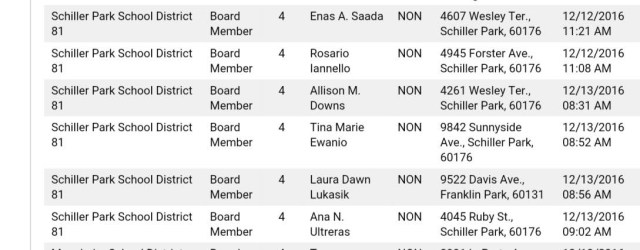
Six Candidates have filed for four seats

 Roy F. McCampbell's Blog
Can Illinois Have A Budget Deal without Madigan ?
Possible budget deal in the Illinois Senate announced this afternoon. But where is the Illinois House and Mike Madigan?
Details remain fluid, but the Senate began moving multiple pieces of legislation Monday that include an increase in the income tax to 4.95 percent, up from the current 3.75 percent; a penny-per-ounce tax on soda and other sweetened beverages; new casinos, including one in Chicago; and a hike in the minimum wage from $8.25 an hour to $11 an hour by 2021. The new revenue would in part be used to pay off roughly $7 billion in new borrowing to help pay down the state’s $11 billion backlog of unpaid bills.
Other proposals include an overhaul the state’s public employee pension system, consolidation of local units of government and a change in rules for how schools do contracts with outside vendors. The package would also include funding for universities and social service providers, which dried up Jan. 1. Efforts to overhaul the workers compensation system and freeze property taxes still had not been written into a bill as of early Monday afternoon, but those are key issues Rauner and Republicans have pushed for.
Stopgap budget set to expire, returning Rauner-Madigan standoff to where it was last summer
It’s unclear if the Senate would vote on the ideas later Monday. Democrats and Republicans are huddling separately behind closed doors to go over the proposals, which could easily derail any movement should major opposition arise.
Even if the measures don’t get a Senate vote, the effort allows Senate lawmakers to send a signal that they will not take a back seat to the House, which is tightly controlled by Madigan. Democrats there are weighing a different budget proposal that would tap into special funds to funnel money to universities and social service providers.
Share this: