Why Schools Resist Consolidating —-There are financial and educational benefits to merging small school districts, yet it’s almost always a hard sell.


No great surprise here: A recent audit in New Jersey recommended that the state move forward with school district consolidation efforts. While New Jersey has already merged several school districts, it still has some 545 of them, more than many other states, even states with larger populations. What’s more, a remarkable 144 of New Jersey’s districts are made up of only one school.
State Auditor Stephen Eells points out the inefficiency of having one K-6 school handle all the administrative costs of running a school district. According to Eells, if that school were to join with a couple of other K-6s, a K-8 and maybe even a high school, the schools could eliminate duplicative administrative jobs, merge administrative tasks like payroll, and purchase commodities at lower rates thanks to the benefits of buying in bulk.
New Jersey’s auditor is hardly alone in his thinking. Throughout the country there was a great wave of school district consolidation in the 1970s and 1980s. Generally speaking, this consolidation consisted of bringing multiple small school districts together under a single set of administrators. Sometimes, but not always, individual schools were closed in the process. Although the trend slowed down over the years, there appear to be a growing number of states revisiting this managerial move — and with good reason.
The Education Debate We’re Not Having

The benefits of school consolidation go beyond fiscal savings. There are educational improvements. Four districts with one small high school apiece may not have the resources to provide, say, a dedicated music teacher. But if the four districts are unified, then it can quickly become affordable to hire one itinerant music teacher. Languages are another good example. Are there enough potential Latin students to offer that language in one school in one district? Maybe not. But over a broader terrain, Latin may become an affordable way to serve those students who want to translate e pluribus unum (for the non-Latin learners among us, that’s “out of many, one”).
This sounds appealing. But pulling together four or five school districts into one can be met with the same difficulty as assembling a 1,000-piece jigsaw puzzle. In New Jersey, for example, a law was passed in 2007 that required executive county superintendents to submit consolidation plans for all K-12 districts by March 2010. The plans were submitted to the commissioner of education and that office identified 30 feasibility studies that needed to be done, potentially eliminating 104 districts. “But each report said there was no funding available to do the studies,” says Eells, so the process stalled.
Maybe there really wasn’t enough funding. But in New Jersey and other states, there are lots of reasons why school districts resist consolidation, notwithstanding the potential benefits. In Iowa, when district consolidation leads to the closing of schools, “there’s been a struggle,” says Jeff Berger, deputy director of the Iowa Department of Education, “with our rural communities wanting to keep the pulse of the town alive.”
Consider high school sports teams. In many parts of the country, the high school football team and its rivalry with the next town over are very much at the heart of the town’s sense of self. If that sounds silly to urban dwellers, then they’ve never gone to public school in a sports-crazy community where the highlight of the year is the homecoming game against the neighboring town.
There is also the issue of autonomy, which is seen as a potent pull toward maintaining the status quo. In areas where smaller districts are merged with larger ones, the smaller school districts are concerned that their level of representation in the superintendent’s office will almost certainly wane.
How legislatures craft bills about consolidation can play a huge role in the success of the effort. One state that didn’t do so well is Maine. In 2007, the legislature passed a law requiring small districts to regionalize under threat of penalty in those districts that did not comply.
“There was a lot of resistance, even immediately,” says Janet Fairman, associate research professor at the University of Maine. Moreover, efforts to ease the path toward regionalization included creating new jobs for occupants of duplicated positions. That meant that the fiscal benefits weren’t nearly as large as anticipated and couldn’t be translated into additional educational opportunities.
Maine’s law kept being amended every year. Exceptions and exemptions were made as schools argued that it was unreasonable for them to regionalize. Finally, in 2012, the state kept the law intact but removed the penalties. The result: A number of the school consolidations that had taken place are now shedding members who would rather be out on their own than part of one family.
Maine may have made some mistakes in basing compliance on the potential for punitive measures, rather than convincing people of the benefits. But at the end of the day, the problems were the same as those likely to be confronted in other states that try to consolidate schools. “What it came down to is control,” Fairman says. “Many really didn’t want to give that up.”

Posted in Economy, Education, Elections, Finance, Illinois Pensions, politics, Schiller Park School District 81, Special Education | Tagged | Leave a comment

Russ Stewart’s Comments on Some Suburban Elections 


January 18, 2017

BUNGLES, BLOOPERS AND MADIGAN TAKEOVER HIGHLIGHT 2017 SUBURBAN ELECTIONS
ANALYSIS & OPINION BY RUSS STEWART
by RUSS STEWART
There is a fundamental difference between municipal politicians in Chicago and municipal office holders in the Cook County suburbs: Those in Chicago always give grief, while those in the suburbs occasionally engender hilarity.
There are 30 townships and 120 municipalities in Cook County, and all have elections in 2017, some in February but the bulk in April. Most will be dreary affairs for time-wasting, under-paying, politician-intriguing, career-stifling offices which are steppingstones to political obscurity. They are to Illinois politics what the Class A minors are to baseball — a lowly farm team.
Some are lifetime jobs, or part of the “family business.” Regime changes are rare, and the 2017 outcomes are mostly a foregone conclusion, but there will be a handful of titanic and expensive battles, with Chicago politicians such as Mike Madigan deploying their precinct troops.
Maine Township: Encompassing Park Ridge and Des Plaines, it’s the quadrennial season to be jolly, with the boisterous escapades and fantastic foul-ups of the local politicians providing endless amusement for the local electorate. The biggest guffaw emanates from Des Plaines, where the boy-wonder mayor, Matt Bogusz, who was elected in 2013 at age 26, decided to change the city’s motto from “City of Destiny” to “Good Move.”
“Bogusz’s Blunder” evoked a huge controversy, especially the fact that he hired a public relations firm and paid it $180,000 to concoct the new motto. Normally there is a no-cost contest and people submit suggestions. Bogusz’s aldermanic critics publicly and colorfully bemoaned the fact that “Good Move” sounded like either a laxative for chronic constipation or a successful bar pick-up. Bogusz countered that “Good Move” was meant to be an encouragement to move into or do business in the city. The “City of the Good Move,” or “Good Move City,” died aborning. The aldermanic cabal prevailed, and “Good Move” was flushed away. Voters surely thought, “We elected these dolts?”
The mayor’s job is term limited to 8 years, with the mayor paid $9,600 and the aldermen paid $2,000 annually. One of the city’s eight aldermen, Malcolm Chester, is opposing Bogusz. The rap on Bogusz is that he’s arrogant and ambitious and that he rarely shows up at City Hall. At $9,600, who can blame him? Des Plaines residents get what they pay for. Rosemont’s mayor will earn $260,000 in 2017, and Des Plaines has the casino. Bogusz earns $800 per month; Bradley Stephens will earn $712.33 per day.
Bogusz’s mentor, former mayor Marty Moylan, helped get him elected in 2013. Moylan now is a Democratic state representative who is tight with Madigan and the unions but who will now back Chester. If Bogusz wins in 2017, he’ll be termed out in 2021, and he will run against Moylan in 2018 or 2020. “Bring it on,” Moylan said. He was re-elected with 59 percent of the vote on Nov. 8.
The other blunderer is township Republican Committeeman Char Foss-Eggemann, who beat township Supervisor Carol Teschky in 2014 for the post by 2,058 votes. There are more factions than fingers, the main adversaries being “township” versus ideological conservatives. After state Senator Marty Butler died in 1998, the party plunged into a battle between the pro-choicers, led by state representative Rosemary Mulligan, and pro-lifers, led by Bob Dudycz. The once-vibrant organization collapsed, losing the state Senate seat in 2006 and the Mulligan’s House seat in 2012. Mulligan, the township Republican committeeman, bungled her petitions and didn’t get on the ballot, handing her seat to Moylan.
Foss-Eggemann is aligned with talk show superstar Dan Proft and the Illinois Policy Institute, a conservative think tank funded by Governor Bruce Rauner and others. In 2016, with gobs of money, she backed Donald Trump, Bob Dold, Mel Thillens and Dan Gott. All lost in the township, Trump by 33,424-21,519. Only Dan Patlak won, for the Board of Review.
After Teschky announced her retirement last summer, Foss-Eggemann anointed Roger Schubert for the job, but then Schubert withdraw and Trustee Laura Morask, a sometime ally of Teschky who once was elected as a Democrat, was selected at the December caucus. The Republican Party is in a shambles, although Foss-Eggemann did get her ally, Susan Sweeney, who lost to Moylan in 2012, slated for township trustee. State Senator Laura Murphy, the Democratic committeeman, slated no Democrat for supervisor, assessor or road commissioner, but did file four trustee candidates. Dysfunction is the norm.
In Park Ridge, the 2015 death of Mayor Dave Schmidt, a no-nonsense, cost-cutting conservative Republican, created a vacuum. Schmidt headed another Republican faction. The acting mayor is Marty Maloney, an alderman who is unaligned with anyone or any faction. The election is nonpartisan. He is opposed for the $10,000-a year job by attorney Lucas Fuksa, but he should win easily.
Norridge: Illinois Secretary of State Jesse White is retiring in 2018 after 20 years, and the “exit strategy” of Tom Benigno, his chief deputy, is to become Norridge’s mayor. That’s called downsizing, although some might think it’s a route to another pension. Benigno tried in 2013, flooded the city, which contains only 11 precincts and 14,572 residents, with 13th Ward payrollers. He spent $131,417, and his campaign was run by Marty Quinn, Madigan’s alderman. (The ubiquitous Quinn ran the losing 2016 campaign of Merry Marwig against Republican state Representative Mike McAuliffe.) Democrat Benigno lost 1,910-1,403-266 to James Chmura, the candidate of the incumbent crowd which ruled since 1948, when the village was founded. Joe Sieb was the mayor for 47 years.
“They were stumbling all over each other,” Chmura said after his 2013 win, referring to the army of Madigan workers, five or six per precinct. “People resented it, and resented them.” Benigno’s muddled message was that it was time to replace the “Sieb machine,” but voters clearly perceived that they had a choice between an insider outsider and an insider insider. Benigno was an interloper.
So what’s changed since 2013? Chmura has been a competent but lackluster mayor like his predecessors, including Sieb. Benigno has been more involved in the community, and he spends his off hours campaigning door to door. If the 2013 turnout of 3,579 remains the same, all it will take is a switch of 200 2013 Chmura voters for Benigno to win. Surely, mighty Madigan can do that. A Benigno spokesman acknowledged that Benigno was a “late comer” to Norridge politics and that he “lacked resources” in 2013, meaning that he didn’t, like Chmura, have a slate for mayor, clerk, and three trustees — which he has now. That’s nonsense. Benigno had at least 50 precinct workers, and he outspent Chmura’s 4-1.
Benigno’s spokesman said that his theme is that he is “an option” if voters want change. He said that economic development and “rising crime” will be issues. Chmura will argue that Norridge, which has low bonded indebtedness, will be pillaged by Benigno, Madigan and their lawyer and development cronies.
In neighboring Harwood Heights, after tempestuous elections in 2013, 2009, 2005 and 2001, Mayor Arlene Jezierny has finally settled in. Her 2017 United Team Party slate is unopposed. Jezierny is a Republican, and she helped McAuliffe win by 3-2 in 2016. The village has only five precincts, and Jezierny won 993-856 in 2013.
Norwood Park Township, which includes the two villages, went 5,470-5,124 for Clinton on Nov. 8, a remarkably good showing for Trump.
In Rosemont, with four precincts, Bradley Stephens, the son of village founder Donald Stephens, is, as usual, unopposed. Stephens has $351,286 in his campaign accounts, and he is probably the best paid, least overworked mayor in America. Rahm Emanuel earns only $216,210. However, the 4,202 residents have no complaint, as the ever-burgeoning revenue from the convention center, restaurants, bars and commercial properties make the village a veritable utopia — a cash cow, and the money has to be spent somewhere.
In Niles Township, which includes Niles, Skokie, Morton Grove and Lincolnwood, regime change is a fantasy. It’s called the “Land of Lang,” run by Democratic township Committeeman Lou Lang, who has been a state representative since 1987 and who is chairman of the local Caucus Party, which dominates the municipalities and the township. Lang has $1,095,981 in his legislative account and $700 in the township party account, which has a debt of $665,000 to Citizens for Lou Lang.
The only blip for Lang was Morton Grove. Until 2013 the Republican-aligned Action Party was dominant, but then Action Party trustee Danny DiMaria ousted one-term Action Party Mayor Dan Staackmann in the caucus and was elected 1,556-679 with Caucus Party backing. Staackmann is back for a rematch as an independent, but the Action Party is defunct.
Clinton won the township 32,816-13,007, and the heaviest anti-Trump vote was in Skokie, a once heavily Jewish bastion which is now loaded with Filipinos, Koreans, Chinese, Japanese, Vietnamese, Indians, Pakistanis, Hispanics and an array of Middle Eastern Muslims. The Jewish population is less than 20 percent. However, there is no political diversity in Skokie or the township. The Caucus Party incumbents, mostly Jewish, are in control, and nary a non-Anglo name is to be found on the ballot.
In Skokie, Mayor George Van Dusen, who has been in office since 1999, is unopposed, as are all the township candidates. In Niles, Mayor Andy Przybylo, a longtime trustee, a county employee, and until recently the co-owner of the White Eagle, is opposed by Steven Yasell for a second term, having eradicated all 2017 opposition in the 2015 trustee election. In Lincolnwood, Mayor Jerry Turry is opposed by Barry Bass.
Send e-mail to russ@russstewart. com or visit his Web site at www. russstewart.com.

Posted in Elections, O'Hare Noise | Tagged | Leave a comment

Illinois Has Too Many School Districts


From 1930 through 1970, a gradual consolidation process eliminated 9 of every 10 school districts nationally. The number of districts in the U.S. fell dramatically, to fewer than 20,000 from over 120,000.
Illinois followed similar trends. In 1942, Illinois had more than 12,000 districts – the most of any state in the nation. Over 10,000 of these were one-room schools with an average enrollment of 12 students. By 1955, the state had cut the number of districts to 2,242, and by the year 2000, the district count had fallen to 894.
Today, Illinois has 859 school districts. Nearly 45 percent are elementary, 12 percent are secondary (high school), and 45 percent are unit districts, meaning they serve both elementary and secondary students.

Despite the massive reduction in Illinois school districts, the state is still not efficient when compared with its 14 peer states that also serve 1 million or more students. Florida, for example, averages 40,012 students per district. Georgia, North Carolina, California and Virginia all serve more than twice the 2,400 students per district Illinois does.

If Illinois school districts served the same number of students as school districts in California, the most populous state in the country, serve, Illinois would have just 342 school districts. And if Illinois school districts served the same number of students as North Carolina’s, Illinois would have just one-fifth of the school districts it has today – and one-fifth of the administrative bloat.

Small student populations in many Illinois districts also contribute to the inefficiencies of Illinois education. Of Illinois’ 859 school districts, more than one-third serve fewer than 600 students. An additional layer of administration, over and above what already exists at the school level, is excessive and expensive for school districts of this size.

There are many school districts that oversee too few schools. Twenty-five percent of school districts in Illinois, or 212, are single-school districts.

Another 152 school district offices serve just two schools. This kind of mismanagement presents plenty of opportunities to merge district supervision and reduce administrative costs without interfering with the schools’ daily operations.

Posted in Economy, Education, Finance, Illinois Pensions, News, politics, Schiller Park School District 81, Special Education, Taxation | Tagged | Leave a comment

Should We Consider Consolidating School Districts In Leyden Township ?


School funding in Illinois is the subject of considerable debate as Illinois weighs the fairness of its funding formula and tries to narrow the budget chasm. Education in Illinois needs a major overhaul, not just a tweak.
That’s why, as part of this discussion on school finances, Leyden Township school districts should look at school district consolidation.
Simply put, there’s no reason to have separate high school and elementary school districts in Leyden Township. The money saved on administration could be put to use in the classroom.
The conversation should begin sooner than later. 

Posted in Education, Elections, Finance, politics, Schiller Park, Schiller Park School District 81, Special Education | Tagged | Leave a comment

Interesting Editorial in the Pantograph To Think About


Pantograph Editorial: Illinois needs to push harder for school consolidationMay 1, 2016 

One of the maddening aspects of the state’s ongoing financial crisis is that some obvious long-term solutions are rarely considered.
As we’ve stated before, one solution to the massive tax collections by state and local government is to reduce the number of local governments. That includes school districts that have been slow to consolidate in ways that would save money and allow more money to flow into classrooms.
According to a recent research report by the Illinois Policy Institute, the state’s 859 school districts are ripe for consolidation. About 25 percent of them serve just one school. One-third of Illinois school districts serve fewer than 600 students.
Although the districts are small, that doesn’t mean there isn’t a layer of bureaucracy. Not only does every district have a superintendent, but many have assistant superintendents, transportation supervisors, human resource and business staffs and other positions that could be eliminated with more school consolidations.
When compared with other states that serve more than one million students, it’s clear the Illinois system is inefficient. Florida, which has taken school district consolidation to the extreme, has an average of more than 40,000 students per district. California and Texas have about 6,000 and 4,000 students per district, respectively. Illinois has 2,339 students per school district, on average.
The savings of district consolidation could be significant, in both administrative costs and future pension costs. The institute study looked closely at districts in the New Trier Township. This wealthy Chicago suburb is home to six elementary school districts that feed into a single high school district. Taxpayers pay for seven superintendents; the average salary of those seven is $280,000 per year. Taxpayers could save millions a year on superintendent salaries alone.
The savings would not be confined to just one district, however. Because taxpayers across the state pay into the educators’ pension system, reducing the number of administrators in this one district would save taxpayers $30 million over the next 30 years, said the study.
The institute estimates if the state cut the number of districts in half, putting the average district size still less than California, there would be district operating savings of between $130 million and $170 million annually. The costs in pensions would be between $3 billion and $4 billion over the next 30 years.

In other words, this is something that would save the state, and taxpayers, real money. There are obstacles to consolidation, including a concern about the loss of identity. However, in this case, consolidation is not a rural issue. In fact, some of the greatest targets for consolidation are in heavily-populated areas.
There is little doubt that consolidating school districts is politically difficult. But so is raising taxes and explaining to schools why they don’t receive the resources they expect from the state.
To escape from its current financial doldrums, Illinois government needs to fundamentally change and the size of government needs to be smaller. School district consolidation is one place where change is necessary.

Posted in Economy, Education, Elections, Finance, Illinois Pensions, politics, Schiller Park School District 81, Uncategorized | Tagged | Leave a comment

Last night on WGN. Talking peace and justice.


Fred Klonsky's avatarFred Klonsky

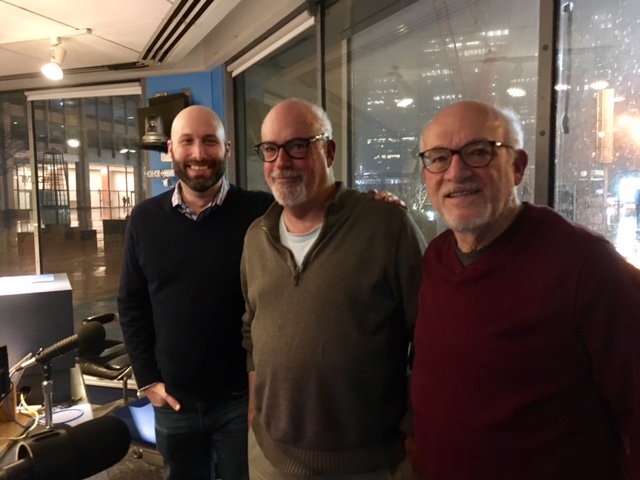
klonsky-brothersJustin Kaufmann, host of The Download on WGN and the Brothers Klonsky.
It was more than a little strange walking into the Tribune Tower on north Michigan Avenue last night. The gothic lobby is imposing, as it was meant to be. Engraved quotes from the captains of capitalism surround you like bible verse.

My friend and fellow teacher, Mark Stefanik texted me as the show began, “McCormick is spinning in his grave at the sound of your ideas on his radio station,” referring to the Trib’s founder Colonel McCormick.

It was imposing until Justin Kaufmann, host of the nightly The Download (7-11, 720 AM and streaming over the internet) came bounding into the green room to greet my brother Mike and me.

My brother and I had been invited by Kaufmann to be on his show to talk about Martin Luther King and our history of political engagement.

I remember WGN…

View original post 482 more words

Posted in Uncategorized | Leave a comment

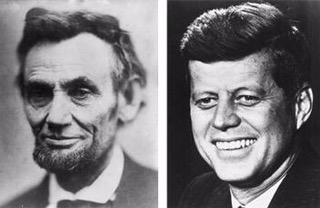
Interesting Facts During Inauguration Week


Have a history teacher explain this if they can.
Abraham Lincoln was elected to Congress in 1846.
John F. Kennedy was elected to Congress in 1946.
Abraham Lincoln was elected President in 1860.
John F. Kennedy was elected President in 1960.
Both were particularly concerned with civil rights.
Both wives lost a child while living in the White House.
Both Presidents were shot on a Friday.
Both Presidents were shot in the head.
Now it gets really weird.
Lincoln’s secretary was named Kennedy.
Kennedy’s Secretary was named Lincoln.
Both were assassinated by Southerners.
Both were succeeded by Southerners named Johnson.
Andrew Johnson, who succeeded Lincoln, was born in 1808.
Lyndon Johnson, who succeeded Kennedy, was born in 1908.
John Wilkes Booth, who assassinated Lincoln, was born in 1839.
Lee Harvey Oswald, who assassinated Kennedy, was born in 1939.
Both assassins were known by their three names.
Both names are composed of fifteen letters.
Now hang on to your seat.
Lincoln was shot at the theater named “Ford.”
Kennedy was shot in a car called “Lincoln” made by “Ford.”
Booth and Oswald were assassinated before their trials.
And here’s the “kicker”:
A week before Lincoln was shot, he was in Monroe, Maryland.
A week before Kennedy was shot, he was with Marilyn Monroe.
AND……………….:
Lincoln was shot in a theater and the assassin ran to a warehouse…
Kennedy was shot from a warehouse and the assassin ran to a theater… 

Posted in Elections, politics | Tagged , , | Leave a comment

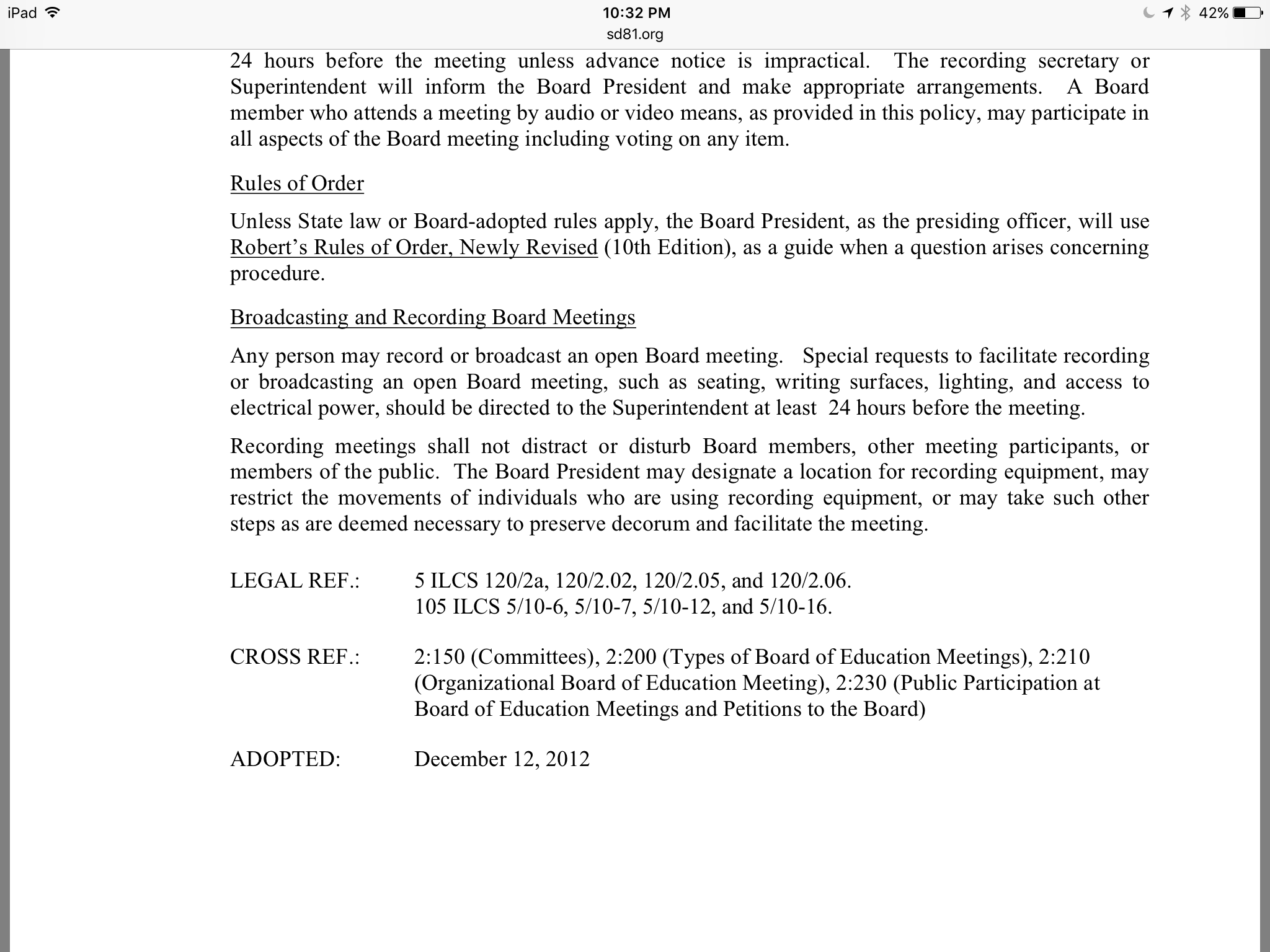
Does Schiller Park School District 81 need to amend their policy because of the Illinois AG Opinion Concerning Norridge District 80 ?


Does Schiller Park School District 81 have similar exposure to an adverse ruling by the Illinois Attorney General since their policy is identical to Norridge School District 80 ?

Below is a copy of Schiller Park School District 81 policy:


Attorney General rules Norridge District 80 violated Illinois Open Meetings Act / Natalie Hayes Pioneer Press

….. The Norridge School District 80 Board violated the Illinois Open Meetings Act by blocking a resident from recording a school board meeting last fall, according to a ruling from the Illinois Attorney General’s Office.

….. The ruling, issued Dec. 28, was in response to a complaint filed in October. In the complaint, Norridge resident Adam Chudzik claimed the school board prevented him from recording the open session of the Sept. 20 school board meeting under the board’s “advance notice rule.”

….. The rule called into question in Chudzik’s complaint is a policy District 80’s board has written into its code for board meeting procedures, which requires meeting attendees planning to record the proceedings to first get permission from the board or the superintendent.

….. The Open Meetings Act says meetings may be recorded.

….. ”Because the Open Meetings Act specifically provides that meetings may be recorded, any public body that prescribes a rule requiring advance notice of recording a meeting would have a steep burden to overcome in order to demonstrate that such a rule is reasonable,” according to the binding opinion issued by public access counselor Sarah Pratt.

….. Chudzik claimed in the complaint that he approached board President Srbo Radisavljevic 10 minutes before the meeting to ask whether he could record the open session portion, and was told he could not. According to the complaint, Radisavljevic told him he needed to provide the board with sufficient advance notice of his intent to make a recording.

….. The school district will now be required, under the Attorney General’s order, to review the policy in question and to begin conducting its future board meetings in compliance with the Open Meetings Act. The school board has until Feb. 1 to file a complaint for administrative review in Cook County Circuit Court.

….. Radisavljevic said the school board hasn’t reviewed the Attorney General’s decision yet, but said District 80’s policy was designed in line with sample policies provided by the Illinois Association of School Boards.

….. ”The board will work with the IASB to update, align and to rectify the portion of the policy which the Attorney General views as in violation of the Open Meetings Act,” he said in an email.

….. In its response to the Attorney General Office’s request for a response to the allegations filed by Chudzik, the school district’s legal counsel had submitted the school board’s written policy for recording public meetings, which requires anyone planning to record a meeting to notify the school board in advance. The board “implements its policy by requiring 24 hours advance notice of any request to record a meeting,” according to the school district’s response sent to the Attorney General’s Office. “It is the board’s position that 24 hours advance notice of such request is a reasonable rule to govern the right to record a meeting under section 2.05 of [the Open Meetings Act].”

….. The board further backed its claim by saying there were children at Leigh School Learning Resource Center during the time Chudzik asked to make a recording. The learning center was the location of the Sept. 20 board meeting. Because School District 80 doesn’t have a public board meeting room, the meetings are typically held on alternating months in the libraries at Leigh and Giles schools.

….. ”The possibility that images of children and students present in the [learning resource center] may also have been recorded was unacceptable and an additional reason to deny the recording request without 24 hours notice,” according to the board’s response to the Attorney General.

….. The Attorney General determined that the school district’s interpretation of the part of the Open Meetings Act in question violated the part of the law that says there’s no provision to grant a public body the authority to prevent someone from recording an open meeting.

….. ”The board failed to demonstrate that its rule was necessary to prevent interference with the proceedings or protect the safety of those in attendance,” the Attorney General’s ruling said.

….. Because modern-day recording devices are often embedded into smartphones, an advance-notice rule would be “difficult or impossible to enforce,” the ruling added.

….. Chudzik said he believes the Attorney General’s ruling serves to support his belief that the board has “no real interest in engaging the public.” Since a recent referendum failed, school board members have sought more public involvement for planning the next steps the district should take to address its growing deficit.

….. ”The district continues to claim they are asking the public for help, only to spend a great deal of time preventing people from any meaningful participation,” Chudzik said in an email. “You can’t have it both ways — they’re just going through the motions.”

….. Calling himself a “Norwood Park Watchdog,” Chudzik posts videos he records of public meetings on his blog.

….. ”The video recording issue shouldn’t have happened,” Chudzik said. “Out of courtesy, I asked if I could place my camera and tripod in a corner out of the way, to keep it out of the audience seating area, [and] in reply they threw a rule book at me.” 

Adam Chudzik can be reached at https://www.norridgeintegrity.com

Natalie Hayes is a freelance reporter for Pioneer Press.

http://www.chicagotribune.com/suburbs/norridge/news/ct-nhh-open-meetings-tl-0112-20170105-story.html

Posted in Education, News, politics, Schiller Park School District 81 | Tagged , , | Leave a comment


Posted in Uncategorized | Leave a comment

Does Schiller Park


Posted in Uncategorized | Leave a comment