The push to make Juneteenth a federal holiday, which successfully led to the first national Juneteenth observance last year, brought a new wave of attention to the history behind this celebration: That on June 19, 1865, enslaved men and women in Texas found out—weeks after the Civil War ended—that they were free, and the Union Army’s Major General Gordon Granger issued General Order No. 3: “The people of Texas are informed that, in accordance with a proclamation from the Executive of the United States, all slaves are free.”
“There are some enslavers in Texas that didn’t tell their enslaved people that they were free, and they had them keep on working,” says Daina Ramey Berry, Professor of History and Dean of Humanities and Fine Arts at the University of California, Santa Barbara.
So then when did slavery actually end in the United States?
158 years ago on June 19, 1865, Major General Gordon Granger (born in Sodus, NY 130 miles from Buffalo) and 2,000+ soldiers of the 13th Army Corps arrive in Galveston, TX to spread the word about the Emancipation Proclamation that President Lincoln issued more than 2 years earlier on September 22, 1862.
General Granger first read General Orders No. 3 at Union Army Headquarters at the Osterman Building (formerly located at The Strand and 22nd Street) which provides in part:
“The people of Texas are informed that in accordance with a Proclamation from the Executive of the United States, all slaves are free. This involves an absolute equality of rights and rights of property between former masters and slaves, and the connection therefore existing between them becomes that between employer and hired laborer.”
Historians believe the reason for the 30-month lag time was that the Emancipation Proclamation wasn’t enforceable before the end of the Civil War. Juneteenth is celebrated because it was a significant milestone in the ongoing fight for racial equality.
Juneteenth celebrations started in Texas in 1866 and this holiday is the oldest known celebration commemorating the end of slavery in the United States. This year marks the 48th Juneteenth celebration in Buffalo and the third year Juneteenth is acknowledged as a national and state holiday.
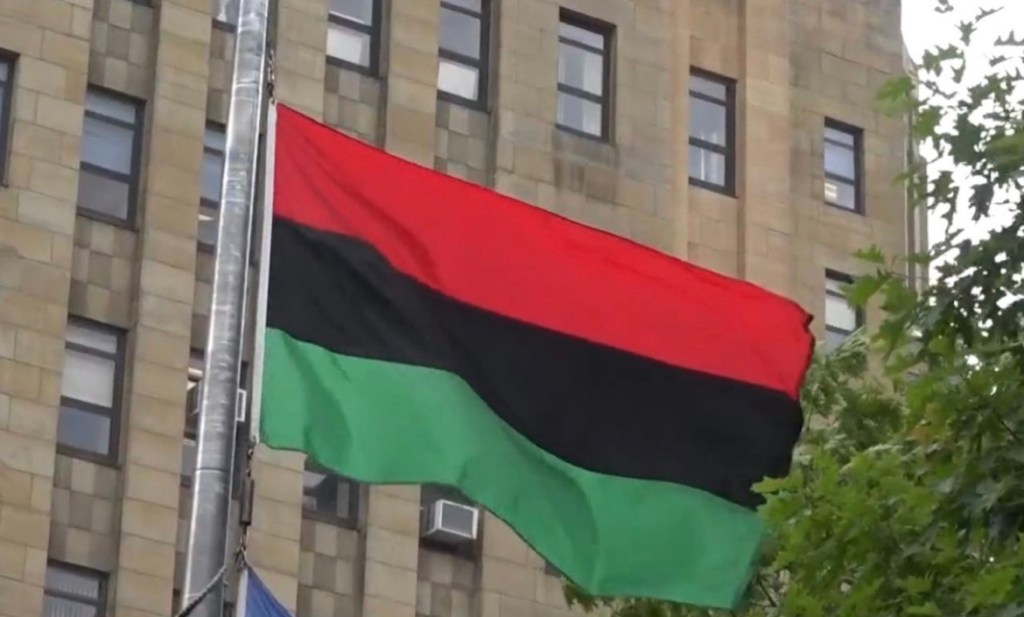
Pictured here is the Pan-African flag flying at Buffalo City Hall in celebration of Juneteenth. The Universal Negro Improvement Association and African Communities League (UNIA) first adopted this flag in 1920. According to UNIA’s website:
The three Pan-African colors on the flag represent:
Red: the blood that unites all people of Black African ancestry, and shed for liberation; Black: black people whose existence as a nation, though not a nation-state, is affirmed by the existence of the flag; and Green: the abundant natural wealth of Africa.
You can use marijuana in Illinois, and you can own a gun – but you can’t do both at the same time.
“If you’re a normal, everyday Illinois resident who uses marijuana regularly, whether it’s lawfully or unlawfully, it doesn’t matter,” said attorney Billy Jackson. “You can’t possess a firearm because under federal law, as you point out, it’s still illegal to even possess marijuana.”
Do you use marijuana? It’s one of many “yes or no” questions on the ATF’s Form 4473. Filling out the form is a requirement for gun purchasers in every state across the nation. Lying on that form is a federal crime.
“The federal government still looks at marijuana usage the same as they look at heroin or cocaine,” said Portsmouth Sheriff Michael Moore. Moore was a special agent in the ATF who worked on drug and gun trafficking cases.
Taylor is charged with making a false statement when buying a gun and possessing a firearm while illegally using marijuana.
“That’s why we have these laws on the books,” Jackson said. “To hold these individuals accountable for both their own firearm possession and what flows, what kind of danger flows from that firearm possession. And here, that harm that flowed from it was just devastating.”
Jackson was a federal prosecutor for more than six years. He brought those same charges against many defendants, most often violent offenders he wanted to take off the streets quickly.
“It’s an easy charge to convict someone of,” Jackson said.
Smoking a joint one time isn’t enough to make buying a gun illegal. To prove those charges, Jackson said prosecutors must show that a person uses marijuana regularly.
“Hopefully in the very near future this form, and the federal government, will be able to address that change,” he continued.
Sleep is vital to how we function. Poor sleep has been linked to a higher risk of cardiovascular disease, diabetes, obesity, and dementia. Sleep deprivation affects your mood, makes you less likely to remember things, and makes your immune system less capable of fighting infections. It also affects performance. You are far more accident-prone and have far poorer judgment when you’re sleepy. As the National Institutes for Healthobserves, “Sleep deficiency has also played a role in human mistakes linked to tragic accidents, such as nuclear reactor meltdowns, grounding of large ships, and plane crashes.”
The military method is a sleep technique practiced by the U.S. Army to help soldiers sleep under any conditions, including gunfire. The method consists of five steps, focusing on progressive muscle relaxation, deep breathing, and guided imagery to achieve a calm and peaceful state. Incorporating the military method into a nightly routine can improve sleep habits and overall well-being.
For people in the military, getting good sleep can be a matter of life and death. This is why the U.S. Army practices the “military method” of sleep.
It was said that pilots in the Pre-Flight School who used the military method were able to fall asleep within 10 minutes. Within only six weeks, 96% of pilots using the method were reportedly able to fall asleep within this timeframe — even with gunfire in the background.
The five steps
So, what is this magic technique? Below we lay out the military method’s steps to a good night’s sleep. It’s deliberately designed to be easy and efficient, so anyone can start tonight.
Relax your face. Focus on your forehead, your eyes, your cheeks, your jaw, and so on. Feel the tension held in them and consciously push it away.
Drop your shoulders. Let your arms flop down and your shoulders relax. Imagine there is a soft, warm wind gently pushing your arms down.
Take a deep breath. Slowly inhale and let it out. As you do so, focus on how it relaxes your stomach. Don’t try to hold your stomach in; let it all out.
Relax your legs. The warm wind is back, and this time it’s gently easing your legs down. Let your legs sink into the bed or the floor. They are leaden, and the bed is soft.
Clear your mind. There are a few ways to do this. For instance, try to visualize some calming images, like lying by a flowing river or staring at the clouds. If that doesn’t work, try saying the words “don’t think” over and over for about 10 seconds. If you get distracted, don’t get angry; just pull your mind back to one of those two techniques.
Practice makes perfect
What does the science say about the military method of sleep? It turns out that Winter and the U.S. Army might be on to something. Stages 1, 2, and 5 are otherwise known as “progressive muscle relaxation,” and evidencesuggests it’s a good way to induce a calm, peaceful state. What’s more, the breathing techniques in stage 3 and the “guided imagery” of stage 5 have been shown to “enhance relaxation states, and improve overall well-being.”
But there’s also a hidden benefit lurking within the military method, and that’s the fact that it’s a method. Research has shown that keeping a routine is one of the best ways to improve your sleeping habits. It could be reading before bed, taking a shower, or doing some light exercise. The point is that routine itself is important. So give the military method a go, but don’t expect instant results. It can take between two and six weeks to become an expert — enough time for it to become routine. Stick at it, and you might just wake up feeling well-rested.
Five years ago, a federal court issued a crucial ruling. People experiencing homelessness, the Ninth Circuit Court of Appeals said, can’t be punished for sleeping outside on public property if there are no adequate alternatives available.
The 2018 decision in Martin v. Boise did not create the homelessness crisis, which researchers attribute primarily to the lack of affordable housing. The number of people experiencing unsheltered homelessness — meaning those sleeping on the streets, in parks, in abandoned buildings or train stations, or anywhere not meant for humans to live — was rising before the decision.
But as the number of unsheltered homeless people continued to grow over the past half-decade, the Martin decision has become a pivotal factor in shaping how cities respond to the very visible problem of tent encampments, particularly on the West Coast.While the case never gained huge name recognition, it undergirds the policy and politics of homelessness in 2023. So much of the fight about how to addresshomelessness today is, at this point, a fight about Martin.
The case dates back to 2009, when Robert Martin and a group of fellow homeless residents in Boise, Idaho, sued, arguing that police citations they received for breaking local camping bans violated their constitutional rights. In 2018, theNinth Circuit agreed that prosecuting people for sleeping or camping on public property when they have no home or shelter to go to violated the Eighth Amendment’s prohibition on cruel and unusual punishment.
“The government cannot criminalize indigent, homeless people for sleeping outdoors, on public property, on the false premise they had a choice in the matter,” the court declared.
States, cities, and counties urged the US Supreme Court to take up the case, arguing the Ninth Circuit had created “a de facto” right to live on sidewalks and in parks that would “cripple” local leaders’ ability to safely govern their communities. But in 2019, the court declined, baffling some experts, though others suspect it’s because there were no conflicting circuit decisions at the time. Since then, Martin has shaped cities’ response — or lack thereof — to the growing challenge of homeless tent encampments.
While the decision only formally applies in areas under the Ninth Circuit’s jurisdiction, the ruling has reverberated nationally, as local governments consider how to address unsheltered homelessness in ways that could avoid costly constitutional legal battles. There have already been dozens of court casesciting Martin, including in the Fourth Circuit in Virginia, and federal lower courts in Ohio, Missouri, Florida, Texas, New York, and Hawaii.
For now, though, Martin’s impact can be seen most clearly out West. Just before Christmas 2022, for example, a district judge cited Martin when she ruled that San Francisco can no longer enforce encampment sweeps — meaning clear out homeless individuals and their property from an outdoor area — since the city lacks enough shelter beds for those experiencing homelessness to move into. San Francisco appealed the decision, arguing it’s “unnecessarily broad and has put the City in an impossible situation.”
In Phoenix, Arizona, residents and business owners filed a lawsuit last summer against the city for allowing a downtown homeless encampment to grow with nearly 1,000 people, but a federal judge — echoing Martin — barred Phoenix in December from conducting sweeps if there are more homeless people than shelter beds available. A competing decision issued in March by a state judge ordered Phoenix officials to clean up the “public nuisance” at the encampment by July 10, arguing the city has “erroneously” applied Martin to date.
In Portland, Oregon, meanwhile, officials have scrambled to revise their local camping ordinance to be a “daytime” camping ban from 8 am to 8 pm instead, in recognition that any total camping ban is likely illegal under Martin.
Supporters of a more “get tough” approach to encampments say the social and political costs of allowing tent cities to proliferate are too high, and that waiting for cities to buildenough new housing before acting is untenable, both morally and politically. Some think officials are getting complacent in relying on Martin as an excuseto maintain the status quo.
Advocates for those experiencing homelessness say politicians are squandering an important opportunity by fighting for the right to conduct encampment sweeps — which can be both cruel and counterproductive to the larger goal of ending homelessness. Instead of looking for legal loopholes to Martin like daytime camping bans and sanctioned encampment sites, advocates say leaders should be investing more in solutions like affordable housing and shelter options that afford people more privacy.
“Our end goal is not to create a right for people to sleep on the streets. That’s the limited remedy we’ve been given under our Constitution,” said Eric Tars, the legal director for the National Homelessness Law Center. “They’re missing the point of Martin if they’re just trying to continue a criminalization approach in a more constitutional way.”
Cities are scrambling to comply with — and find loopholes in — Martin v. Boise
Unsheltered homelessness has risen sharply over the last seven years, and at a faster rate than homelessness overall. Unsheltered homeless people now account for 40 percent of all homeless people in the country, up from 31 percent in 2015.
Political pressure has mounted to respond to this growing problem of people sleeping in alleys, parks, and train stations. While it’s not clear this would be legal under Martin, a number of cities have turned to the idea of so-called sanctioned encampments, or legalized campsites. These are effectively designated areas where unhoused individuals can live outside, and some come with varying degrees of public services, like bathrooms, power outlets, medical care, and on-site case management.
In Portland, Oregon, lawmakers voted in November to create several large sanctioned campsites for homeless individuals, and ban the more than 700 other encampments spread across the city. Austin, Texas, has operated one sanctioned encampment of so-called “tiny homes” since 2019, on a seven-acre plot of asphalt near the airport. Denver, Colorado, is also moving to make its so-called “managed campsites” from the pandemic a permanent homelessness response tool.
The trade-off for legalized campsites, however, is that sleeping outside anywhere else in a city would then be illegal. This helps alleviate leaders’ political problem of having tents pitched all over a city, but activists worry it’s just a way to steer the sight of homelessness out of public view, and criminalize people who refuse to go. Some cities are considering sanctioned encampments witha six-month residency limit, even if there’s no permanent affordable housing option for those experiencing homelessness to go to after that point.
Some advocates have taken a firm stance against the idea; they see sanctioned encampments as a means to segregate and criminalize unhoused people and effectively kick the can down the road by not finding them permanent housing.
They’re not wrong that sanctioned encampments can require a great deal of money, staff time, and effort. In 2018, the United States Interagency Council on Homelessness warned that “creating these environments may make it look and feel like the community is taking action to end homelessness on the surface — but, by themselves, they have little impact on reducing homelessness.”
For these reasons, some cities — like Houston — have rejected the idea. “We can do better as a society. We shouldn’t tolerate it and say that’s okay,” Marc Eichenbaum, the special assistant to Houston’s mayor on homeless initiatives, told NPR.
But other cities with fewer available housing options say sanctioned encampments represent a decent interim solution, and maybe even better for unhoused residents compared to scattered campsites if cities can more effectively target social services to those corralled together.
Legalized campsites can also have a lower barrier to entry than many existing shelters, so supporters are framing them as a harm-reduction approach to homelessness. Groups like the National Homelessness Law Center, which used to firmly oppose sanctioned encampments, have recently softened their stance to say they should be considered on a case-by-case basis.
“The only time that we would see a role for that approach is if you had an exit plan,” said Tars, who pointed to some models in Seattleand Gainesville, Florida, that he thought were more positive. “Otherwise you are just creating a permanent shanty town.”
Meanwhile, Republican-governed states are exploring more punitive models. In at least half a dozen states, lawmakers have pushed sanctioned encampment bills based on templates from the Cicero Institute, an Austin-based conservative think tank. The bills propose to penalize cities that permit tent encampments, to put time limits on sanctioned encampment sites, and to divert funding from permanent supportive housing into things like mandatory drug treatment.
In 2022, Tennessee became the first state to pass a bill that would make camping on local public land a felony. Missouri’s version will allow the state’s attorney general to sue local governments that don’t enforce encampment bans. Activists say Cicero’s aggressive opposition to housing-first will lead invariably to more homeless people in jail.
Looming ultimately above all these various sanctioned encampment models is the Martin decision, which says a city-wide camping ban would be unconstitutional if the city lacks sufficient shelter options. Leaders recognize they probably can’t ban camping everywhere under Martin, but they want to see if they can ban it in mostplaces instead. Yet whether any bans could exist if a city lacks enough shelter beds remains an open Eighth Amendment question.
Tars, of the National Homelessness Law Center, thinks the answer is no. “Martin is very clear when it’s talking about ‘adequate’ [housing] alternatives it’s talking about indoor shelter beds, and legalized encampments are not shelter beds,” he said, pointing to a 2021 federal court decision that found a sanctioned encampment site in Chico, California, was inadequate “shelter” under Martin. A federal judge described Chico’s encampment as “open space with what amounts to a large umbrella for some shade” that “affords no real cover or protection to anyone.”
Tars acknowledged, though, there’s a “legal gray area” in the Martin decision, as one footnote suggests cities could create some “time/manner/place” restrictions for camping.
Earlier this year, when a Maricopa County Superior Court judge ordered Phoenix officials to clear its notoriously large downtown encampment, he urged the city to consider “the creation of controlled, outdoor camping spaces on vacant City property” if there were not enough shelter beds to move people into.
As in Houston, Phoenix officials have rejected the sanctioned encampment approach to date, saying resources should be invested into housing solutions with air conditioning: Over 80 percent of Maricopa County’s 425 heat-related deaths in 2022 occurred outside. Local officials estimate unsheltered homeless people are at “200 to 300 times higher risk” of heat-related deaths than the rest of the population.
Still, even if Phoenix leaders embraced sanctioned encampments, it’s not clear the idea would hold up under Martin. Resolving some of these questions will realistically require the Supreme Court, but that’s unlikely to happen until there’s competing circuit court decisions to pressure it to take the issue up.
Homelessness policy is at a crossroads
There are court rulings, and then there’s enforcement of those rulings. Homeless advocates say it seems as though too many cities are failing to comply with rulings that bar unconstitutional sweeps.
For example, lawyers say little has changed in San Francisco since a federal judge ruled against sweeps six months ago, and that homeless residents continue to be displaced under the guise of street cleaning.
“What we’ve seen has been a really aggressive media campaign led by the city to suggest we are pro-open-air drug markets and anti-accessibility for sidewalks,” said Zal Shroff, an attorney with Lawyer’s Committee For Civil Rights representing the homeless plaintiffs.
“You’re allowed to clear genuine public safety hazards, but when you do that and throw their laptops and cellphones into dumpsters, that’s not a cleaning — that’s a seizure of someone’s belongings without due process,” he added. In late May, Shroff’s team filed a court motion, calling for increased monitoring.
Jen Kwart, a spokesperson for San Francisco’s city attorney, told Vox they’re “complying with the preliminary injunction while simultaneously expending hundreds of millions of dollars annually to provide shelter and services to unhoused people.”
In Phoenix, while the city is working to clear out its large homeless encampment by July 10, per the Maricopa County Superior Court, the ACLU has been arguing the city’s clearings have violated the rights of unhoused people.
“Even if you’re unsheltered, you have due process rights to your belongings under the Fourth and 14th Amendments,” said Benjamin Rundall, an attorney with ACLU of Arizona. “You can’t violate someone’s constitutional rights in order to vindicate someone’s private property rights.”
A spokesperson for Phoenix’s Mayor Kate Gallego did not return requests for comment, but an April city press release said they were exploring hotel options and expected 800 new shelter beds to come online before the end of 2024.
Some conservative legal advocates see the Maricopa County Superior Court ruling as offering a blueprint for other cities and states to clear out their tent encampments. “For too long, liberal leaders have used the Martin ruling as an excuse to allow rampant crime and homelessness to take over neighborhoods,” argued Austin Vanderheyden, a liaison at the Goldwater Institute, in the Orange County Register. “But no longer.”
“Our lawsuit was never about solving homelessness,” wrote Ilan Wurman, who represented the Phoenix business and property owners. “It was about solving the humanitarian crisis that these encampments create.”
Meanwhile, as pandemic eviction aid dries up, homeless advocates are bracing for more people to lose their housing in the coming months. Washington, DC, recently reported an 11.6 percent increase in homelessnessfrom 2022. While the nation has been increasing its shelter bed capacity over the last few years, fewer people are choosing to stay in them. Many have decided sleeping outdoors is preferable to the rules and conditions of congregate shelters.
Figuring out where cities go next will be shaped in no small part by how leaders and courts land on interpreting Martin.
“It really feels like we’re at a tipping point,” said Tars. “Things could either get much better or much worse.”
A unanimous Illinois Supreme Court ruling yesterday in a case called Chapman v. Chicago reverses a lower court’s ruling and blocks plaintiff Matt Chapman’s open records request for information from the City of Chicago’s Department of Finance. The court’s ruling undermines the public’s right to know about the workings of government and is a threat to research, journalism and the public interest.
The Better Government Association, Illinois’ leading defender of the right of access to public records, will work to address this change in the law, in an effort to protect the ability of residents of the state to effectively hold their government accountable.
“At a time when the need for government accountability is greater than ever, the Illinois Supreme Court with this ruling has taken a step backward. The language of the court’s ruling may seem narrow, but its implications are vast,” said David Greising, president of the Better Government Association. “The ruling will have the effect of blocking access to public records. They are called public records for a reason, and creating hurdles to access is not in the public interest. The BGA’s policy team will work with good-government protectors in the General Assembly to develop legislation that will repair the damage done by the Supreme Court’s ruling.”
The court’s decision hinges on an exemption to Illinois’ Freedom of Information Act that allows governments to deny access to technical information “that, if disclosed, would jeopardize the security of the system or its data or the security of materials exempt under this Section.” Data sets covered by the exemption include software, operating protocols, computer program abstracts, file layouts, and other information.
The Cook County circuit court had previously ruled that each type of information specified in the exemption was subject to the modifying language “if disclosed, would jeopardize the security of the system.” In the opinion of that court, the City of Chicago did not adequately demonstrate that the requested database information would jeopardize the system’s security, and therefore the request was not exempt from FOIA.
The Supreme Court reversed the ruling, holding that the “security of the system” clause only applies to the phrase “any other information,” and that “file layouts” and other specifically named types of information are automatically and entirely exempted from FOIA. Relying on a dictionary definition rather than standard data science conventions, the court determined that Chapman’s requested information constituted a “file layout,” and was therefore exempt from FOIA.
Matt Topic, a lawyer for the plaintiff stated: “No purpose is served by withholding technical information from the public when no harm will come from its release, and it is critically important that researchers, journalists, and others have robust access to non-identifying information about government databases. For that reason, similar information about federal databases is publicly available on a federal website. The General Assembly should follow suit and amend this exemption to ensure public access unless a harm can be demonstrated from its release.” Topic is an expert in Freedom of Information Act law and serves as BGA Outside General Counsel.
Chapman’s public records request sought an index of tables and columns from a City of Chicago Department of Finance database. Database indexes such as the one sought by Chapman’s request are used to query and sort specific subsets of information from large databases, and are a fundamental tool of data analysis and management.
You may have heard of “the world’s oldest profession.” But the world’s oldest organized profession was stone masonry. Ancient civilizations realized you had better know what you are doing if you are going to build with stone. This gave rise to ancient stone masons’ guilds, which required mandatory education, training, and rankings. Stone masons became known for their high levels of morality and ethics in building.
A novice was entered into the craft as an apprentice. Although only an apprentice, he was still entered into, or associated with, the craft. After years of training, he could be passed to the level of a fellow of the craft, or Fellowcraft. With more years, he could become a Master Mason.
Over the centuries, men joined the craft, not necessarily to be operative stone masons, but for the education in ethics, morality, and the arts and sciences. In time, more men joined for this academic and moral education and social interaction than to be actual operative stone masons. By the late 1600’s, most were not operative masons, but what were call Speculative or Accepted Masons.
In the year 1717, Masons joined together to form the Grand Lodge of England in London. This is considered the birth of Modern Freemasonry as we know it today, although our history and traditions go back much farther.
Fast forward to 1776, and the questions on American’s lips were, “Who is going to be our new king? What will be our system of royalty and nobility? What will be our class structure? What will be our official religion? After all, every country has these things (and many still do, even today).
Masons like Benjamin Franklin, John Hancock, Paul Revere, and George Washington said to the other Founding Fathers, “Many members of royalty and nobility around the world are Masons. But in our lodges, we all meet on the level, as equals. What if we have a country without royalty or nobility, where all are equal under the law? And what if we elect our leaders, as we do in our lodges, for specific times, then they return to the ranks? We Masons require a belief in God, but each man’s religious opinions are his own. What if this new country had no official religion? Masons have long advocated education for everyone. What if we have free public education?”
These things were radical ideas at the time. There had never been a country like that in the history of the world. At a time when everyone recognized and accepted class, caste, and social divisions, Masonry taught Equality (represented by the level). While many taught that one should be satisfied with his lot in life, Masonry encouraged self-improvement.
While some institutions promote differences between men, Masonry promoted Brotherly Love, Relief (charity) and Truth (honest and moral behavior towards all, represented by the square). We advocate harmony in society. We stand for the brotherhood of man under the fatherhood of God.
Masonic tools and ideals permeate our society: A “square” deal. Are you on the “level?” The police gave him the “third degree.” Our modern educational system is based upon the Masonic education system of ancient times. The Three Degrees of Masonry are Entered Apprentice (Associate of the craft), Fellow (Bachelor) of the Craft, and Master Mason. Masons use the geometric term, raised by “degrees.” What are the three college degrees? Associate, Bachelor, and Master’s Degree. Did you ever wonder why they call it a college “degree”? From Masonry! And what do they call that flat square hat you wear when you graduate? A mortar board, yet another mason’s tool. Speaking of mason’s tools, almost all presiding officers and judges use a mason’s gavel.
Now-a-days we have diplomas to prove our educational achievements. In ancient times, a mason’s apron, made of lamb or sheepskin, was his diploma. Did you ever hear of a diploma called a “sheepskin”? A mason was free to travel, hence a Freemason, or “journeyman.” He could prove membership by certain secret signs, words, and modes of recognition, universally recognized by masons around the world, and still used today. These are the “secrets” you hear about. We are not a “secret society.” We are a society with secrets. Fifteen U.S. presidents have been Masons.
Masonry takes good men and makes them better. We practice self-control, act ethically, practice charity, speak the truth, and help each other and ourselves to improve. We practice age-old ceremonies-the same ceremonies experienced by George Washington, Benjamin Franklin, Clark Gable, John Wayne, and many, many, famous and historic men through the ages.
As a Mason, your reputation and conduct will reflect upon the entire fraternity. If you would like to join like-thinking men of good character to improve yourself, all you have to do is ask.
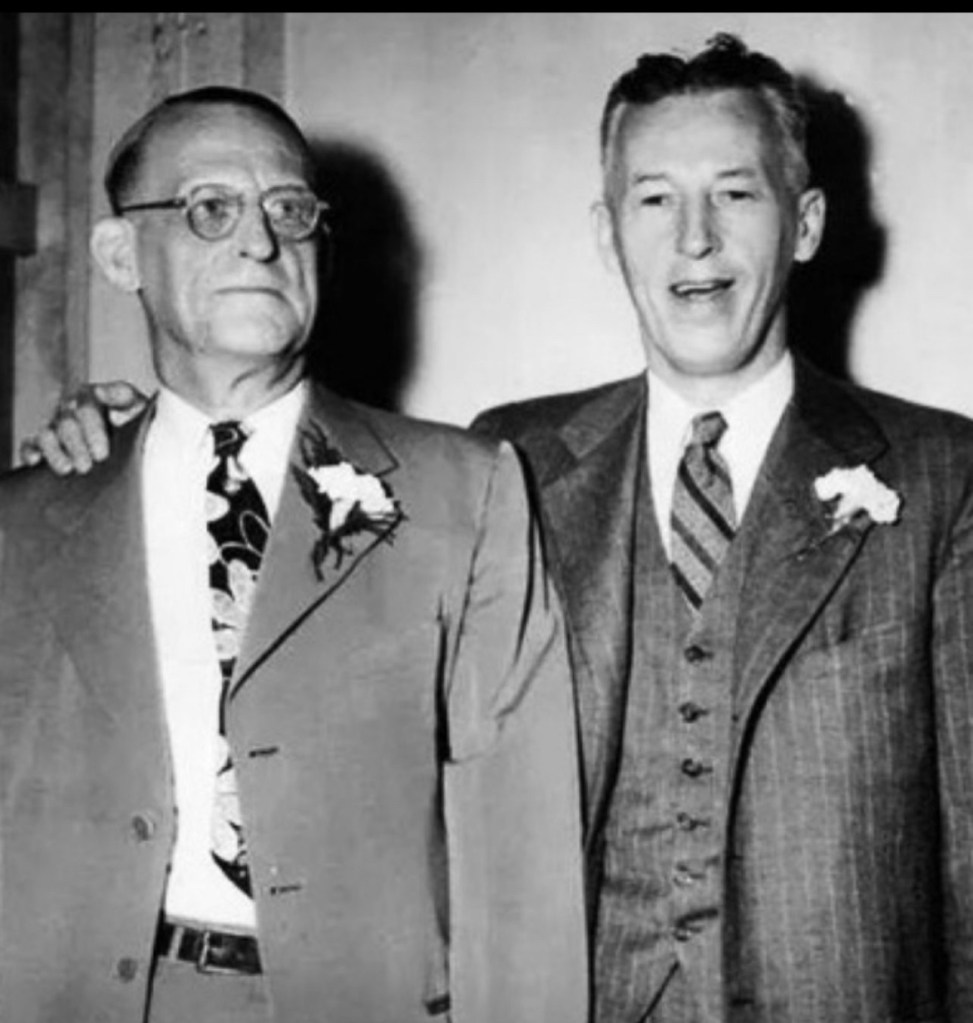
88 years ago on June 10, 1935, Robert Holbrook Smith, a.k.a. ‘Dr. Bob,’ drank one bottle of beer to settle his nerves so he could perform an operation. It was the last drink he ever had. The date is celebrated as the anniversary of the founding of Alcoholics Anonymous, the organization Dr. Bob (left) co-founded with Bill Wilson, a.k.a. ‘Bill W’ (right).
Out of Bill W.’s and Dr. Bob’s regular meetings for chronic alcoholics at Akron City Hospital grew the Twelve Step Program of Recovery. Dr. Bob sponsored more than 5,000 alcoholics before his death on November 16, 1950.
In Dr. Bob’s remarks on July 30, 1950 at the First International AA Convention in Cleveland, OH, he said:
And one more thing: None of us would be here today if somebody hadn’t taken time to explain things to us, to give us a little pat on the back, to take us to a meeting or two, to do numerous little kind and thoughtful acts in our behalf. So let us never get such a degree of smug complacency that we’re not willing to extend, or attempt to extend, to our less fortunate brothers that help which has been so beneficial to us.
Democratic Illinois Gov. J.B. Pritzker signed a bill into law Tuesday mandating that any lawsuit challenging a state law or executive order must be filed in two deep-blue counties being Cook or Sangamon.
.
Residents who want to redress their grievances with the state must take their plights to either Cook or Sangamon county after the Democrat-controlled state legislature passed the bill last month, according to the Chicago Tribune. Democrats argued the law would prevent plaintiffs from picking a county in which to file based on the likelihood of a favorable ruling. Democratic state Sen. Don Harmon said the law would still allow individuals to file cases against the state in local court if they do not intend to overturn the state law, according to WTVO.
The move to restrict lawsuits against state laws and executive orders comes three years after the start of the pandemic, during which Illinoisans brought several lawsuits win multiple counties challenging Pritzker’s executive orders.
Senate Republican leader John Curran said Tuesday that the move “is clearly an attempt by the governor and the attorney general to send constitutional challenges to courts that they believe will be more favorable to the Administration,” according to the Chicago Tribune. “In doing so, they are discrediting judges in suburban and downstate Illinois, and creating geographic barriers to citizens accessing our court system,” Curran added, per the outlet.
Republican State Rep. Dan Caulkins, who sued the state in January over its gun bans, lamented the law, according to the Tribune.
“They pass unconstitutional laws to make law-abiding citizens criminals, and then they make those same citizens travel hundreds of miles to a kangaroo court that they control. Tyrants are always the same, whether kings or lawless Chicago politicians,” he said, per the outlet.
Pritzker signed the budget today. He took time to correct the pay raise for legislators and lower it to a 5% increase instead of the illegal 5.5% the Dems had voted for themselves. He let the $300k grant to BLM Lake County stand even though the Marxist organization appears to be out of business and the leader has multiple felonies.
Pritzker Throws His Weight Around. “The Democratic definition of efficient government in Illinois is now lawmaking without judicial review. Downstate courts are often the only place where progressive laws encounter any resistance. Mr. Pritzker has eliminated them by fiat.” wsj.com/articles/illin…
Chicago Mayor Brandon Johnson was widely ridiculed for his comments this week about the city’s violent Memorial Day weekend. “We understand that when communities have been disinvested in and traumatized, that you are seeing the manifestation of that trauma,” Johnson said. He talked about his “holistic” approach to fighting crime, which means funding community groups. “Poverty didn’t go away over the weekend,” Johnson said.
“Yes, he actually said that, which goes a long way to explaining why gunmen patrol the streets with impunity,” a Wall Street Journal editorialsaid about those comments. The Journal went on, “Does the mayor have a date when he thinks poverty will vanish, the ‘trauma’ will ease, and the shootings stop? Is the July 4 weekend too soon, or will it be Labor Day?”
Unreported except by Center Square were Pritzker’s comments Wednesday that were to the same effect as Johnson’s. Asked if there’s more that should be done to reduce violence, he said, “When there is more poverty in a community, there is more likely to be criminal activity that arises in that community,” Pritzker said. “The more we can lift people up, and we are doing that in a number of ways, one of which is providing more education funding, early childhood education and alleviating some of the burdens on young families.”
That’s just “one of the ways” he is making public safety a priority, he said at the outset, and he did say that supporting the police is number one. But what are those other ways? He offered none except, like Johnson, spending on social programs and the “peacekeepers” who were ineffective over the weekend. How is he supporting police? The state has done nothing significant to help them. Instead, Pritzker and Johnson support the highly controversial Safe-T Act that will hamstring prosecutors and police if it survives current court challenges. Video of Pritzker’s full answer is here.
Yes, poverty contributes to crime and some social programs are part of a long-term solution. But, as with Johnson’s comments, Pritzker said nothing about lax prosecution by Cook County State’s Attorney Kim Foxx, personal responsibility, bad parenting, unwed births and other factors behind Chicago’s violence.
Also like Johnson, none of Pritzker’s comments were directed to those who need to hear a stern message, criminals themselves, to whom Johnson and Pritzker apparently ascribe no individual agency.
On this Memorial Day, 2023, thank you Peter Sobacki, a 1967 graduate of Holy Cross High School, who inspired a 13 year old to attend Holy Cross High School. Peter Sobacki was killed in Vietnam in 1968. Peter was my inspiration to attend Holy Cross High School in 1968. Peter was someone who loved his community and his country.
















 Roy F. McCampbell's Blog
The 5-step “military method” for falling asleep in minutes
Sleep is vital to how we function. Poor sleep has been linked to a higher risk of cardiovascular disease, diabetes, obesity, and dementia. Sleep deprivation affects your mood, makes you less likely to remember things, and makes your immune system less capable of fighting infections. It also affects performance. You are far more accident-prone and have far poorer judgment when you’re sleepy. As the National Institutes for Healthobserves, “Sleep deficiency has also played a role in human mistakes linked to tragic accidents, such as nuclear reactor meltdowns, grounding of large ships, and plane crashes.”
The military method is a sleep technique practiced by the U.S. Army to help soldiers sleep under any conditions, including gunfire. The method consists of five steps, focusing on progressive muscle relaxation, deep breathing, and guided imagery to achieve a calm and peaceful state. Incorporating the military method into a nightly routine can improve sleep habits and overall well-being.
For people in the military, getting good sleep can be a matter of life and death. This is why the U.S. Army practices the “military method” of sleep.
It was said that pilots in the Pre-Flight School who used the military method were able to fall asleep within 10 minutes. Within only six weeks, 96% of pilots using the method were reportedly able to fall asleep within this timeframe — even with gunfire in the background.
The five steps
So, what is this magic technique? Below we lay out the military method’s steps to a good night’s sleep. It’s deliberately designed to be easy and efficient, so anyone can start tonight.
Practice makes perfect
What does the science say about the military method of sleep? It turns out that Winter and the U.S. Army might be on to something. Stages 1, 2, and 5 are otherwise known as “progressive muscle relaxation,” and evidencesuggests it’s a good way to induce a calm, peaceful state. What’s more, the breathing techniques in stage 3 and the “guided imagery” of stage 5 have been shown to “enhance relaxation states, and improve overall well-being.”
But there’s also a hidden benefit lurking within the military method, and that’s the fact that it’s a method. Research has shown that keeping a routine is one of the best ways to improve your sleeping habits. It could be reading before bed, taking a shower, or doing some light exercise. The point is that routine itself is important. So give the military method a go, but don’t expect instant results. It can take between two and six weeks to become an expert — enough time for it to become routine. Stick at it, and you might just wake up feeling well-rested.
Share this: