
It’s already been a busy summer of travel — the Transportation Security Administration (TSA) reports that as of early June, seven of the agency’s 10 busiest travel days have happened in 2024 — so there’s a good chance you’ll find yourself filing through airport security sometime soon.

There are numerous things you’ll be allowed to bring with you through a TSA checkpoint. Sure, you may have to quickly chug the water you forgot to empty from your bottle and put your shampoo in one of those little travel containers, but you shouldn’t have any other problems.

When it comes to traveling with marijuana, regardless of what form it’s in, it’s a bit more complicated.
Marijuana may soon be a Schedule III drug: What will change?
Marijuana may soon be a Schedule III drug: What will change?
Over the last couple of years, more and more states have legalized recreational and medical use of marijuana. In 2023, Ohio became the 24th state to do so. Kentucky also legalized medical marijuana last year, but patients will have to wait until next year for the program to officially launch.

Federal authorities also appear poised to reschedule marijuana as a less dangerous drug in the U.S. While that doesn’t mean it will be immediately legal nationwide, it could be a step in that direction.
Until then, however, bringing marijuana in your carry-on could delay you more than a sudden thunderstorm directly over the airport.

Can you bring edibles or CBD products through TSA?
It depends. TSA does have some guidelines on what cannabis products you can have in your checked bag or carry-on: those with no more than 0.3% THC on a dry weight basis, and those approved by the Food and Drug Administration.
Currently, the FDA has only approved four such products: Epidiolex, a cannabidiol (or CBD); and three synthetic cannabis-related drug products: Marinol and Syndros, both considered dronabinol, and Cesamet, a nabilone, which can be used to treat nausea and vomiting caused by cancer medicines.
So if your edibles or CBD products meet those requirements, you’re allowed to fly with them.
These rules apply regardless of what airport — and what state — you’re flying to or from.
What if I have other marijuana products?
You may, or may not, be stopped by a TSA agent. Ultimately, those agents are “focused on detecting security threats and protecting the nation’s transportation system,” a TSA spokesperson tells Nexstar.
“If during the security screening process, an item is identified as a potential security threat, additional screening will occur,” the spokesperson adds. “If during that follow-up screening a TSA officer discovers anything that violates local, state or federal law, TSA refers the matter to the appropriate law enforcement agency. TSA remains focused on carrying out our transportation security priorities.”
TSA spokesperson previously told Nexstar that officers don’t search for marijuana or any other illegal drugs but are required to report it if they find it during the screening process. Local law enforcement will then decide what steps, if any, are taken.
“The TSA has gone out of its way to say that its focus is not on marijuana,” Larry Mishkin, an Illinois lawyer at the Hoban Law Group, which offers legal services for individuals in the marijuana industry, previously told The Washington Post.
What if marijuana is legal in the state I’m traveling to or from?
You’ll be able to bring through marijuana products that adhere to the TSA rules outlined above, but you may still be forced to ditch your items before moving through the security checkpoint.
Some airports, like O’Hare in Chicago, have amnesty boxes that allow travelers to abandon their weed before security. Los Angeles International warns passengers that while its airport police division has “no jurisdiction to arrest individuals if they are complying” with California’s marijuana law, TSA “screening stations are under federal jurisdiction.”
Additionally, because of TSA’s rules regarding marijuana, your airline likely won’t permit such products on their planes. Delta Air Lines and American Airlines, for example, explicitly say passengers are not allowed to transport marijuana on their flights, with the latter noting that “anyone traveling with or transporting marijuana on American flights does at their own risk.”

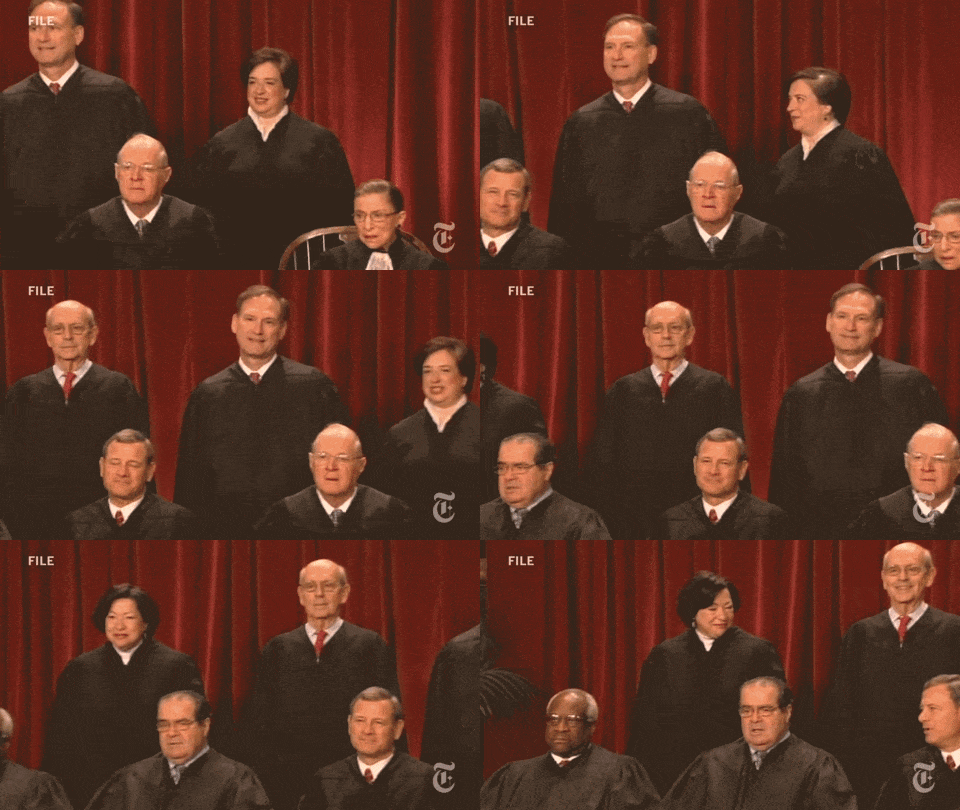











 Roy F. McCampbell's Blog
White House pressure “Cannot Be Dismissed as Mere Persuasion.”
OUTRAGED: Justice Samuel Alito EXPLODES after Supreme Court dismisses case against Biden’s White House pressuring social media companies to censor what they deemed disinformation during COVID and the 2020 election, says America might regret the decision, says, White House pressure “Cannot Be Dismissed as Mere Persuasion.”
In dissenting, Justice Alito was joined by Justices Thomas and Gorsuch
Alito penned a withering dissent in the Murthy case in stark contrast to the bewildering majority opinion in which Coney Barrett seems to contend there is some benign coercion exception to the federal govt violating the 1st Amendment. The naivete expressed by the majority as to what the government was doing is galactic in scope. One of the worst decisions in recent memory. A terrible day for fans of living in a free society.
NOTE: Justice Alito expressed significant concern about the extent of government influence on social media platforms, emphasizing that the interactions went beyond mere encouragement and ventured into coercion.
“The Government’s pressure tactics, which included threats of adverse regulatory action, cannot be dismissed as mere persuasion.”
NOTE: The dissent argued that the majority mischaracterized the plaintiffs’ standing, asserting that the connection between government actions and social media censorship was sufficiently established.
“The majority’s demand for concrete evidence of causation in each instance of censorship overlooks the broader pattern of government pressure and its chilling effect on free speech.”
NOTE: The dissent emphasized the potential chilling effect of government actions on free speech, warning that the ruling could embolden future government efforts to suppress dissenting views.
“This ruling effectively grants the government a free pass to continue its campaign of suppression, threatening the foundational principles of free expression.”
NOTE: Justice Alito argued that judicial intervention is necessary to prevent further government overreach in influencing social media moderation policies.
“Judicial oversight is imperative to safeguard against the encroachment of government on the marketplace of ideas.”
NOTE: The dissent highlighted ongoing evidence of government influence over social media platforms, pointing to continued communications and pressure tactics.
“The record is replete with instances of continued government engagement with social media companies, underscoring the persistent nature of the coercion.”
Share this: