🚨Chevron’s Exit From Venezuela By May 27th, 2025 Threatens US Energy Independence And Hands China A Strategic Victory 🚨


🚨Chevron’s Exit From Venezuela By May 27th, 2025 Threatens US Energy Independence And Hands China A Strategic Victory 🚨

We should as a nation be concerned about the growth of China in our hemisphere. South America in particular Venezuela is politically important.

How China is about to grow even more powerful in the Western Hemisphere, control Latin America, kill thousands of American jobs and have dominance over Venezuela’s oil unless President Trump extends the licenses for American oil companies in Venezuela by May 27th
@realDonaldTrump @JDVance @SecRubio @marcorubio
 
On May 27, 2025, @Chevron, the last major American oil company operating in Venezuela, will be forced to wind down its operations in the South American nation, marking a significant blow to U.S. energy interests and a dangerous step backward for American energy independence. This deadline, set by the U.S. Treasury Department under President Donald Trump’s administration @SecScottBessent, stems from the revocation of Chevron’s OFAC-issued license to operate, move tied to escalating sanctions against Venezuela’s Maduro regime.

While the intent behind these sanctions was to punish what many view as a corrupt and anti-democratic government, it is clear the ultimate consequences of this license revocation could undermine America’s strategic position in the global energy market, cede critical influence and power to China, and weaken our nation’s ability to secure affordable, reliable energy for the American people and initiate another migrant crisis at our borders. Rather than America First, this policy shift signals a China First approach that should be avoided at all costs.
 
For over a century, Chevron has been a cornerstone of American energy presence in Venezuela, a country sitting atop the world’s largest proven oil reserves—some 300 billion barrels. Chevron’s joint ventures with Venezuela’s state-owned PDVSA produceapproximately 242,000 barrels per day, accounting for roughly a quarter of Venezuela’s total oil output. In 2024 alone, Venezuelan crude made up 13% of imports to U.S. Gulf Coast refineries, providing a vital supply of heavy crude to American refiners like Valero Energy, PBF Energy, Phillips 66, and ExxonMobil which is simply unavailable in large, commercially viable quantities from US domestic oil producers.

This steady flow of oil has helped stabilize domestic fuel prices and ensured that American consumers aren’t left at the mercy of volatile global markets. But, with Chevron’s forced exit, this critical supply chain is at risk, threatening higher energy costs for American families and businesses at a time when economic stability is paramount and at a time where a global economic showdown between the US and China is festering.
 
The decision to push Chevron out of Venezuela is rooted in the Trump administration’s aggressive stance against Nicolas Maduro’s regime, which has been accused of electoral fraud, human rights abuses, and U.S. demands on the repatriation of illegal aliens.
 
On March 4, 2025, the Trump administration replaced Chevron’s General License 41 with a wind-down order, extended to May 27th via General License 41B, signaling a return to the “maximum pressure” sanctions of Trump’s first term – arguably one of the few foreign policy failures of the first Trump administration. Additionally, a 25% tariff on countries purchasing Venezuelan oil, effective April 2nd, aims to choke off Maduro’s revenue streams. While these measures may hurt Maduro’s coffers, they are much more likely to simply drive Venezuela’s oil trade underground, reducing transparency and empowering adversaries like China to fill the void left by American companies.
 
Why would we want to give China the upper hand and allow them to control Venezuela’s oil reserves when we can use these reserves to our benefit and negotiate a deal with Venezuela that allows for illegal alien repatriation and US control over Venezuelan oil with strict stipulations that President Trump and his special envoy Ric Grenell @RichardGrenell can implement and control?

Grenell’s recent visit to Venezuela proved that @NicolasMaduro Maduro, despite his flaws, has a deep respect for President Trump and is willing to comply with illegal alien repatriation and hostage releases. Moreover, he has demonstrated a preference for doing business with American controlled companies over Chinese, CCP controlled companies. Why would we want to further stoke conflict with Venezuela when we can take control of their oil reserves to benefit our long term goal of energy independence?
 
China, already the largest buyer of Venezuelan oil, stands to gain the most from Chevron’s departure. In February 2025, China imported 503,000 barrels per day—55% of Venezuela’s total exports—often at steep discounts due to sanctions. With Chevron out, Venezuela’s Vice President Delcy Rodríguez has actively courted Chinese investment, and even met with Chinese officials in April to secure increased oil purchases and supplies of diluent needed to process Venezuela’s tar-like crude.
 
This move not only strengthens China’s grip on Venezuela’s vast oil reserves, but also enhances Beijing’s influence in America’s backyard, just across the newly proclaimed Gulf of America. As Chevron CEO Mike Wirth recently warned, if American companies are forced out, “the oil production continues, and American companies are replaced” by Chinese and Russian drillers who offer less favorable terms to Maduro but secure strategic footholds in the Western Hemisphere.
 
Allowing China and Russia to have an increased presence and economic control in the Western Hemisphere poses a national security threat, and it contradicts President Trump and the State Department’s recent move to take back the Panama Canal for the explicit purpose of countering Chinese influence in Central and South America and the Panama Canal Zone.
 
The implications for American energy independence are dire. The United States, the world’s largest oil producer, has championed energy dominance under Trump’s “America First” agenda. Yet, losing access to Venezuelan crude—a reliable, geographically proximate source that compliments, rather than competes with domestic production—could increase U.S. reliance on more distant suppliers like Saudi Arabia or Iraq, raising procurement costs and exposing American refiners to geopolitical risks due to the perpetual state of chaos and violence in the Middle East.
 
U.S. Energy Secretary Chris Wright @SecretaryWright has downplayed the impact of China gaining more control over oil exports in Venezuela, claiming “small interruptions from other nations” won’t affect global supply. However, analysts at TD Cowen have recently warned that Chevron’s exit from Venezuela could spike crude prices, hitting U.S. Gulf Coast refineries hard and potentially driving up gasoline and diesel costs for American consumers. At a time where inflation remains a current concern, as the US continues its efforts to recover from Biden’s economy, this is a self-inflicted wound we cannot afford.

Additionally, why should America forgo the tens of thousands of well-paying jobs that will be created by allowing American companies to do business with Venezuela? These are American jobs in oil-field services, refining, and trading that will instead be sacrificed, once again, to China if the licenses to Americans in the oil industry are not extended in Venezuela.

These are American jobs in oil-field services, refining, and trading that will instead be sacrificed, once again, to China if the licenses to Americans in the oil industry are not extended in Venezuela.

Moreover, Chevron’s departure risks undermining the transparency and efficiency it brought to Venezuela’s oil sector. The “Chevron model,” which paired joint ventures with PDVSA with strict oversight to curb corruption, boosted Venezuelan production by 70,000 barrels per day in 2023 alone. Without Chevron’s expertise and capital, Venezuela’s crumbling energy infrastructure could deteriorate further, reducing output and forcing Maduro to rely on opaque deals with Chinese firms controlled by the CCP, or shadow fleets, as seen during earlier sanction periods.

These shadow oil fleets operate with a high degree of non-transparency and evade sanctions and regulations. These ships, often older and flagged in countries outside of Western sanctions, are used to circumvent price caps and other restrictions imposed on Russian oil exports. 
 
This will not only enrich corrupt intermediaries, but it also diminishes U.S. leverage over Venezuela’s oil market, handing China a free pass to dictate the terms.
 
From an America First perspective, maintaining a strong U.S. presence in Venezuela’s oil sector is not about coddling Maduro, but about securing our national interests. Chevron’s operations have kept American companies at the forefront, ensuring that the United States—not China or Russia—benefits from Venezuela’s vast resources. By forcing Chevron out, we risk ceding this strategic asset to adversaries who will use it to fuel their own economic and geopolitical ambitions.
 
As the looming May 27th deadline approaches, the United States must reconsider this path. An extension of Chevron’s, and other American’s licenses will allow for the Trump administration to have a pragmatic approach with strategic engagement, ensuring that American companies, not Chinese companies, shape the future of Venezuela’s oil industry.
 
The stakes are high. Losing ground in Venezuela not only threatens our energy security but also emboldens China to challenge U.S. leadership in the Western Hemisphere. For the sake of American workers, consumers, national security, and our global standing, we must prioritize energy independence and keep Chevron and other American oil companies in the game to block China from turning Venezuela into their personal oil depot.
 
President Trump’s energy strategy is about dominance—drill, baby, drill, and keep our adversaries at bay. Letting Chevron leave Venezuela is a step backward, and we can’t afford to lose ground to Communist China.


Posted in China, law, Law Offices of Roy F McCampbell, left, legal services, Roy F McCampbell Blog Ranked #4 on the 20 Best Political Satire Blogs and Websites in 2024 for 5th year in a Row, Roy F. McCampbell, Social Media, Top 30 Political Satire Blogs and Websites in 2021, Venezuela | Tagged , , , , , , , | Leave a comment

Roy F McCampbell Blog makes number 4 on 15 Best Political Satire Blogs and Websites in 2025


Roy F McCampbell Blog makes number 4 on 15 Best Political Satire Blogs and Websites in 2025
https://bloggers.feedspot.com/political_satire_blogs/

Posted in illinois politics, law, Law Offices of Roy F McCampbell, legal services, political satire, politics, Roy F McCampbell Blog Ranked #4 on the 20 Best Political Satire Blogs and Websites in 2024 for 5th year in a Row, Roy F. McCampbell, Schiller Park Commentaries, schillerparkblog, Top 20 Political Satire Blogs in 2024, top 30 blog, Top 30 Political Satire Blogs and Websites for 2023, Top 30 Political Satire Blogs and Websites in 2021 | Tagged , , , , , , , , , , , , | Leave a comment

JB Pritzker’s “EV Flop”


The Wheels On The Bus Fell Off: JB Pritzker’s “EV flop”

CHICAGO — Back in June 2023, JB Pritzker, Dick Durbin, Tammy Duckworth, and a crowd of lawmakers flocked to Joliet, patting themselves on the back as they cut the ribbon on Lion Electric’s electric vehicle plant. Fast forward two years and Lion Electric’s disastrous tenure in Illinois is coming to an end. The results of Pritzker’s “EV Flop” speak for themselves:
December 2024: The wheels on the bus fell off as Lion Electric shuttered their Joliet plant and laid off hundreds across the United States and Canada

Last week: Quebec announced it would NOT invest $24 million to help Lion relaunch

May 15th: The company’s equipment goes on the auction block, and liquidation seems all but certain

Don’t forget: Last December, Pritzker announced that $19.9 million of our taxpayer dollars would be used to build 70 electric school buses in nine school districts — over $284,000 per bus.

Posted in #taxation, Better Government Association, blog, campaign, Chicago, Culture, Economic Development, Economy, Electric vehicle, Illinois, illinois politics, law, Law Offices of Roy F McCampbell, legal services, liability, lobbying, mental health, News, politics, pork, Pritzker, robbed, Roy F. McCampbell, senator durbin, Social Media, State of the Union, state representative, stock market, Taxation, theft, Top 30 Political Satire Blogs and Websites in 2021, US Supreme Court, USCongress, vote | Tagged , , , , , , , , , , , , | Leave a comment

The Day Virgin Airlines Was Born


In 1979, British Airways made a tiny mistake that cost them $5 billion.

They canceled one man’s flight.
He took it very personally.

So personally, that he launched his own airline just to compete with them.

What followed became one of the most brutal rivalries in business history…

The man’s name was Richard Branson

Before he became Sir Richard Branson, he was a 29-year-old record label owner, just trying to get to the British Virgin Islands.

But when British Airways canceled the last flight of the day, leaving him and dozens of others stranded…

Branson made a split-second decision – one that would eventually lead to a $5 billion airline empire.

Frustrated but quick-thinking, Branson grabbed a small blackboard and scribbled:

“Virgin Airlines – $39 one-way to BVI.”

Then he walked through the terminal, calling out:

“Who wants to join me? I’ve chartered a plane!”

Within minutes, he filled the flight with stranded passengers and covered the $2,000 charter cost.

That day, Virgin Airlines was born.

While flying on “his” plane, a lightbulb went off in Branson’s mind:

“If I can fill a plane with frustrated British Airways customers this easily… why not start my own airline?”

It would take five more years to make it happen.
But he never forgot that feeling of being stranded by a corporate giant that simply didn’t care.

That spark of frustration became the fuel for Virgin Atlantic.

June 22, 1984, A single leased Boeing 747 took off from London Gatwick to Newark.

That flight marked the birth of Virgin Atlantic – built on:

One aircraft

One route

One bold mission: “Make flying great again.”

British Airways executives laughed.
To them, Branson’s airline was a joke.

They had no idea a war had just begun.

BA’s Chairman, Lord King, publicly mocked Branson:

“He’s too old to rock n’ roll and too young to fly.”

But Branson saw something BA didn’t:

Customers were fed up with the soulless, corporate experience of most airlines.

He knew they wanted something different, something personal.

British Airways wasn’t just the UK’s flag carrier, it was a monopolistic giant, with:

60% market share of UK flights

Strong government ties

A massive marketing budget

Recently privatized and led by aggressive management

On paper, they should have crushed Virgin without breaking a sweat.

But Branson turned his underdog status into a weapon, doing the complete opposite of what British Airways stood for:

Free ice cream for passengers

In-flight massages

Stand-up bars on planes

Fashion-designed uniforms for the crew

“Flying Ladies” – beautifully painted planes that turned heads

Virgin Atlantic wasn’t just an airline; it was an experience that BA couldn’t match.

As Virgin grew from 1 to 10 aircraft by 1991, British Airways began to feel the heat.

That’s when they launched what would later be called the “Dirty Tricks Campaign” – one of the most unethical corporate espionage operations in business history.

British Airways didn’t just compete; they sabotaged Virgin at every turn:

Hacked Virgin’s systems

Called Virgin’s customers, falsely claiming flights were canceled

Spread rumors to journalists about Virgin’s financial troubles

Poached passengers at airports with lies about Virgin

Spied relentlessly, gathering intel to crush Branson’s growing empire

By 1992, the pressure from BA had taken its toll.

Branson was forced to sell his beloved Virgin Records just to keep his airline afloat.

But instead of giving up, he did something unprecedented:

He declared war on British Airways – publicly.

In 1992, Branson took the battle to court, suing BA for libel.

As the case unfolded, shocking evidence emerged:

BA staff admitted to shredding incriminating documents

Whistleblowers came forward, exposing the “dirty tricks” campaign

BA executives refused to testify, further incriminating themselves

The aviation world watched in shock as the corporate giant was slowly unraveled.

In 1993, British Airways surrendered.

They paid:

  • £1M to Branson personally
  • £250k to Virgin Atlantic
  • All legal fees

And they also issued a formal public apology.

BA’s Chairman, Lord King, was forced to resign in disgrace.

But Branson’s most brilliant move came next…

Instead of keeping the money, he distributed it to every Virgin Atlantic employee as a “BA Bonus.”

The message was clear: “They tried to kill us. We’re still here. And we’re all in this fight together.”

The David vs. Goliath victory created unmeasurable brand value:

  • Virgin bookings surged 30%
  • Staff loyalty became unbreakable
  • The media portrayed BA as corporate villains
  • Virgin’s brand reputation soared

The £1M settlement generated £100M+ in brand value.

So what can we learn from Sir Richard Branson and Virgin Atlantic?

✔️Challenge with purpose – Branson didn’t just compete; he wanted to transform the airline experience.

✔️ Leverage your underdog status – Being small gave Virgin the ability to offer unique experiences, unlike the giants.

✔️ Fight back when attacked – Branson used strategy, integrity, and public pressure to overcome unethical tactics.

✔️ Invest in your people – Branson’s decision to share the settlement with his team built unbreakable loyalty.

✔️ Brand loyalty is priceless – Virgin’s victory led to a surge in bookings and skyrocketing brand value.

When you fight with purpose, leverage your unique position, and put people first, you can turn even the most brutal battles into monumental success.

Posted in #taxation, blog, casino, Economic Development, Economy, gambling, intelligence, law, Law Offices of Roy F McCampbell, legal services, liability, pilot, political satire, politics, Roy F. McCampbell, Social Media, Transportation | Tagged , , , , , , , , , | Leave a comment

Interesting History of “Sayings” or “Anecdotes “


Most people got married in June because they took their yearly bath in May, and they still smelled pretty good by June. Since they were starting to smell, however, brides carried a bouquet of flowers to hide the body odor. Hence the custom today of carrying a bouquet 💐 when getting married.

Baths consisted of a big tub 🛀 filled with hot water. The man of the house had the privilege of the nice clean water, then all the other sons and men, then the women, and finally the children. Last of all the babies. By then the water was so dirty you could actually lose someone in it … hence the saying, “Don’t throw the baby out with the Bath water!”

Houses had thatched roofs-thick straw-piled high, with no wood underneath. It was the only place for animals to get warm, so all the cats and other small animals (mice, bugs) lived in the roof. When it rained it became slippery and sometimes the animals would slip and fall off the roof, resulting in the idiom, “It’s raining cats and dogs.”

There was nothing to stop things from falling into the house. This posed a real problem in the bedroom where bugs and other droppings could mess up your nice clean bed, therefore, a bed with big posts and a sheet hung over the top afforded some protection. That’s how canopy beds came into existence.

The floor was dirt. Only the wealthy had something other than dirt, leading folks to coin the phrase “dirt poor.”

The wealthy had slate floors that would get slippery in the winter when wet, so they spread thresh (straw) on floor to help keep their footing. As the winter wore on, they added more thresh until, when you opened the door, it would all start slipping outside. A piece of wood was placed in the entrance-way, subsequently creating a “thresh hold.”

In those old days, they cooked in the kitchen with a big kettle that always hung over the fire.. Every day they lit the fire 🔥and added things to the pot. They ate mostly vegetables and did not get much meat. They would eat the stew for dinner, leaving leftovers in the pot to get cold overnight and then start over the next day. Sometimes stew had food in it that had been there for quite a while, and thus the rhyme, “Peas porridge hot, peas porridge cold, peas porridge in the pot nine days old.”

Sometimes they could obtain pork, 🐷 which made them feel quite special. When visitors came over, they would hang up their bacon to show off. It was a sign of wealth that a man could, “bring home the bacon.” They would cut off a little to share with guests and would all sit around and “chew the fat.”

Those with money had plates made of pewter. Food with high acid content caused some of the lead to leach onto the food, causing lead poisoning death. This happened most often with tomatoes, so for the next 400 years or so, tomatoes were considered poisonous.

Bread was divided according to status. Workers got the burnt bottom of the loaf, the family got the middle, and guests got the top, or the “upper crust.”

Lead cups were used to drink ale or whisky. The combination would sometimes knock the imbibers out for a couple of days. Someone walking along the road would take them for dead and prepare them for burial.. They were laid out on the kitchen table for a couple of days and the family would gather around and eat and drink and wait and see if they would wake up, creating the custom of holding a wake.

They used to use urine to tan animal skins, so families used to all pee in a pot 🍲 & then once a day it was taken & sold to the tannery. If you had to do this to survive you were “piss poor.”
But worse than that were the really poor folk who couldn’t even afford to buy a pot; they “didn’t have a pot to piss in” & were the lowest of the low.

The next time you are washing your hands & complain because the water temperature isn’t just how you like it, think about how things used to be. Here are some facts about the 1500s.

England is old and small and the local folks started running out of places to bury people. So they would dig up coffins and would take the bones to a bone-house, and reuse the grave. When reopening these coffins, 1 out of 25 coffins were found to have scratch marks on the inside 😳 and they realized they had been burying people alive, so they would tie a string on the wrist of the corpse, lead it through the coffin and up through the ground and tie it to a bell. Someone would have to sit out in the graveyard all night (the graveyard shift.) to listen for the bell; thus, someone could be, saved by the bell or was considered a dead ringer.

Posted in #420day, Anecdote, benefits, Roy F McCampbell Blog Ranked #4 on the 20 Best Political Satire Blogs and Websites in 2024 for 5th year in a Row, Roy F. McCampbell, sleep, tips, Top 30 Political Satire Blogs and Websites in 2021, unconstitutional, US Supreme Court, USCongress | Tagged , , , , , , , , , , , , , | Leave a comment

Can You Fail a Drug Test from Secondhand Marijuana Smoke?


Posted in Uncategorized | Leave a comment

What is 420 Day ?


Posted in Uncategorized | Leave a comment

Denied a FOID Card in Illinois ? What are your options ?


In Illinois, many people get denied when applying for their Firearm Identification (FOID) card. Most of the time, this denial happens because of a criminal conviction. Other times, a denial can happen because of previous admissions for mental health treatment or because a law enforcement agency objects to an applicant who may be a danger to themselves or others.

In the event that an applicant is denied based upon a criminal conviction, there are two main types of appeals. The level and severity of the criminal conviction will determine which appeal an applicant must pursue.

The first type of appeal is an administrative appeal directly to Illinois State Police (ISP) and their newly established FOID Card Review Board (FCRB). This appeal is typically necessary when an applicant is denied based on a conviction for a misdemeanor or low-level drug-related felony. This appeal consists of gathering and submitting documentation to the FCRB so that the board can determine whether an applicant may overcome the denial and be granted a FOID card. The FCRB requires (1) a request for investigation form, (2) a personal statement from the applicant, and (3) at least two letters of support from the applicant’s friends, family, and/or colleagues. These letters of support require the writers to attest to the applicant’s fitness to own a firearm, and must include the writers’ relationship to the applicant, along with the writers’ personal details like name and date of birth. All letters submitted to the FCRB must be notarized and have the strict requirement to be notarized within 45 days of submission to the FCRB. This type of administrative appeal can be mailed or e-mailed to the FCRB, and it is free to file. If the FCRB determines the applicant has demonstrated their fitness for a FOID card despite their conviction(s), ISP will issue the FOID card.

The second type of appeal after a denial of a FOID application is an appeal to the circuit court. If an applicant is denied after an administrative appeal to the FCRB, the applicant must then appeal that decision to the circuit court. This type of appeal is also usually necessary when an applicant is prohibited from obtaining a FOID card based on a felony conviction. Although some drug felonies are eligible for the FCRB appeal, Class 2 drug felonies and higher require the applicant to appeal directly to the circuit court in which the applicant resides. There are certain misdemeanors that require an applicant to appeal in circuit court, too; most notably a conviction for domestic battery or domestic violence. Appealing in circuit court is essentially filing suit against the Illinois State Police; this type of filing is engaging in litigation with ISP to try and appeal their denial through judicial review. This type of filing incurs filing fees and fees associated with serving ISP and potentially serving a county State’s Attorney that may be necessary to the suit. This is typically a long process that involves the applicant (or their attorney) filing the initial complaint, answering ISP’s and/or the State’s Attorney’s objections, and eventually participating in an evidentiary hearing after which a judge will rule in favor or against the applicant. If the applicant is successful in persuading the court that they should be allowed a FOID card despite their conviction(s), the judge issues an Order that directs ISP to issue the FOID card.

It is important that a skilled attorney helps an applicant navigate their FOID appeal – first to determine which kind of appeal is necessary, and secondly to submit that appeal efficiently and without defect.

Contact Roy F. McCampbell. Esq, for questions on your FOID Card eligibility at 708/878-7957

Posted in assault weapon, ATF, bond, Bradley Stephens, cash bail, chokeholds, foid, gun, gun confiscation, gun control, Illinois, illinois politics, injunction, law, Law Offices of Roy F McCampbell, legal services, liability, mental health days, Roy F McCampbell Blog Ranked #4 on the 20 Best Political Satire Blogs and Websites in 2024 for 5th year in a Row, Roy F. McCampbell, SAFE-T Act, Social Media, state representative, student discipline, unconstitutional, US Supreme Court, USCongress | Tagged , , , , , , , , | Leave a comment

🇺🇸 Ross Perot Was Right. Trump is Proving It !


🇺🇸 Ross Perot Was Right. Trump Proved It.

In 1992, during a historic presidential debate, independent candidate Ross Perot looked America in the eye and gave us a prophecy.

“If you’re paying $12, $13, $14 an hour for factory workers, and you move your factory south of the border… pay a dollar an hour, have no health care, no environmental controls, no retirement… there’ll be a giant sucking sound going south.”

He wasn’t wrong. He was early.

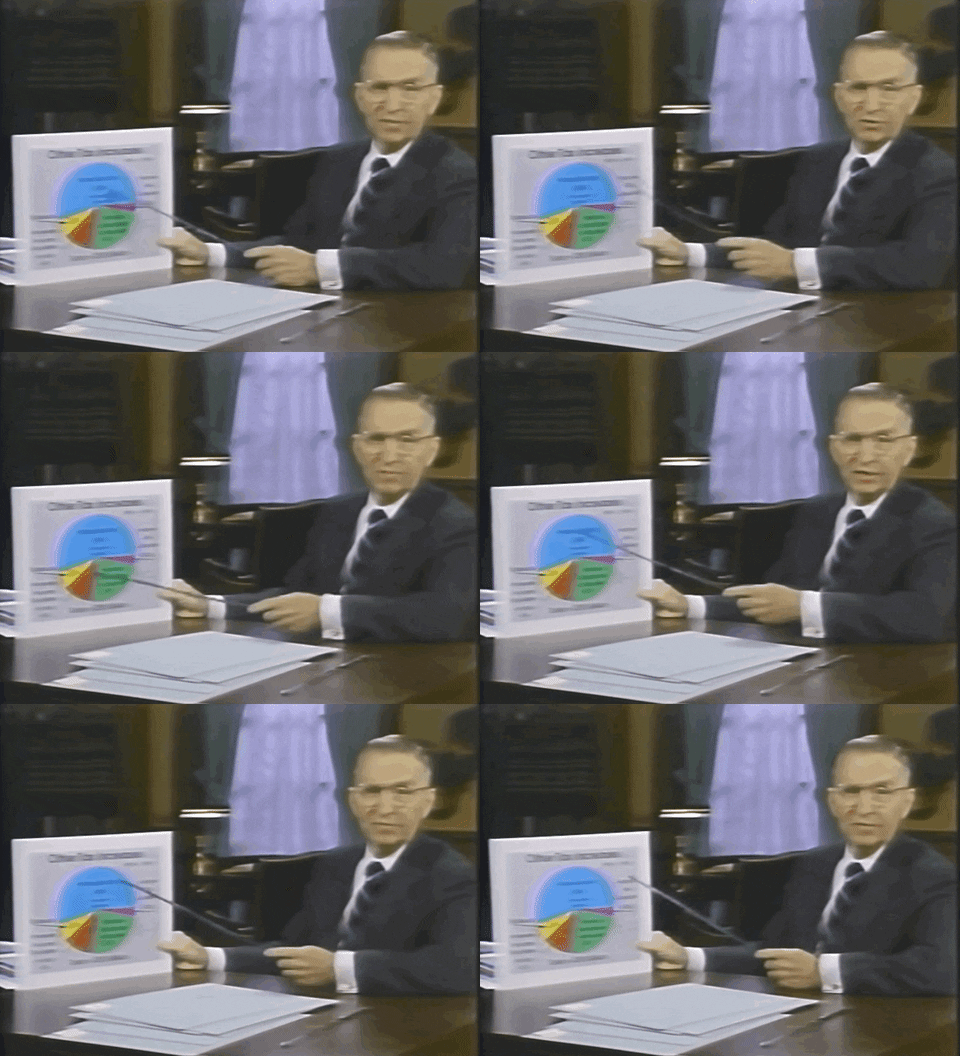
Perot wasn’t backed by PACs, parties, or special interests. He was powered by 5.5 million Americans who put him on the ballot because they were tired of being lied to. Tired of the fake choices between two corrupt machines. He brought charts, truth, and the heart of a businessman who had built things — not just talked about it.

He spoke of balanced budgets, public accountability, and the decay of the middle class. He waved a “voodoo stick” in one speech to mock the voodoo economics of the establishment. He exposed how corporate executives got richer while average Americans struggled to pay rent.

📉 Between 1977 and 1992:

The poorest 60% of Americans lost purchasing power.

The top 1% increased their wealth by 138%.

Trickle-down? It never trickled. It pooled at the top.

He warned of a government run by lobbyists, of $4 trillion in public debt, and of outsourcing America’s future to countries that don’t share our values.

He said:

“We need to practice 21st century capitalism — not 19th century exploitation. We need small business growth, modern industry, and to rebuild this great country. Not just let it rot while politicians play golf.”

He called for:

Slashing congressional perks and staff

Ending special interest contributions

A simplified, fair tax system

Investment in Made in USA jobs and industries of the future

Stopping career politicians from lobbying after leaving office

A government that works for the people, not themselves

Sound familiar?

🔁 Fast forward to @realDonaldTrump:

Withdrew from the TPP

Replaced NAFTA with USMCA

Slapped tariffs on China and brought manufacturing back

Promoted economic patriotism and fair trade over free trade

Refused to be bought by donors and global corporations

Today @POTUS Trump delivered on what Perot had long ago demanded.

This isn’t about Republican or Democrat.
It’s about America First. It’s about finally having a leader who fought for the same people Perot stood up for.

📽️ Perot said:
“You move your factories across the border, lose your middle class, and you won’t be able to defend this country.”

He was mocked. Laughed at. Even “fact-checked.”

But 30 years later — we’re living in his warning.

And Trump?
He did something about it.

We must never forget Ross Perot’s voice. He lit the fire. Trump kept it burning.

Let’s finish what they started with @POTUS 2025.

Posted in antifa, banking fraud, benefits, Betsy Ross, Biden, black lives matter, campaign, census, China, citizenship question, civil war, cocaine, collusion, constitution, corruption, Crime, Deport, Economic Development, Economy, Education, election fraud, Elections, face masks, Fauci, gambling, gangs, gasoline, Gaza, George Floyd, gun, gun confiscation, gun control, Hamas, Health, health risk, HIPPA, homelessness, Illinois, illinois politics, law, Law Offices of Roy F McCampbell, left, legal services, liability, lobbying, London, marijuana, marine, mental health, migrants, PLO, politics, Population, Pritzker, privacy, Putin, quarantine, rape, referendum, Religion, rioting, Roy F. McCampbell, sanctions, Social Media, social security, teamsters, terrorist, Terrorists, tips, Trump, Turkey, Ukraine, Ukrainia, unconstitutional, Union, US Supreme Court, USCongress, vaccines, vaping, wages, weapon ban, weed | Tagged , , , , , , , , , | Leave a comment

Are You Scared Of Tariffs ?


Tariffs will have ZERO long-term impact on the stock market.

There…I said it.

Don’t believe me? Basic math says I’m correct.

If you’re scared of tariffs, you won’t be after reading this 👇

In a healthy economy, tariffs should have a long-term impact on the stock market.

But we don’t live in a healthy economy.

We live in a currency debasing shitshow.

Regardless of what any politician does to the stock market…

The Federal Reserve can add digits on a computer screen, and your stocks will skyrocket.

And that’s exactly what they’ll be doing soon.

Not necessarily because they want to…because they have to.

Here’s the situation.

The U.S. is $36.6 trillion in debt.

$9.2 of that $36 trillion needs to either be refinanced or paid this year.

Let’s examine both options and see how all roads lead to higher stock prices.

Option 1:

The $9.2 trillion is paid off.

There are only a handful of ways to make this happen.

  • Tax citizens to pay it off
  • Cut government spending and reallocate funds
  • Print money (Quantitative Easing)

Here’s why printing money is the only logical choice of the 3.

The government collected ~$5 trillion in taxes last year.

Which means we’re still $4 trillion short.

Plus, Trump is preaching zero income taxes.

So raising taxes to collect $4 trillion more? Political suicide.

Paying off the $9.2 trillion with taxes is off the table.

Next, the government can cut spending elsewhere and reallocate funds.

Such as the military, federal programs, etc.

But that wouldn’t work either.

Military = $900B
Social Security = 1.4T
Medicaid and other health insurance programs = $1.6T

Even if I tally up all government expenditures, it still doesn’t pay off the debt.

And finally…the only possible choice.

The Federal Reserve will perform quantitative easing.

Which is a fancy-pants way of saying they’ll print money out of thin air.

This money will be used to purchase bonds from the US Treasury.

This directly injects cash into the financial system.

If the Fed creates $9.2 trillion, it’s practically impossible for stocks not to rise.

Alright, so that’s what’ll happen if the Fed performs quantitative easing.

The other option is refinancing the debt at new interest rates.

Basically…kicking the can down the road.

The problem with refinancing at new rates is that interest rates are relatively high right now.

And the US is already paying ~$1.2T in yearly interest.

If we refinance $9.2T at current rates, that $1.2T in yearly interest would soar.

Not good.

So what’s the solution?

Cutting rates, of course.

Afterwards, the debt will be rolled over.

So the Fed’s options are the following:

Print $9.2 trillion (stocks would go parabolic)

Or cut rates, which means more lending will occur.

Lending with interest is how smaller banks effectively create money.

So no matter what happens, more money will be printed.

Which means your assets will rise.

There you have it.

Stocks will rise – regardless of Trump’s tariffs.

All roads lead to the money printer.

If you’re wondering when a genuine bear market could take place…

The most likely answer is 2026.

We live in a global economy with 4-year debt cycles.

The year of quantitative tightening and rate hikes worldwide is most likely 2026.

Until then, enjoy this monumental buying opportunity.

There you have it!

Are you scared of tariffs?

Posted in Afghanistan, black lives matter, census, chicago fashion mall, citizenship question, civil war, cocaine, coffee, Collapse of society, constitution, Crash, Culture, Deport, Education, Elections, Finance, Food, gambling, intelligence, internment camps, iraq, Ireland, Japanese Americans, law, Law Offices of Roy F McCampbell, legal services, liability, lobbying, marijuana, migrants, minimum wage, Muslim, News, pilot, PLO, police, politics, Population, Pritzker, Putin, quarantine, Referendums, rioting, Roy F. McCampbell, sanctions, slavery, stock market, student discipline, Taxation, terrorist, theft, unconstitutional, US Supreme Court, USCongress, vietnam, vote, wages, Weather, World War II | Tagged , , , , , , , , , , , | 1 Comment