A federal judge on Thursday declined to block Illinois’ new “medical aid in dying” law from going into effect this weekend, clearing the way for terminally ill adults to legally seek life-ending medication from physicians.
Illinois’s End-of-Life Options for Terminally Ill Patients Act (EOLA), which legalizes medical aid in dying for terminally ill adults, faces several key legal, ethical, and religious controversies. [1, 2, 3]
Disability Rights Concerns
Allegations of Discrimination: Disability rights advocates and individual plaintiffs sued the state, arguing the law discriminates against vulnerable populations. [1, 2, 3]
Fear of Coercion: Opponents claim the law could implicitly pressure disabled or chronically ill individuals—who may not actually have a terminal prognosis—into ending their lives prematurely. [1, 2]
Impaired Doctor-Patient Trust: Critics argue the framework strains the relationship between patients with disabilities and their medical providers. (A federal judge declined a preliminary injunction to halt the law, ruling plaintiffs failed to prove immediate irreparable harm). [1, 2]Religious and Conscience Objections
Catholic Leadership Opposition: Chicago Archbishop Cardinal Blase Cupich, local dioceses, and Catholic healthcare organizations strongly oppose the law, viewing it as a violation of the sanctity of life.[1, 2, 3]
Conscience Protections: Legal challenges and temporary restraining orders have been sought to protect faith-based healthcare workers and institutions that refuse to participate in or facilitate aid-in-dying services due to moral objections. [1, 2]Medical and Ethical Debates
The Oath to Do No Harm: Opponents, including some physicians and religious leaders, argue that prescribing life-ending medication directly conflicts with the traditional healing role and ethical oaths of doctors. [1]
Division Among Physicians: While a majority of Illinois Physicians’ Attitudes Toward Medical Aid in Dying express overall support for the concept as an end-of-life choice, practicing doctors remain closely divided on whether they personally would be willing to write a lethal prescription. [1]Capitol News IllinoisJudge declines to block Illinois’ ‘medical aid in dying’ law ahead of Sept. 12 startSep 10, 2026 — Article Summary Illinois is set to become the first Midwestern state to allow terminally ill patients to seek life-ending medication from their physicians when …
AxiosIllinois medical-aid-in-dying law takes effect Saturday – Axios ChicagoSep 10, 2026 — Advocates for the Medical Aid in Dying Act in 2023 in New York. Jim Franco/Albany Times Union via Getty Images Legal challenges to Illinois’ medical-aid-in-dyin…
STLPRJudge declines to block Illinois’ ‘medical aid in dying’ law ahead of Sept. 12 startSep 11, 2026 — Capitol News Illinois The Dirksen Courthouse in Chicago. A federal judge on Thursday declined to block Illinois’ new “medical aid in dying” law from going into …
Facebook·ABC 7 Chicago0:32A federal judge Friday approved a requested temporary restraining order …
ABC7 ChicagoFederal judge approves temporary restraining order in lawsuit filed by Catholic leaders in Illinois ‘medical aid in dying’ lawSep 11, 2026 — Judge approves TRO in suit filed by Catholic leaders in Illinois ‘medical aid in dying’ law. … A federal judge approved a temporary restraining order in a law…
Compassion & ChoicesSurvey of Illinois Physicians’ Attitudes Toward Medical Aid in Dying as an …By a margin of 58-25 percent, Illinois physicians support medical aid in dying or physician-assisted death (MAID/PAD). When asked whether they support or oppose…
ABC7 ChicagoFederal judge declines to block Illinois’ ‘medical aid in dying’ law ahead of Sept. 12 startSep 10, 2026 — Chicago Archbishop Cardinal Blase Cupich and 2 orders of Catholic nuns filed a lawsuit in an effort to block an Illinois medical aid-in-dying law. … CHICAGO –
WTTW NewsFederal Judge Rejects Bid to Block Illinois’ ‘Medical Aid in Dying’ Law Days …Sep 10, 2026 — Federal Judge Rejects Bid to Block Illinois’ ‘Medical Aid in Dying’ Law Days Before It Takes Effect. … A federal judge has denied a motion that sought to bloc…
NBC 5 ChicagoJudge temporarily blocks Illinois’ ‘medical aid in dying’ law from starting — for someSep 11, 2026 — A federal judge on Friday temporarily blocked Illinois’ ‘medical aid in dying’ law that was set to start this weekend — for some. With the judge’s approval, a…
Facebook·Eyewitness News0:40A federal judge has temporarily blocked enforcement of portions of Illinois’ new …
You can access state-specific guides, forms, and advance directives through Compassion & Choices Illinois as the state implements its medical aid in dying law. [1]
Illinois is the first Midwestern state to authorize medical aid in dying for terminally ill patients under the End-of-Life Options for Terminally Ill Patients Act, also known as Deb’s Law. [1, 2]
Eligibility Requirements
- Age & Residency: Must be an adult (18 or older) and a resident of Illinois.
- Diagnosis: Must have a terminal illness with a prognosis of six months or less to live, confirmed by two independent physicians.
- Mental Capacity: Must be mentally capable of making healthcare decisions, and depression alone does not qualify a patient.
- Administration: Must be physically able to self-administer the medication.[1, 2, 3, 4]
How the Process Works
- Requests: Patients must make explicit oral and written requests. Family members or surrogate decision-makers cannot request the medication for a patient. [1]
- Witnesses: Written requests must be signed and witnessed by two individuals who confirm the patient acts voluntarily and without coercion. [1]
- Informed Consent: Attending physicians must discuss all end-of-life care options, including hospice, palliative care, and pain control. [1]
Provider Participation and Legal Status
- Voluntary Participation: No doctor, pharmacist, or healthcare worker is required to participate.
- Facility Rules: Hospitals and healthcare networks can choose not to offer medical aid in dying.
- Current Challenges: Ongoing legal challenges and temporary restraining orders apply to certain religiously affiliated health systems while court battles proceed. [1, 2, 3, 4]
Under SB 1950, individuals with a prognosis of six months or less to live can request a prescription for aid-in-dying medication. The oral and written requests can only be made by the patient to the patient’s attending physician. SB 1950 includes language for what that written request should entail. (A written, signed request is required.)
The attending physician’s duties include determining the mental capacity of the patient (with referral to a mental health profession if warranted), confirming that coercion did not play a role in the request, providing information on other end-of-life treatment options, and referring the patient to a consulting physician for medical confirmation. No health care provider is required to participate, and SB 1950 makes it a felony to coerce anyone to request the medication or to forge a request.
The Illinois Department of Public Health will produce annual reports on the number of prescriptions for aid-in-dying medication, the number of physicians who prescribed it, and the number of deaths. Oregon’s Death With Dignity Act was the first of its kind in the nation and dates back to 1997. In 2024, there were 607 recipients of aid-in-dying medication in Oregon and 376 deaths. The number of deaths under the Oregon law has risen over time — from 42 in 2003, to 73 in 2014, to a high of 386 in 2023 (followed by the slight decline in 2024).
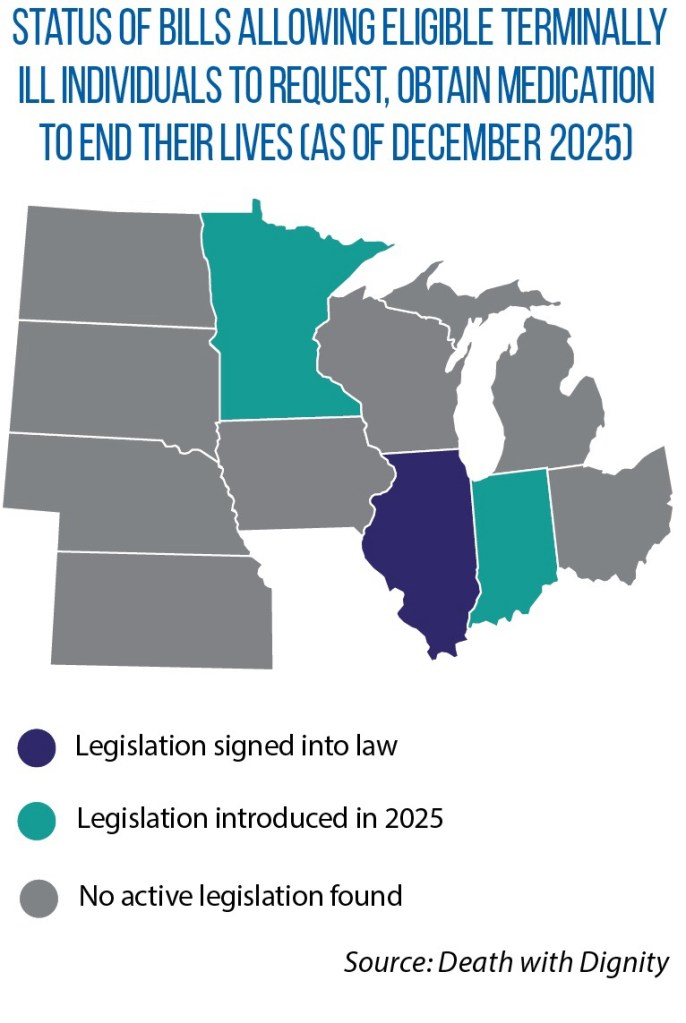
Over the past five years, these measures have been introduced but not passed in several Midwestern states: Indiana (HB 1011of 2025), Iowa (SF 2101 and HF 2288 of 2024), Kansas (HB 2202 of 2021), Michigan (SB 681 of 2023), Minnesota (SF 3215 of 2025), and Wisconsin (AB 781 of 2024).
Canada has allowed eligible adults to request medical assistance in dying for nearly a decade. The federal law does not make eligibility contingent on a terminal illness; the criteria is having a “grievous and irremediable medical condition.” The aid-in-dying medication can be administered by either a health professional or the patient. In 2023, the number of medically assisted deaths in Canada reached a one-year high of 15,343 — 4.7 percent of all the country’s deaths that year.
To ensure the highest safeguards for patients, the law is effective in September of 2026, which affords participating health care providers and the Illinois Department of Public Health (IDPH) significant lead time to implement stringent processes and protections as outlined in the law.
Also known as “Deb’s Law,” the bill honors Deb Robertson, a lifelong Illinois resident living with a rare terminal illness who has strongly advocated for the bill and shed light on the impacts on families and individuals struggling with terminal illness as they seek dignity and autonomy to peacefully end their lives on their terms.
“I have been deeply impacted by the stories of Illinoisans or their loved ones that have suffered from a devastating terminal illness, and I have been moved by their dedication to standing up for freedom and choice at the end of life in the midst of personal heartbreak,” said Governor JB Pritzker. “Today, Illinois honors their strength and courage by enacting legislation that enables patients faced with debilitating terminal illnesses to make a decision, in consultation with a doctor, that helps them avoid unnecessary pain and suffering at the end of their lives. This legislation will be thoughtfully implemented so that physicians can consult patients on making deeply personal decisions with authority, autonomy, and empathy.”
The legislation expands compassionate end of life options in a manner that establishes clear processes, guidelines, and protocols. Several safeguards are in place to ensure robust patient protection for Illinois residents. No physician, health care provider, or pharmacist is required to participate in the option. The law makes it a felony to coerce anyone to request the medication or to forge a request. Adult patients (18 or older) requesting end-of-life medication must:
- Have a terminal illness that will result in death within six months (as determined by two physicians).
- Be informed by their physician about all of their end-of-life care options, including comfort care, hospice, palliative care, and pain control.
- Have the mental capacity, confirmed by their physician, to make medical decisions.
- Make written and oral requests in order to receive the aid-in-dying medication, among other requirements. The request can only be made by the patient, not by the patient’s surrogate decision-maker, health care proxy, health care agent, attorney-in-fact for healthcare, guardian, nor via advance care directive.
Lawmakers and the Governor have heard numerous personal stories from families and individuals who have faced harrowing circumstances as they near the ends of their lives. Some were enduring unbearable pain, even travelling thousands of miles to seek medical aid-in-dying in other states and countries while sick. They also heard from families who spoke of the pain of seeing their loved one experience prolonged suffering that they were desperate and powerless to end.
“With this law, we are strengthening our commitment to compassionate care for every patient, bodily autonomy for every person, and basic human dignity at every stage of life,” said House Majority Leader Robyn Gabel (D-Evanston).
“Both of my parents died of cancer. I’ll never forget the helpless feeling of watching them suffer when there was nothing I could do to help them,” said Senate Assistant Majority Leader Linda Holmes (D-Aurora). “I believe every adult patient of sound mind should have this as one more option in their end of life care in the event their suffering becomes unbearable.”
“I want to thank Governor Pritzker for signing this measure into law – giving the full range of end-of-life options for Illinois residents,” said Deb Robertson, a retired Lombard social worker who worked to pass the Deb’s Law. “Today, I know the end for me could be near. But I’m pleased to have been able to play some role in ensuring that terminally ill Illinoisans have access to medical aid in dying.”
“As someone who is disabled, disability justice has always meant having the right to determine how I live,” said Beth Langen, a longtime disability rights advocate from Springfield who testified in support of Deb’s Law. “We know that disability is not terminal. And like anyone else, I may face a terminal illness in the future that will make death imminent. If I do, I want my right to self-determination to include the final days of my life.”
“My son, Andrew, died peacefully utilizing the option of medical aid in dying in California, where he lived,” said Suzy Flack, a former Naperville resident who testified in support of Deb’s Law. “Most of our family members were able to travel to be with him, but his grandmother couldn’t travel to California because of her age. She never got to see Drew for a final goodbye. No other family in Illinois will experience that hardship.”
“Deb’s Law adds medical aid in dying care to the full range of health options that Illinois residents can choose and safely access as a result of a deep commitment from our state’s leaders,” said Khadine Bennett, Advocacy and Intergovernmental Affairs Director at the ACLU of Illinois. “Terminally ill individuals living in Illinois will no longer have to agonize about spending their remaining days fearful of a painful death because the full range of end-of-life care options were not available in our state. We thank Governor Pritzker for listening to the people directly impacted by this issue and applaud his continued commitment to ensuring that Illinois continues to be a place where our residents are allowed to make the most vital, personal decisions throughout their lives without government interference.”
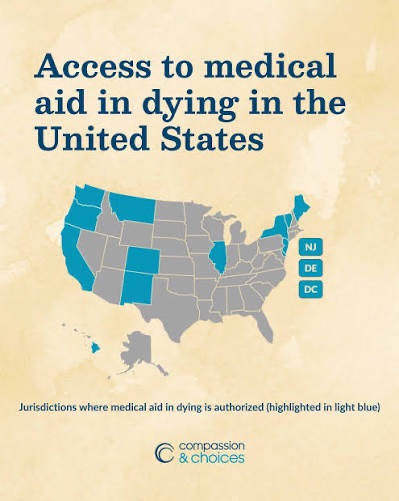
“We applaud Governor Pritzker for signing this compassionate legislation, honoring the 71% of Americans who support the option of medical aid in dying for their fellow Illinoisans facing their last months, weeks, or days with a terminal illness,” said Kevin Díaz, President/CEO for Compassion & Choices and Compassion & Choices Action Network. “Thanks to Governor Pritzker’s thoughtful leadership in signing Deb’s Law today, Illinois will become the first state in the Midwest to authorize medical aid in dying, joining the growing number of U.S. jurisdictions that have committed to law their dedication to patient-driven healthcare at all stages of life.”
“Today, Illinois affirms the dignity and autonomy of individuals confronting the final stages of a terminal illness” said Illinois Department of Public Health Director Dr. Sameer Vohra. “IDPH is committed to implementing this new law with the highest ethical standards, transparency, and care, supported by strong safeguards and detailed reporting systems that protect patients and guide providers.”
“Abundant research has shown that strong safeguards like the ones in this bill not only protect the patient, but also improve end-of-life care,” said Dr. Cynthia Chatterjee, Psychiatrist and Physician, and member of the Illinois State Medical Society who testified in support of Deb’s Law. “With these safeguards, patients who meet all the requirements will be able to end terrible suffering from a terminal illness and experience an easy, comfortable death.”
“In signing this law, Gov. Pritzker has given those who are at the end of their life freedom from the fear of enduring unrelenting, needless suffering, and replaced it with the chance to experience death as the final sacred moment of their being,” said Episcopalian minister Reverand Judith Doran from Chicago.
PROCESS TO RECIEVE MEDICAL AID IN DYING MEDICATION
- Patients who meet eligibility criteria must make several oral and written requests in order to receive medical aid in dying medication.
- The written request must be signed by the requesting patient and witnessed by at least two individuals who attest that the patient has the mental capacity to make this decision, is making it voluntarily, and is not being coerced or doing so under duress.
- Patients who qualify must be able to self-administer the medication.
Patients who qualify and receive medication have the right to withdraw their request at any time or choose not to ingest it. The death certificates of those who take end-of-life medication under the bill will attribute their cause of death to the underlying terminal disease. The option to prescribe aid in dying will be available on September 12, 2026, when the Medical Aid in Dying bill goes into effect.
REQUIREMENTS FOR PHYSICANS
- Attending physicians must provide informed consent regarding all appropriate end-of-life care options, not just medical aid-in-dying.
- They must provide an in-person examination to determine whether the patient has an illness that will result in death within six months. Two doctors must concur.
- As part of the process, the physician must also confirm that the individual has the mental capacity to make the decision to pursue medical aid-in-dying. If there are any questions about fitness, the patient will be referred to a licensed mental health professional. If the mental health professional determines that the patient does not have mental capacity, the patient will not qualify for medical aid-in-dying.
- If a patient elects the end-of-life option as outlined in the Act, physicians must submit information within 60 days after the patient’s death to the Illinois Department of Public Health (IDPH) regarding the patient, their diagnosis, notice that requirements under the Act were completed, and notice that medication has been prescribed pursuant to the Act. This information is to be considered confidential, privileged, and not discoverable in any civil, criminal, administrative, or other proceeding.
Health care professionals are not under any duty to participate in the provision of aid-in-dying and are not subject to criminal or civil liability for participating or refusing to provide aid-in-dying care to a patient in good faith compliance with the Act.
HEALTH CARE ORGANIZATIONS AND ENTITIES
Health care entities can also prohibit their staff from practicing aid-in-dying care while working for the organization. The Act also requires that an insurance plan, including Medicaid, cannot deny or alter benefits to a patient with a terminal disease based on the availability of aid-in-dying care, their request for medication pursuant to this Act, or the absence of a request. It does not require coverage of this care either by private insurers or Medicaid.


 Roy F. McCampbell's Blog