Before leaving office, President Joe Biden gave Dr. Anthony Fauci a sweeping pardon. It covered any federal offenses Fauci may have committed or participated in from January 1, 2014, through January 20, 2025, arising from his service as director of the National Institute of Allergy and Infectious Diseases, as a member of the White House coronavirus response, or as the President’s chief medical adviser.
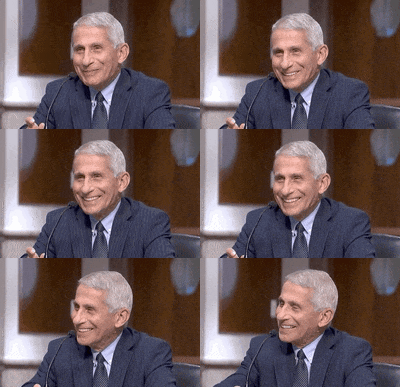
It was broad enough to cover the waterfront.
Then Fauci was summoned before the United States Senate and asked questions about the government’s response to COVID-19, the origins of the virus, federally funded research, and the decisions made behind closed doors while Americans were being ordered to close their businesses, shutter their churches, mask their children and trust the experts.
Fauci invoked the Fifth Amendment more than 100 times.
The Senate committee has now voted to hold him in contempt.
Now, I’m a lawyer, and I believe in the Fifth Amendment.
It isn’t a technicality. It isn’t a loophole. It’s one of the great protections of the English-speaking legal tradition and a shield between the individual and the enormous power of government.
But there’s a question here that no amount of legal jargon can entirely conceal:
If Fauci has already been pardoned for the federal offenses connected to his public service, what federal crime is he afraid of admitting?
His lawyers will say the pardon doesn’t protect him from every imaginable danger. A president can’t pardon state crimes. The pardon doesn’t reach conduct occurring after January 20, 2025. There may be arguments over whether some particular act falls within the pardon’s language.
Those are legitimate legal points.
But they don’t answer the larger question.
The American people weren’t asking Fauci to confess to some unrelated state offense. They wanted answers about COVID. They wanted to know what the government knew, when it knew it, what research it funded, what risks were concealed, and whether public officials told Congress and the country the truth.
Those are precisely the subjects the pardon appears designed to cover.
And that’s where the story begins to smell wrong.
For years, Fauci was presented to America as the calm, unquestionable voice of science. We were told to trust him. We were told that disagreement was dangerous. We were told that skepticism was ignorance and inquiry was misinformation.
Businesses were ruined. Children lost irreplaceable years in classrooms. Families were separated from dying parents and grandparents. Churches were closed while other gatherings were tolerated. Americans who asked hard questions were mocked, censored or dismissed.
And now, when Congress finally asks questions under oath, the man who told an entire nation to trust him says, in effect, that his answers might incriminate him.
Maybe his lawyers can construct a theoretical legal danger somewhere beyond the edges of the pardon. Lawyers are trained to imagine every storm cloud on the horizon. But the Fifth Amendment requires more than embarrassment, political discomfort or fear that the public won’t like the answers.
It protects against self-incrimination.
And a pardon is supposed to remove the danger of prosecution for the conduct it covers.
That’s why the contradiction matters.
The pardon says: You cannot be federally prosecuted for the covered conduct.
The Fifth Amendment plea says: My truthful answers about that conduct may expose me to prosecution.
Both propositions cannot comfortably occupy the same ground.
Perhaps Fauci had a valid basis for refusing to answer certain carefully identified questions. But invoking the Fifth more than 100 times begins to look less like a precise constitutional safeguard and more like a wall built to keep the public from seeing what lies behind it.
And after all we endured, the American people are entitled to look behind that wall.
A pardon may protect a man from prison.
But it doesn’t pardon arrogance. And It doesn’t erase history.
It doesn’t relieve a public servant of the moral obligation to tell the truth to the people whose lives he helped govern.
For years, Anthony Fauci demanded our trust.
Now America is demanding his answers.


