The 2015 Joint Comprehensive Plan of Action (JCPOA) was sold as the definitive solution to the Iranian nuclear threat, yet it contained a fatal flaw: it placed no restrictions on the ballistic and cruise missiles required to deliver a nuclear warhead.
And the UK allowed this for years
For Tehran, this omission was critical, as decades of sanctions have left it with an aging air force incapable of penetrating regional defenses, making ballistic missiles the only viable delivery system for its strategic ambitions.
Exploiting this diplomatic gap, China emerged as Iran’s primary external supplier, providing everything from solid rocket fuel precursors to satellite guidance via its BeiDou-3 navigation network, which replaced American GPS in Iran’s military.
U.S. intelligence tracked massive shipments of Chinese chemicals and supersonic anti-ship missiles destined for the IRGC, while a 2025 raid on a merchant vessel confirmed that Beijing was actively industrializing Iran’s arsenal.
By the start of Operation Epic Fury, Iran possessed the Middle East’s largest missile force—2,000 projectiles housed in hardened bunkers—rebuilt and sustained through Chinese industrial networks.
The Obama administration’s decision to exclude missiles from the JCPOA was a deliberate act of deferral, driven by a desire for a landmark deal and the refusal of Russia, China, and Iran to negotiate on the matter.
To secure the agreement, the U.S. watered down UN enforcement language, replacing binding prohibitions with weak suggestions that Iran merely be “called upon” to limit its missile activity.
Unconstrained, Iran spent the following decade perfecting guidance systems and solid-fuel propulsion, building a mass-produced arsenal that technically violated no provision of the nuclear deal.
The strategic goal was to make military action against Iran’s nuclear sites prohibitively expensive; today, the math remains stark, with Iran able to build 100 missiles for every few interceptors produced by the U.S.
During Operation Epic Fury, these missiles were used as coercive instruments against Arab capitals, with strikes hitting civilian areas in Abu Dhabi, Dubai, and Manama, effectively holding the Gulf states hostage.
The Gulf allies, who were not consulted during the JCPOA negotiations, had long warned that ignoring the missile program would eventually endanger their populations—a warning now validated by the falling debris in their streets.
Secretary of State Marco Rubio recently collapsed the decades-old diplomatic distinction between the nuclear and missile files, stating that the objective of current operations is to destroy Iran’s ability to hide a nuclear program behind a missile shield.
The urgency of this shift was driven by projections that Chinese assistance would expand Iran’s arsenal to 10,000 missiles by the end of the decade, with every warhead bearing a “Chinese fingerprint.”
From Beijing’s perspective, this investment serves a triple purpose: it drains American interceptor stockpiles, provides a live laboratory to study U.S. defense performance, and signals to Pacific allies that American protection has material limits.
The twelve-day war in 2025 saw the U.S. burn through years of missile production, forcing a choice between Middle Eastern stability and Pacific deterrence—a dilemma Beijing carefully engineered.
Operation Epic Fury represents the American refusal to accept that choice, seeking to turn years of Chinese strategic investment and transferred technology into ash by eliminating the missiles once and for all.
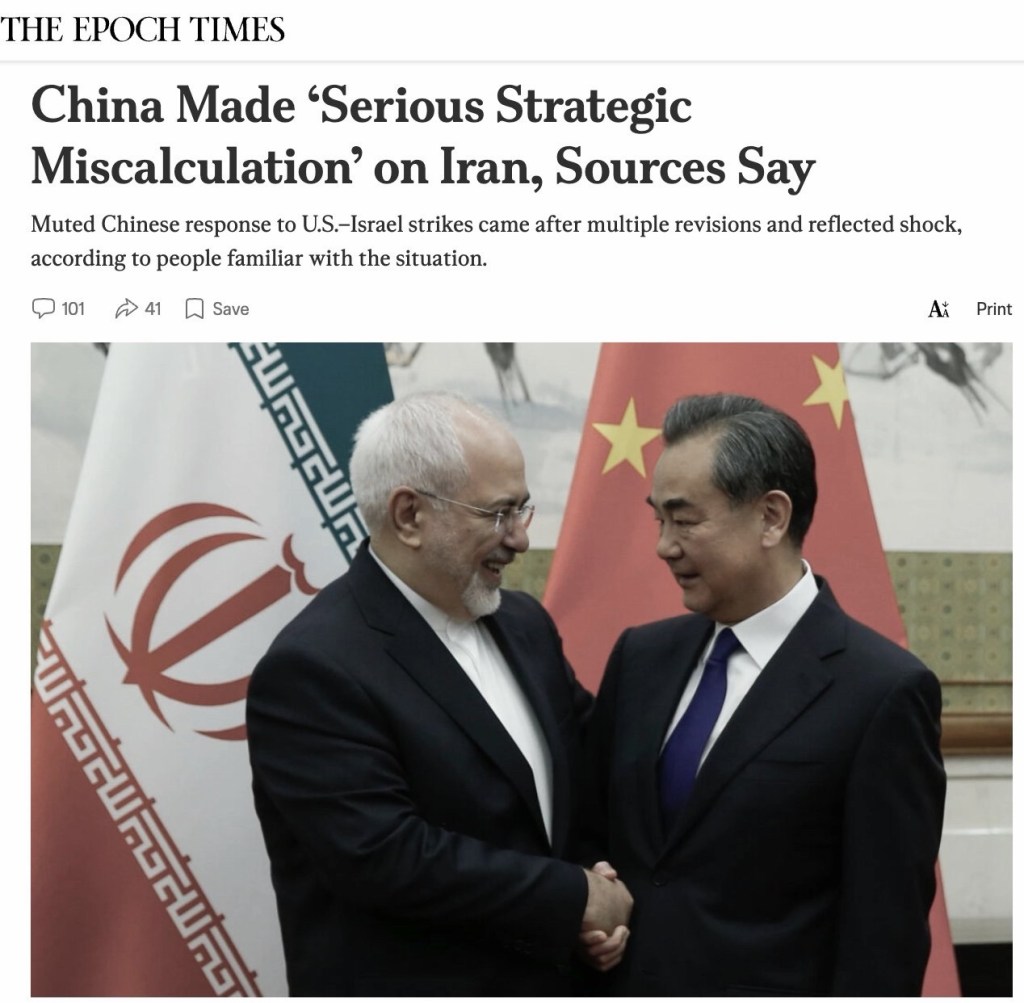
Beijing’s unusually muted response to the recent U.S.–Israeli military strikes on Iran was the result of a severe strategic miscalculation, according to insiders within China’s diplomatic system. Chinese authorities reportedly dismissed the possibility of a direct U.S. kinetic offensive, mistakenly believing that the conflict would remain purely rhetorical and leave Iran’s core power structure intact.
This shock was directly reflected in the Chinese foreign ministry’s initial statement, which took seven hours to release and contained just over 80 words. Sources revealed that early drafts heavily criticized the United States and Israel, but panicked officials hastily deleted these condemnations line-by-line during internal meetings, ultimately deciding not to mention either nation by name once the missiles actually hit Tehran.
The extent of this intelligence failure was highly evident on the ground. Because Beijing relied on outdated diplomatic frameworks assuming Iran would never face a full-scale attack, the Chinese government evacuated fewer diplomatic personnel from Tehran than it did during a recent raid in Caracas, Venezuela. Foreign Ministry spokesperson Mao Ning later confirmed that Beijing received absolutely no advance notice of the military operation.
Following the confirmation of Iranian Supreme Leader Ali Khamenei’s death a day later, Beijing’s tone shifted slightly toward condemnation, with Mao labeling the targeted killing a violation of international law.
Analysts suggest that the sudden and violent elimination of a long-standing “old friend” has deeply unsettled Chinese Communist Party officials, sparking internal fears about their own vulnerabilities to similar strikes.
Despite the devastating blow to a key strategic and energy partner, analysts note that Beijing is primarily taking a cautious, wait-and-see approach to avoid any direct confrontation with Washington. With an upcoming meeting between U.S.
President Donald Trump and Chinese leader Xi Jinping set to address critical domestic issues like trade, technology restrictions, and economic sanctions, Beijing appears entirely willing to sideline its Iranian partnership to protect its own core economic interests.
theepochtimes.com/world/china-ma…


 Roy F. McCampbell's Blog