
FIRST CONCLUSIONS
Conclusions from the results of the U.S. midterm elections in 2026 look something like this.
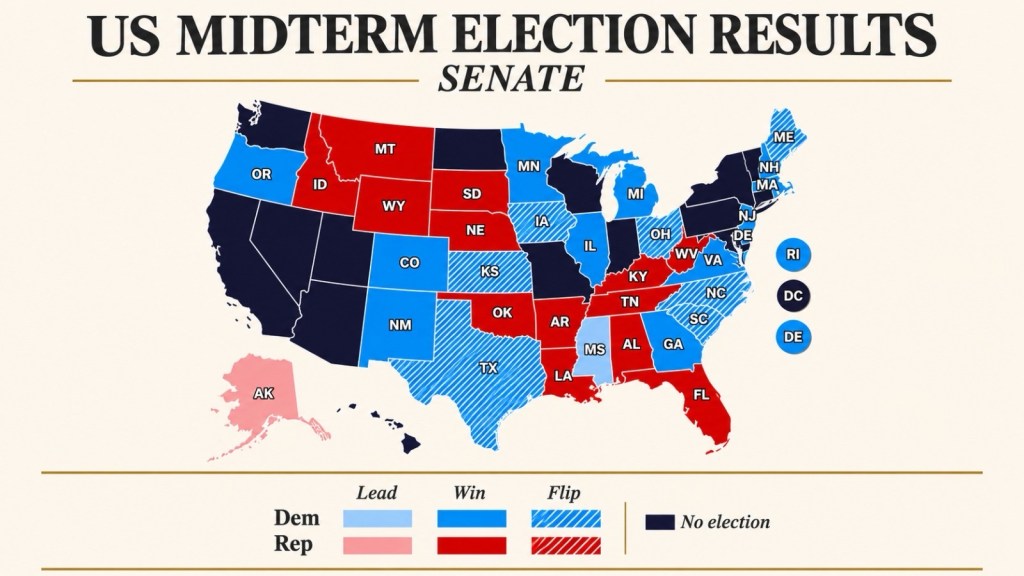
1) The Democratic Party achieved a decisive and major victory. Such a major victory in congressional elections, including both midterms and presidential ones, hasn’t happened in 50 years, since 1974 (with Watergate).
Exact results are not yet known, but the Democrats will have 54-55 seats in the Senate and 240-260 seats in the House of Representatives – that’s a significant margin by the standards of recent years. If Democrats had been told about such a margin a year ago, they would have thought it was crazy – it took a combination of many factors for such a crushing victory to become reality.
Democrats won the Senate race in Texas (where they last won in 1988) and in Kansas (in 1932) – deeply Republican places.
Control over both chambers of Congress will substantially limit President Trump’s power. Democrats will control the budget, the movement of bills, and new appointments. In addition, Democrats will have the opportunity to hold hearings with sworn witnesses and organize all sorts of investigations. They’ll be able to stage impeachment again and, this time, organize not nominal hearings in the Senate like in 2019 and 2021, but months-long ones, with live broadcasts and lengthy solo performances. They still won’t have the votes to remove him from power, though.
2) Once again, forecasts proved accurate. The number of competing firms doing forecasts has grown, but in the end, the most accurate predictions came from those using the most advanced statistical methods – first and foremost, Nate Silver. The SilverBulletin model not only accurately predicted the outcomes of many races but Silver himself, right before the elections, correctly guessed that the “vibes” pointed to an underestimation of Democrats. But other groups (NYT, RCP/PollVault, 50PlusOne, Decision Desk) weren’t far behind him.
3) The main reason for the Republicans’ defeat was the extreme unpopularity of President Trump. Among the main reasons for his low popularity – first, the war with Iran that he started, which led to a sharp 25-30% rise in gasoline and diesel prices. Second, inflation, which he repeatedly promised to end.
Inflation, in principle, isn’t especially high, 3-3.5%, but Trump spent so much time promising to stop it and even lower prices that, in the eyes of voters, he became responsible for it. The same thing happened with the war with Iran – many presidents might have been forgiven for a war, but not the one who spent the entire campaign promising not to start new ones.
It didn’t help the Republican cause at all how ineptly the president ran the campaign. Time and again, he returned to topics unpopular with voters. The conflict with Canada, which Americans love; the bromance with Putin, who is extremely toxic in American eyes; attacks on Ukraine and President Zelensky, who enjoy broad support; rallies where the president spent a long time talking about the muscular butts of Republican candidates – all of that cost points. Little by little, but it did.
4) Interestingly, the seeming cause of dissatisfaction with the president and his party – economic (inflation). But you can’t say the U.S. economy was problematic. On the contrary, unemployment is at a record low, economic growth is steady and, by the standards of the developed world, high. Technological progress is off the charts. It’s hard to understand what Americans don’t like.
5) One of the main “tools” with which President Trump undermined his party was supporting weak candidates in situations where another Republican would have had a better chance against Democrats. An obvious example is Ken Paxton, Texas Attorney General, who ran for Senate after a long string of scandals in his public and private life. Trump backed him in the primary, Paxton beat the incumbent senator from his party, Cornyn, in the primary, and then lost the general election to a Democrat in a landslide.
In North Carolina, Trump essentially forced Republican Tillis to forgo reelection for a second term. The seat was lost. In South Carolina, after Senator Graham’s death, Trump pushed for his sister – who had no political experience – to be appointed to his seat and immediately run for Senate. The result: a state where Trump outpolled Harris by 18 points in 2024 went to the Democrats.
Even the Senate seat in Georgia is, essentially, another gift from Trump. Without Trump, Jon Ossoff’s opponent wouldn’t have been some freak but popular Governor Brian Kemp. But Trump had a grudge against him, and Kemp never dared to enter the race. Ossoff won reelection with off-the-charts margins.
On the other hand, in 2026, not only weak Republican candidates (Paxton, Marshall, Graham) lost, but also strong ones (Abbott, Hinson). So overall sentiment toward Republicans mattered more than the quality of candidates.
6) What I don’t see in the first results of the 2026 elections is new information about some kind of “leftward shift.” Democrats’ victories came mainly from moderate leftists or even pure centrists. (There are exceptions – for example, new Minnesota Senator Peggy Flanagan – but they’re rare.) Or, like Abdul El-Sayed from Michigan and James Talarico, the new senator from Texas, they compensated for their lefty youth with exceptional discipline in their campaigns.
If Democrats take the 2026 results not as the outcome of Trump’s wrong policies and poor campaign strategy, but as validation of their own values – that would be a mistake. The country feels bad about the war with Iran, high gas prices, the bromance with Putin, and so on – that doesn’t mean everyone bought into the need to fight gas-powered cars or mandatory pronouns in signatures.
7) Democrats gained control of the Senate, apparently until 2032 (in the “2020 and 2024 classes,” they have almost no weak senators, because those weren’t the most successful years). In 2032, they’ll have several senators in “Republican” states like South Carolina.
The elderly conservatives on the Supreme Court, Clarence Thomas, 78, and Samuel Alito, 76, will have to live a long time for there to be another chance to replace them with conservative judges.
So how long before the Epstein files are released and criminal charges are filed? They will have no reason to not release everything. This could be a good thing.


